
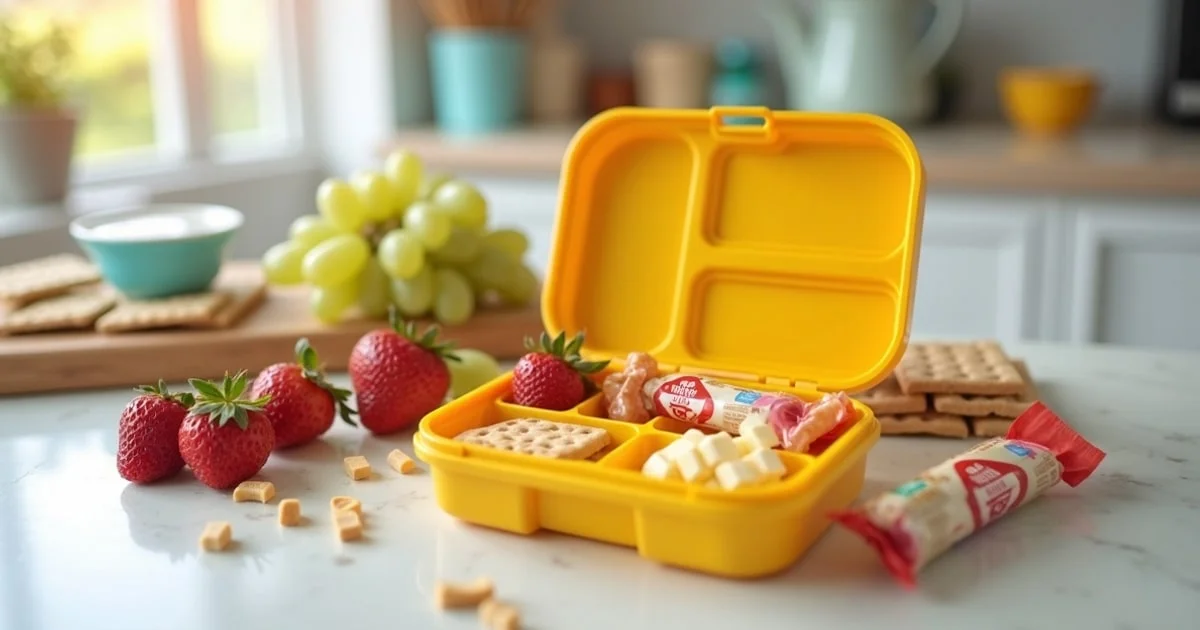
Three E-code checks cover most of the haram risk in the UK snack aisle: E441 (gelatine), E120 (carmine) and E471 (undisclosed emulsifiers). Learn to spot those three on an ingredient list and you can clear a snack for the lunchbox in under thirty seconds, standing in the aisle, without memorising a single brand name.
That matters because brand memory fails. Formulations change, multipacks differ from single bags, and the “same” sweet can be halal in one country and haram in another. The label check works every time; the brand shortcut only works until it doesn’t.
This post gives you the three checks, tells you which of our full aisle audits to use when you want brand-level detail, and covers what “gelatine-free” does and doesn’t prove. For the complete category-by-category lunchbox plan, see the halal lunchbox guide; for sandwiches, school dinners and the weekly shop, the halal school lunch planning guide.
Check 1: E441 — gelatine, the sweet-aisle problem
What you’re looking for: “gelatine”, “gelatin”, “beef gelatine”, “pork gelatine” or E441 anywhere in the ingredient list.
The rule: in UK snack products, undeclared-source gelatine is usually pork-derived. Unless the pack names a halal certifier or explicitly states halal beef gelatine, treat it as haram.
Where it hides in lunchbox snacks:
- Almost all mainstream gummy and jelly sweets — the default setting agent for the entire category
- Marshmallows, including the marshmallow pieces inside some cereal bars and rocky-road snacks
- Layered and “jelly” style children’s yoghurts
- Some chewy sweets where you wouldn’t expect it — which is why the check beats the guess
Why gelatine dominates this aisle — and why “beef gelatine” alone doesn’t settle the question — is covered in the gummy sweets halal problem. When you want to know which gelatine-free and certified brands actually exist on UK shelves, use the UK halal gummy sweets audit — it names the certifier for every certified brand it lists.
Check 2: E120 — carmine, the red flag that is literally red
What you’re looking for: E120, “carmine”, “carminic acid” or “cochineal”.
The rule: E120 is a red dye made from crushed cochineal insects. The mainstream position — and the one this site follows — treats it as haram. It has no source ambiguity to resolve: if it’s on the label, it’s insect-derived.
Where it hides in lunchbox snacks:
- Fruit roll-ups and fruit winder-style strips, especially red varieties
- Red and pink children’s yoghurts and yoghurt tubes
- Some red sweets, even gelatine-free ones — this is the check that catches “vegetarian” sweets that still aren’t halal
- Some red drinks and squashes
The pattern to internalise: anything red or pink aimed at children earns a label check. Manufacturers use E120 precisely because it produces the bright red that sells to kids.
Check 3: E471 — the everywhere emulsifier
What you’re looking for: E471 (mono- and diglycerides of fatty acids), plus its cousins E472a–e and E476 in chocolate.
The rule: E471 can be made from plant oils or animal fat, and UK labels don’t say which. Undisclosed source means Mushbooh — doubtful — not haram. Two things resolve the doubt: a vegan label on the pack (vegan E471 must be plant-derived), or a manufacturer’s written confirmation of plant origin.
Where it hides in lunchbox snacks:
- Sliced bread and wraps — the sandwich itself, not just the snacks
- Chocolate-coated cereal bars and mini rolls
- Most mainstream chocolate bars (often alongside E476)
- Some biscuits — though many plain UK biscuits pass; the UK biscuits halal audit goes variety by variety
The savoury bonus check: flavoured crisps add a fourth code to scan for — E631, usually paired with E627. Both are flavour enhancers that can be pork-derived. Plain and ready salted flavours avoid the issue entirely; for everything else, the UK crisp flavour audit has checked the major brands flavour by flavour, and the complete halal crisps and savoury snacks guide covers the wider category.
Which audit to use, per aisle
We deliberately haven’t listed “best halal snacks” picks here — a ranked list goes stale the moment a recipe changes. Instead, each aisle has a standing audit on this site that gets maintained as verdicts change:
| Aisle | The check | The audit to use |
|---|---|---|
| Gummies & sweets | E441, then E120 | UK halal gummy sweets audit |
| Crisps | E631/E627 on flavoured varieties | UK crisp flavour audit |
| Biscuits | E471 in coatings and fillings | UK biscuits halal audit |
| Anything processed | The full ten-code scan | 10 E-codes to check in snacks |
And the zero-check shortcut for busy mornings: fresh fruit, dried fruit, plain rice cakes, vegetable sticks, plain popcorn made at home. None of them has an ingredient list worth worrying about.
What “gelatine-free” doesn’t tell you
Two different levels of assurance get blurred on this aisle, and it pays to keep them separate:
- Certified halal — the pack carries a named certifier’s mark (HMC, HFA, or a recognised overseas body). The certifier audits the supply chain. This is the higher bar.
- Ingredient-verified — the ingredient list contains nothing impermissible: no gelatine, no E120, no undisclosed animal-source emulsifiers, and a vegetarian or vegan label backing it up. No auditor has checked the factory.
“Gelatine-free” on its own is neither of these — it’s one ingredient ruled out. A gelatine-free sweet can still carry E120, shellac (E904) or alcohol-carried flavourings. If your family’s standard is certified-only, the certifier’s name on the pack is the only thing that counts; if ingredient-verified is acceptable, the full three-check routine above is your floor, not just the gelatine line.
Stocking up near you
If you’d rather buy from a shop where the halal question is already settled, halal grocers carry certified sweets, snacks and lunchbox fillers as standard:
- Halal grocers in Birmingham
- Halal grocers in Milton Keynes
- Halal shops and food spots in London, Manchester and Wolverhampton
How we reached this verdict
- E-code positions: E441 (haram unless certified halal-source), E120 (haram, insect-derived), E471/E476 (Mushbooh when source undisclosed) and E631/E627 (Mushbooh, possible pork derivation) follow the classifications in the HalalCodeCheck E-codes database, which are built on scholarly consensus across the four madhabs and manufacturer source disclosures where they exist.
- Aisle-level findings draw on the site’s standing UK audits — gummy sweets, crisp flavours and biscuits — each of which checks current UK ingredient lists against HMC (Halal Monitoring Committee) and HFA (Halal Food Authority) certification registries and manufacturer statements. UK labels re-checked July 2026.
- Certified vs ingredient-verified framing follows the position accepted across madhabs (and stated by Darul Ifta Birmingham) that a manufacturer’s vegetarian labelling plus absence of alcohol is a halal indicator — while remaining a lower level of assurance than a named certifier’s audit.
No snack is guaranteed halal without formal certification. These checks are the tools for an informed decision at the shelf — not a substitute for a certifier’s mark.
Madhab note
Of the three checks, E120 is the one where schools genuinely diverge. The Hanafi position — dominant in the UK — treats insect-derived colourings as impermissible, and this site follows that as the mainstream UK default. Some Maliki scholars permit cochineal-derived colouring, and rulings within the Shafi’i school vary. E441 pork gelatine is impermissible across all four schools; undisclosed-source E471 is treated as doubtful across all four until the source is confirmed. If your family follows a school that permits E120, the first two checks collapse into one — but the gelatine check never goes away.
Summary: the thirty-second routine
| Question | Answer |
|---|---|
| What are the three checks? | E441/gelatine, E120/carmine, E471 (plus E631 on flavoured crisps). |
| Is gelatine-free enough? | No — it rules out one ingredient. E120 and undisclosed E471 can still be present. |
| What resolves an E471 doubt? | A vegan label on the pack, or the manufacturer confirming plant origin in writing. |
| Certified or ingredient-verified? | Certified means a named certifier’s mark on the pack; ingredient-verified means a clean label with vegetarian/vegan backing. Know which standard your family uses. |
| Fastest zero-check options? | Fresh fruit, dried fruit, plain rice cakes, home-made plain popcorn. |
Spot an E-code this post didn’t cover? Look it up in the E-codes database, or scan the whole ingredient list at once with the ingredient scanner — it flags every additive of concern in one pass.
Ingredients change. Be first to know.
Brands reformulate without warning. We track every E-code update and halal certification — one short weekly email.
Related Articles
 Shopping Guides
 Is Pringles Halal? Every Flavour Checked by Region (2026)
Pringles Original is halal and vegan-labelled. Every flavoured UK variety we verified contains E621 with E627/E631 or E635 — but all carry vegetarian labels. Flavour-by-flavour table for UK, US and certified Gulf/Malaysian versions.
 Shopping Guides
 Halal Lunchbox Guide for Muslim Kids at UK Schools (2026)
Flavoured crisps, yogurt tubes, gummy snacks and cereal bars hide haram ingredients. Aisle-by-aisle guide to halal-safe lunchbox staples, with branded alternatives per category.
 Shopping Guides
 The Complete Guide to Halal Crisps and Savoury Snacks (2026)
Every snack category covered: potato crisps, Doritos, Pringles, popcorn, rice cakes, nuts and crackers. Brand verdicts across Walkers, Tyrells, Kettle, Doritos, Cheetos, Pringles, Popchips and more.