Our Methodology
How we determine
halal verdicts
HalalCodeCheck provides informational assessments based on publicly available product information, recognised halal-certification sources, and mainstream Sunni jurisprudential positions.
Each verdict reflects the evidence available when the page was published or last updated and the rules described in this methodology. Where a verdict depends on a recognised difference of scholarly opinion, we aim to identify the position applied and explain the distinction on the relevant page.
The Three Verdicts
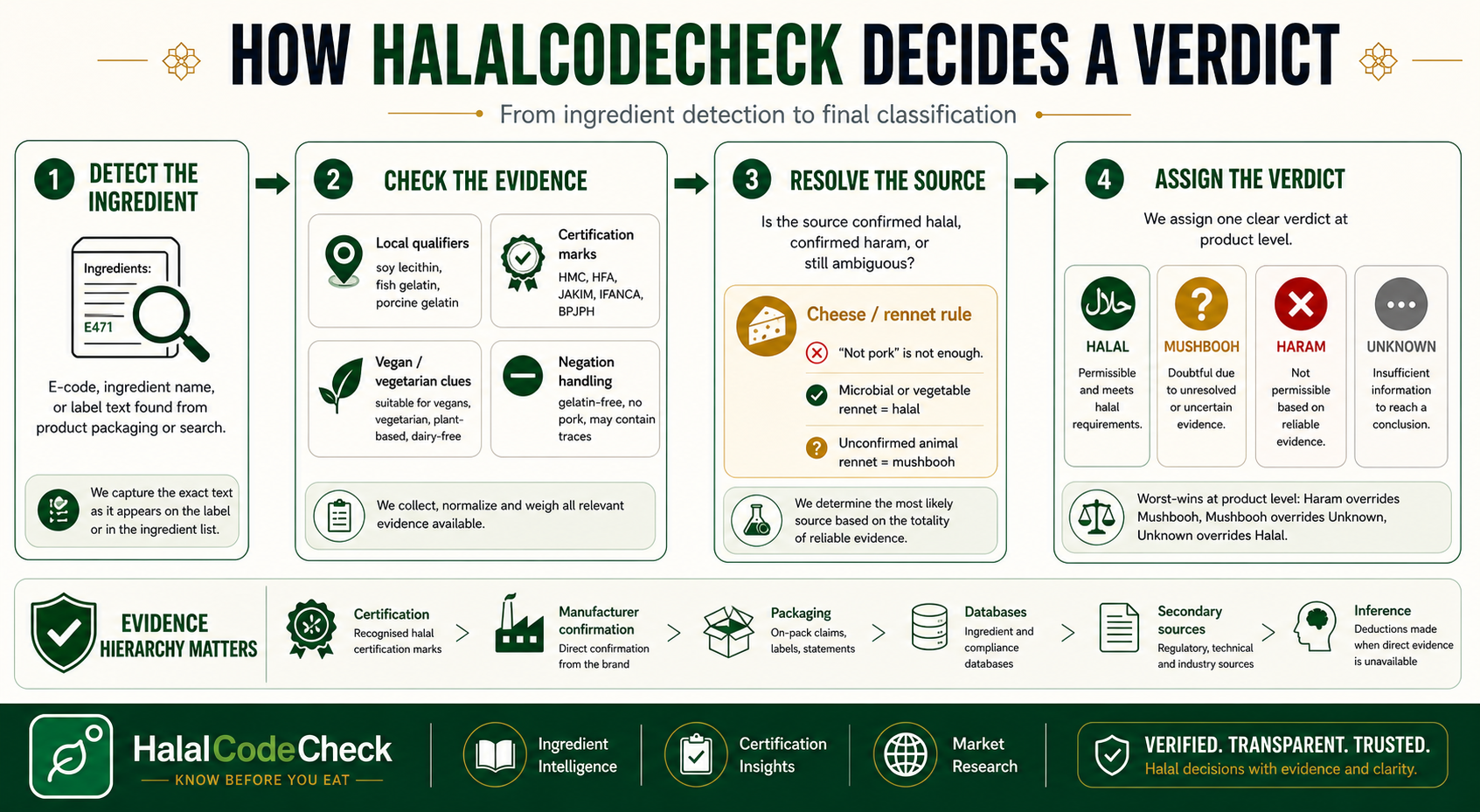
Every ingredient and E-code in our database receives one of three verdicts — Halal, Mushbooh, or Haram — based on its source and the available evidence. A fourth label, Unknown, is a flag rather than a verdict, explained below.
Permissible according to Islamic dietary law. The ingredient or additive is confirmed to be free of any forbidden substances and is derived from a permissible source. Examples: plant-derived lecithin, fish gelatin, most mineral and synthetic additives with known permissible origins.
Doubtful or questionable. The ingredient may be halal or haram depending on its source, and the label or available evidence does not resolve that ambiguity. The name "Mushbooh" comes from the Arabic root meaning "doubtful."
Examples: unspecified gelatin (could be porcine, bovine, or fish), unspecified lecithin (could be soy or animal-derived), "natural flavours" without source disclosure, E471 (mono- and diglycerides) without stated origin.
Our recommendation: treat Mushbooh items as doubtful and seek clarification from the manufacturer or a recognised certification body.
Confirmed to contain or derive from a prohibited source under the jurisprudential position applied by HalalCodeCheck. Examples include porcine gelatin, lard, and ingredients confirmed to be derived from pork. Some ingredients — including carmine and certain alcohol-containing substances — may be classified differently where recognised scholarly opinions diverge; the relevant page explains the position applied.
Unknown is a flag, not a fourth verdict. A small number of entries carry it where there is genuinely insufficient information to issue one. These are kept under review — and because an unresolved ingredient cannot be cleared, an Unknown item prevents a product being marked Halal until it is resolved.
These statuses represent HalalCodeCheck’s assessment under this methodology. They are informational classifications — not fatwas, halal certificates, or guarantees that a product remains unchanged.
How Verdicts Are Determined
Our verdict engine works in layers. For straightforward ingredients, the ruling is direct. For ambiguous source-dependent ingredients, we apply additional evidence resolution.
Database ruling
Each E-code and ingredient in our database has a base ruling established by cross-referencing recognised certification bodies and scholarly sources. Where the ruling is clear and source-independent, this is the final verdict.
Source-dependent resolution
For high-risk ingredients whose ruling depends on their source — gelatin, lecithin, glycerin, mono- and diglycerides, whey, rennet, and enzymes — we apply an evidence layer:
- → Local qualifiers: words adjacent to the ingredient on the label (e.g. "soy lecithin", "fish gelatin", "porcine gelatin") that identify the source.
- → Certification marks: a recognised certifier's mark (HMC, HFA, JAKIM, BPJPH, IFANCA) can resolve multiple ambiguous ingredients on the pack to Halal — provided the certification is current and applies to that exact product and market.
- → Vegan / vegetarian labelling: may help establish that certain ingredients are not animal-derived. It is not treated as equivalent to halal certification and does not by itself resolve questions involving alcohol, production methods, cross-contamination, or other halal requirements.
- → Negation handling: "gelatin-free", "no pork", and "may contain traces of" are treated distinctly — trace context does not override a confirmed ingredient presence.
Cheese, rennet & enzymes
Cheese is only Halal when the rennet is microbial, vegetable, or from a halal-slaughtered animal. "Not pork" is not enough — animal rennet from an unconfirmed (non-halal-slaughtered) source is Mushbooh. We treat a clear "suitable for vegetarians" declaration or a stated microbial/vegetable rennet as resolving the source to non-animal; where the rennet source is undisclosed, the cheese — and any product relying on it — is Mushbooh until the manufacturer confirms otherwise.
Worst-wins merge
When a product contains multiple ingredients, the final verdict follows a worst-wins principle: Haram overrides Mushbooh, which overrides an unresolved (Unknown) item, which overrides Halal. A single Haram ingredient makes the overall verdict Haram, regardless of the other ingredients.
Explanation layer
Where available, results pages show which ingredient drove the verdict, what evidence was found, and — for Mushbooh cases — what evidence was missing that would have produced a more definitive ruling.
When Sources Conflict
Not all evidence carries equal weight. When sources disagree, we rank them — and newer, more specific evidence normally overrides older or more generic evidence.
- 1 Verifiable certification for the exact product and market.
- 2 Current manufacturer confirmation of ingredient sourcing.
- 3 Current packaging and the on-pack ingredient statement.
- 4 Regulatory or certifier databases.
- 5 Secondary public sources.
- 6 Inference from vegan, vegetarian, or "no pork" claims.
Scanning & automated classification
Label scanning and the halal verdict are two distinct steps. Scanning first attempts to extract text from the submitted image; the verdict is then generated from the detected ingredients and available evidence. OCR errors, omitted or obscured text, or incorrect language detection can therefore affect the result. Always compare the extracted text with the original label before relying on the assessment.
Sources We Use
Verdicts are cross-referenced against recognised certification bodies and mainstream Sunni scholarly sources.
Certification Bodies
- HMC — Halal Monitoring Committee (UK)
- HFA — Halal Food Authority (UK)
- JAKIM — Department of Islamic Development Malaysia
- BPJPH — Halal Indonesia, the official Indonesian halal authority (with MUI in a jurisprudential/fatwa role)
- IFANCA — Islamic Food and Nutrition Council of America
Scholarly Basis
- Mainstream Sunni fiqh, primarily following the Hanafi school where juristic positions differ
- Established fatawa on food additives from recognised Islamic scholarly bodies
- Manufacturer-disclosed ingredient sourcing where directly available
Halal certification
A halal certification mark or certificate is treated as strong evidence where it can be linked to the relevant product, brand, market, or manufacturer. Where verifiable from publicly available information, we may also consider the issuing body, certification scope, validity period, and whether the certification applies to the specific product or facility.
The presence of a logo alone does not guarantee that certification is current or applies to every variant or market. Users should confirm current certification with the manufacturer or issuing body where certainty is required.
Scope & Limitations
We aim to be transparent about what HalalCodeCheck is, and is not.
Evidence & timing: product assessments are based on the evidence available at the time the relevant page was published or last updated. Formulations, certification status, and product availability may change after that date.
Where a page identifies a country, market, product variant, or source, the assessment should be understood within that stated context.
What we cover
- ✓ 360+ food additives and E-codes
- ✓ INS additive numbers (international numbering system)
- ✓ UK meat codes (approved establishment identifiers)
- ✓ Common ingredient names (EU, US, Canada, UK labelling)
- ✓ Source-dependent additives with evidence resolution
- ✓ Brand-level halal status where publicly verified
- ✓ OCR-based label scanning with ingredient extraction
What we are not
- — A fatwa-issuing body or religious authority
- — A replacement for your own judgement or a local scholar
- — A real-time product database (formulas change; always check the label)
- — A halal certification service for businesses
- — Affiliated with or endorsed by the brands or certifiers we reference
- — A substitute for the certification on the pack or the manufacturer's own information
Spotted an error? Let us know.
Our verdicts are only as good as the information available when we publish, and manufacturers reformulate without notice. If you have contacted a brand and been told something that contradicts a verdict on this site — or you spot any mistake — please let us know and we will re-check it against the manufacturer and recognised certification bodies, then correct it.
Report a correctionWhat happens next: reports are reviewed against the submitted evidence and, where necessary, manufacturer or certification-body information. A report does not automatically change a verdict. Where a material correction is warranted, it is reflected on the relevant page.
JazakAllahu khayran to everyone who takes the time to flag a correction — it helps keep this resource accurate and trustworthy for the whole community.
We strive for accuracy, but we are not infallible — wallāhu a’lam (and Allah knows best).
Start verifying
Search any ingredient, scan a product label, or browse the full E-code database — free, with no sign-up.