
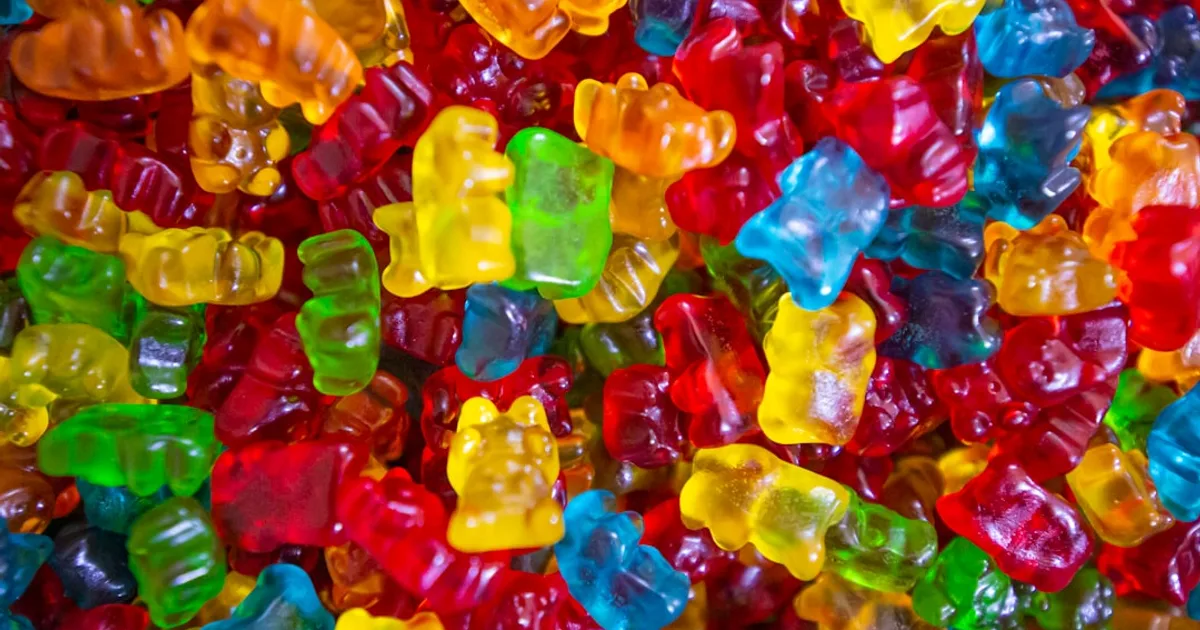
Pick up any pack of Haribo Gold Bears in a UK supermarket and flip it over. The ingredients list will include one word that makes the entire bag haram for Muslims: gelatine. No further detail. No source animal specified. And in European confectionery, that single word almost always means pig.
Gummy sweets are the single biggest halal pitfall in the confectionery aisle. They look innocent — fruit-shaped, brightly coloured, loved by children — but the vast majority sold in UK supermarkets contain porcine gelatin, making them haram under mainstream Sunni (Hanafi, Shafi’i, Maliki, and Hanbali) fiqh. This guide explains exactly why, names the brands to avoid and the brands that got it right, and gives you a 30-second method to spot safe gummies on any supermarket shelf.
Why Gelatin Is the Core Problem
Gelatin is a protein extracted by boiling animal bones, cartilage, skin, and connective tissue. It is what gives gummy sweets their distinctive chewy, elastic texture — no other ingredient replicates it at the same cost and scale.
The Islamic ruling is straightforward: gelatin derived from a pig is haram, regardless of the degree of processing. Gelatin derived from a cow or sheep is halal only if the animal was slaughtered according to Islamic rites. If neither condition is met, the gelatin — and any product containing it — is haram. The full pork-beef-fish breakdown, with label-reading shortcuts, is in Is gelatin halal or haram?
In Europe, porcine (pig-derived) gelatin dominates the confectionery supply chain for two reasons: cost and availability. European pig farming produces an enormous surplus of skin and bones. Bovine gelatin exists but is significantly more expensive and sourced from different supply chains. When a manufacturer’s label simply says “gelatine,” the industry default is porcine. No halal certification body accepts unlabelled gelatin as permissible.
E441: The E-Code You Need to Know
The E-code system is the EU and UK’s standardised numbering for food additives. Gelatin carries the code E441. It appears less commonly on UK labels than the word “gelatine” itself, but you will encounter it — particularly on imported European sweets, supermarket own-brand products, and older formulations.
E441 = gelatine = almost always porcine in European products.
There is no distinction in the E441 code between porcine and bovine gelatin. The number alone tells you nothing about the source animal. Only the presence of a halal certification mark, or an explicit “beef gelatine” statement on the label, changes the ruling.
The Wax Coating Problem
Beyond gelatin, some gummy sweets carry a second hidden issue: their glossy outer coating.
E904 — Shellac (Haram / Mushbooh)
Shellac is a resin secreted by the lac insect (Kerria lacca). It is widely used to give sweets and confectionery that shiny finish. Under Hanafi and most Shafi’i scholarly opinion, shellac is not permissible — it is derived from an insect, and insects are not considered halal food sources in mainstream Sunni fiqh. Some scholars disagree, placing it in the mushbooh (doubtful) category, but the HMC (Halal Monitoring Committee) and HFA (Halal Food Authority) both list E904 as not acceptable.
Look for E904 or “glazing agent (shellac)” in the ingredients.
E903 — Carnauba Wax (Halal)
Carnauba wax is derived from the leaves of the Brazilian carnauba palm tree. It is entirely plant-based and halal. Many brands use it as a safer alternative to shellac. If the label says “glazing agent (carnauba wax)” or lists E903, you can disregard the coating concern.
Brands at a Glance
| Brand / Product | Status | Reason |
|---|---|---|
| Haribo Gold Bears (UK) | Haram | Porcine gelatine |
| Haribo Starmix (UK) | Haram | Porcine gelatine |
| Haribo Tangfastics (UK) | Haram | Porcine gelatine |
| Haribo Halal range (Germany/selected markets) | Halal | Gelatin-free; halal certified — but NOT the UK standard range |
| Maynards Bassetts Wine Gums | Haram | Porcine gelatine |
| Maynards Bassetts Jelly Babies | Haram | Porcine gelatine |
| Rowntree’s Randoms | Haram | Porcine gelatine |
| Rowntree’s Jelly Tots | Halal | No gelatine — starch-set; always verify current label |
| Bebeto (all standard ranges) | Halal | Halal certified; bovine gelatine from halal-slaughtered animals |
| Candy Kittens | Halal | Vegan; no gelatine |
| Swizzels (Love Hearts, Parma Violets, Refreshers) | Halal | No gelatine in these products |
| Mr Chews / Wham bars | Halal | No gelatine; check label for current formulation |
| Trolli (standard European range) | Haram | Porcine gelatine |
| Welch’s Fruit Snacks | Halal | Gelatin-free; no pork derivatives |
Note: Formulations change. Always verify the current ingredients list on the pack before purchasing, even for brands marked halal above.
The “Halal in Some Countries, Not Others” Phenomenon
This is one of the most confusing aspects of modern halal food consumption, and Haribo is the clearest illustration.
Haribo Germany produces a gelatin-free, halal-certified gummy range sold in Turkey, parts of the Middle East, and some specialist European retailers. These products are manufactured to a different recipe — they use starch or pectin as the setting agent instead of gelatine. They carry halal certification and are permissible.
Haribo UK produces its standard range using porcine gelatine. The UK packs do not carry halal certification. The recipe is different from the German halal range.
The key implication: the brand name alone tells you nothing. A Haribo product bought in Istanbul may be halal. The same product bought in Tesco is haram. You must check the label of the specific pack in your hand, every time. Our full Haribo verdict breaks down the UK, EU, and global ranges pack by pack.
This same phenomenon applies to other multinationals that produce region-specific formulations. Nestlé, for example, operates halal-certified factories in several Muslim-majority countries with recipes that differ from their European equivalents. Never assume cross-market equivalence.
How to Spot Safe vs Unsafe Gummies in 30 Seconds
This is the practical method. Use it every time you pick up a bag of sweets.
Step 1 — Find the ingredients list (5 seconds) It is usually on the back or side of the pack, in small print. Look for the bold word “INGREDIENTS.”
Step 2 — Scan for “gelatine,” “gelatin,” or “E441” (10 seconds) Run your eye down the list. These words are usually near the middle or end of the ingredients. If you see any of them, move to Step 3.
Step 3 — Check the source or certification (10 seconds)
- Does it say “beef gelatine” or “bovine gelatine”? If yes, check for a halal mark — bovine gelatin is only halal if from a halal-slaughtered animal.
- Is there a halal certification logo on the pack (HMC crescent, HFA logo, or another recognised body)? If yes, the gelatine issue has been addressed by the certifier.
- If it just says “gelatine” with no qualifier and no halal cert — it is haram. Put it back.
If there is no gelatine at all: check the setting agent. Pectin, starch, carrageenan (E407) and agar are all plant-derived and halal. A product with these as its gelling agents and no other animal derivatives is permissible.
Step 4 — Check the glazing agent (5 seconds) If the pack has a shiny coating, look for E904 (shellac — avoid) or E903 (carnauba wax — fine).
That is it. Four steps, 30 seconds, a confident answer.
Halal-Certified Alternatives Worth Knowing
Bebeto
A Turkish confectionery brand with extensive UK distribution. Bebeto uses halal-certified bovine gelatine in products that require gelatine, and many of their ranges are fully halal certified. Widely available in halal supermarkets, some Asda and Morrisons stores, and online. Their product range covers most Haribo equivalents — bears, worms, rings, fizzy belts.
Candy Kittens
A UK brand founded in 2012, now widely stocked in major supermarkets including Waitrose, Tesco, and Sainsbury’s. All products are vegan, meaning no gelatine of any kind. The setting agent is pectin. Candy Kittens are arguably the most accessible mainstream halal gummy option in UK supermarkets.
Swizzels
The British maker of Love Hearts, Parma Violets, Refreshers, and Drumstick Lollies. Most Swizzels products do not contain gelatine — they use glucose syrup, sugar, and starch as their base. Check individual products, but the core Swizzels range has historically been gelatin-free.
Rowntree’s Jelly Tots
A notable exception within the Nestlé-owned Rowntree’s range. Jelly Tots are starch-set and have historically contained no gelatine, making them halal. However, Rowntree’s Randoms do contain gelatine and are haram. The distinction is product-by-product within the same brand — which illustrates exactly why label-reading is non-negotiable.
Parents applying these checks at speed: a thirty-second label routine for school lunchbox snacks turns the E441 check into a habit, alongside the two other codes worth scanning.
FAQ: “The Pack Says No Artificial Colours — Why Is It Still Haram?”
This question comes up constantly, and the answer is important.
“No artificial colours,” “no artificial flavours,” “no preservatives,” and “natural ingredients” are marketing claims that have nothing to do with halal status.
A product can be:
- Free from artificial colours — and still contain porcine gelatine (haram)
- Organic — and still contain porcine gelatine (haram)
- Vegan — and be entirely halal (no animal products at all)
- “Natural” — and contain shellac E904 from lac insects (not permissible under most scholarly opinion)
The only thing that determines halal permissibility is the source and nature of the ingredients, not the health or marketing positioning of the product. Always read the full ingredients list. Never rely on front-of-pack claims as a proxy for halal status.
How we reached this verdict
Our verdict on gelatine-containing gummy sweets is based on:
-
Ingredient verification: We reviewed publicly available UK pack ingredients for Haribo, Maynards Bassetts, Rowntree’s, Bebeto, and Candy Kittens via manufacturer websites and supermarket listings (verified June 2026).
-
Scholarly consensus: The impermissibility of porcine gelatine is agreed upon across all four mainstream Sunni madhabs (Hanafi, Maliki, Shafi’i, Hanbali). There is no credible scholarly position that permits pork-derived gelatine regardless of processing.
-
Certification body guidance: The HMC (Halal Monitoring Committee) and HFA (Halal Food Authority) — the two primary UK halal certification bodies — both classify unlabelled gelatine in European products as not permissible due to the porcine default.
-
Manufacturer statements: Haribo UK has confirmed via their official FAQ that their standard UK range contains porcine gelatine and is not halal certified. Bebeto’s UK distributor confirms halal certification on their standard gummy ranges.
-
E441 classification: Our E-codes database classifies E441 (gelatine) as Mushbooh (source-dependent) — halal only when from a halal-slaughtered bovine or ovine source with valid certification.
Madhab note
The mainstream position across Hanafi, Maliki, Shafi’i, and Hanbali fiqh is identical on porcine gelatine: it is haram, and the degree of processing does not change this ruling. The argument that chemical transformation (istihalah) renders gelatine permissible is a minority scholarly opinion and is not accepted by HMC, HFA, JAKIM, or MUI. HalalCodeCheck follows the mainstream scholarly consensus for all verdicts on this site.
Bovine gelatine from an animal slaughtered by a Muslim, Christian, or Jew (with valid tadhkiyah) is permissible under all four madhabs. The requirement for halal certification on bovine gelatine applies because the supply chain must be verified — the word “beef gelatine” on a label, without certification, does not confirm halal slaughter.
Summary
| Question | Answer |
|---|---|
| Are most UK gummy sweets halal? | No — porcine gelatine is standard in European confectionery |
| Is E441 the same as gelatine? | Yes |
| Is Haribo halal in the UK? | No — UK Haribo contains porcine gelatine |
| Is Haribo halal anywhere? | Yes — Haribo Germany produces a separate halal-certified gelatin-free range for some markets |
| What about the shiny coating? | E904 (shellac) is not permissible; E903 (carnauba wax) is halal |
| What are safe alternatives? | Bebeto, Candy Kittens, Swizzels core range, Rowntree’s Jelly Tots |
| How do I check quickly? | Look for “gelatine,” “gelatin,” or “E441” — if present with no halal cert, avoid |
Putting the Haribo back on the shelf leaves an obvious gap, and the four brands above are only the start of what is actually stocked in the UK. We have ranked the halal-certified gummies worth ordering in our guide to the best halal gummy sweets you can buy online, certifier and setting agent noted for each.
Use the E-codes database to look up any E-code you find on a sweets label — including E441, E904, E903, and others.
Scan a full ingredient list with the ingredient scanner to get an instant halal verdict on any product.
Ingredients change. Be first to know.
Brands reformulate without warning. We track every E-code update and halal certification — one short weekly email.
Related Articles
 Ingredient Guides
 Malaysia's Gummy Candy Ban and the Halal Gelatin Problem JAKIM Found
Malaysia banned eyeball-shaped gummy candy after a child's death, then JAKIM found pork DNA in most marshmallows tested. Here's how to check gummy candy is halal.
 Ingredient Guides
 The Supplement Capsule Halal Problem: Gelatin vs HPMC vs Pullulan (2026)
Most vitamin capsules use porcine gelatin — the cheapest shell material. Here's how to identify HPMC (vegetable) capsules on any label and which UK supplement brands use halal-safe capsules.
 Ingredient Guides
 "No Pork" Doesn't Mean Halal: 8 Other Ingredients to Check (2026)
Gelatin, carmine, shellac, L-cysteine, isinglass, natural flavours, vanilla extract and animal rennet are all haram or mushbooh — and none come from pork. The complete guide to what else to check.