
In February 2025, a 10-year-old boy in Penang died after choking on an “eyeball” gummy candy bought from a stall outside his school. Malaysia’s Ministry of Health responded fast: the product was pulled from every online platform and domestic market, and a new rule now requires any jelly confectionery 45mm or smaller to carry a choking-hazard warning. Consumer groups like CAP went further, calling for chewy candy to be banned near schools altogether.
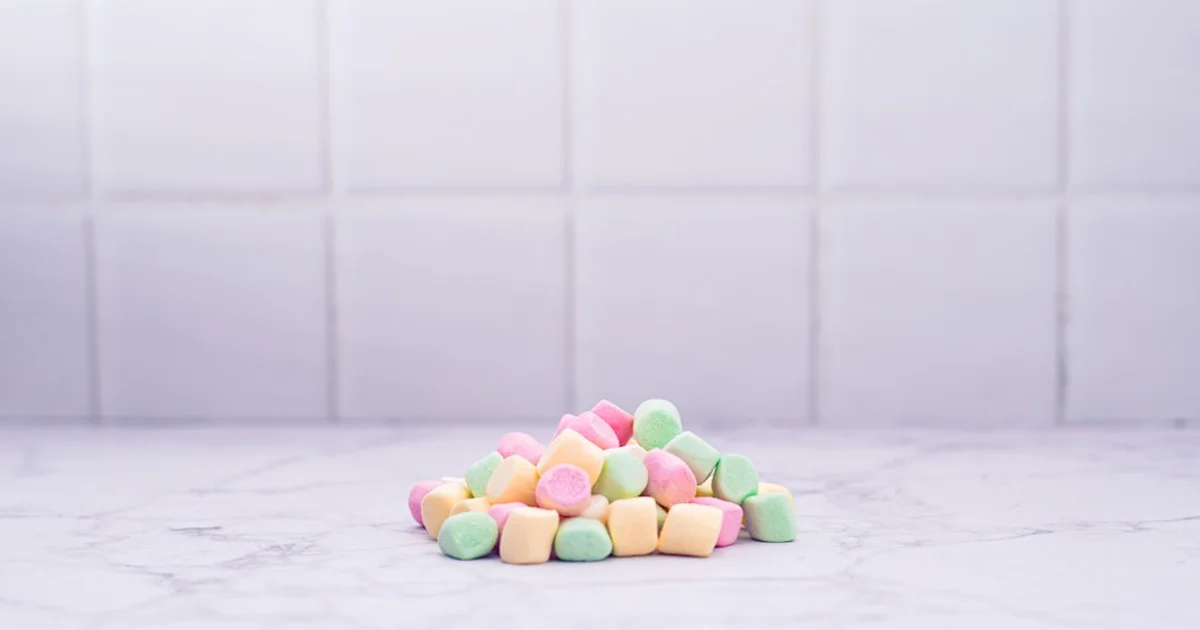
That was a safety story. A separate, quieter story broke around the same time — and it’s the one more relevant to Muslim consumers deciding what to buy. JAKIM and Malaysia’s Department of Veterinary Services (DVS) tested 20 marshmallow samples from the Malaysian market. 70 to 75% came back positive for pork DNA. The rest contained beef DNA or a mix of both. JAKIM’s own figure is blunter still: less than 7% of gelatin on the global market is confirmed halal.
Two separate findings, one product category. This post lays out what each one actually means, and how to check what’s in the pack.
What Actually Happened
The choking ban (food safety, not halal): Following the Penang death, Malaysia’s Ministry of Health banned the sale of eyeball-shaped gummy candy on all e-commerce platforms and in physical stores, and identified dozens of advertisement links promoting the product for takedown. A new labelling requirement now applies to small, round jelly confectionery: products 45mm or smaller in diameter must carry a “MAY POSE A CHOKING HAZARD — NOT SUITABLE FOR CHILDREN UNDER 3” warning. This action targeted a specific product shape and size, not gelatin content or halal status.
The gelatin finding (a halal issue, not a safety one): Separately, JAKIM and DVS ran DNA testing on marshmallow samples circulating in the Malaysian market — a category that shares its core ingredient (gelatin) with gummy sweets. Malaysia Gazette reported that 70-75% of the 20 samples tested contained pork DNA, with the remainder testing positive for beef DNA or a mixture of both. This matters because gelatin’s source animal — and how that animal was slaughtered — is the entire question that determines whether a gummy or marshmallow product is halal.
JAKIM has publicly urged marshmallow and gummy buyers to verify halal status before purchase, specifically flagging that products entering Malaysia can carry a halal logo from the exporting country that isn’t necessarily recognised by JAKIM. Three foreign halal certification bodies have had their recognition withdrawn by JAKIM in recent scrutiny of the import pipeline.
Why Gelatin Is the Recurring Problem
Gelatin is a protein extracted by boiling animal bone, skin, and connective tissue. It’s what gives gummies and marshmallows their chewy, elastic texture, and almost nothing else replicates that texture at the same cost.
The ruling is simple in principle and hard to verify in practice:
- Pork-derived gelatin is haram, full stop, regardless of processing.
- Beef or fish-derived gelatin is halal only if the animal was slaughtered according to Islamic rites. A “beef gelatin” label with no certification is not proof of this — it only tells you the species, not how it died.
- Unlabelled “gelatin” with no source given is treated as the industry default, which — as JAKIM’s own 7% global figure shows — is very rarely halal.
This is the same principle we cover in our gummy sweets guide, our E441 guide, and the complete gelatin sourcing guide: the word “gelatin” alone tells you almost nothing. You need either a recognised halal certification mark, or an explicit, verifiable source statement. It is also why the biggest gummy brand of all splits by market — standard UK and EU Haribo uses pork gelatine, while certified lines exist only in certain countries; our full Haribo verdict maps out which is which.
The Confusion Shows Up in Real Questions, Not Just Lab Reports
A common question that comes up is whether a specific gummy brand is halal simply because gelatin wasn’t listed on the label — with the assumption that “they’re vegetarian” settles it. That conflates two entirely different standards. Vegetarian rules out animal gelatin, but it says nothing about insect-derived colourings like carmine (E120) or alcohol-based glazes, and it’s not a halal certification. We cover this exact mix-up in why vegetarian doesn’t always mean halal.
The opposite point matters just as much: if the source animal was not slaughtered in the halal fashion, it wouldn’t be halal no matter what animal it is — which is precisely the gap JAKIM’s marshmallow testing exposed. Beef gelatin without certification is not a safe assumption.
How to Check Gummy Candy or Marshmallows Are Halal
Step 1 — Check for a halal certification mark. Look for JAKIM’s logo (in Malaysia), or another certification body JAKIM recognises. A certification mark means the gelatin source and slaughter method have already been verified — this is the only reliable shortcut.
Step 2 — If there’s no certification mark, read the ingredients list. Look for “gelatin,” “gelatine,” or E441. If the label doesn’t specify the source animal, treat it as unverified rather than assuming it’s beef.
Step 3 — If it says “beef gelatin” with no certification, don’t stop there. Ask whether the manufacturer can confirm halal slaughter, or look the brand up before buying. A species claim is not a slaughter claim.
Step 4 — If there’s no gelatin at all, check the setting agent. Pectin, starch, agar-agar, and carrageenan (E407) are plant-derived and halal. Products that use these instead of gelatin sidestep the entire issue.
Step 5 — Check the coating, if there is one. Shiny gummies sometimes use E904 (shellac, from the lac insect — not permissible under mainstream Sunni fiqh) versus E903 (carnauba wax, plant-based and halal).
If you’re holding a product right now, our ingredient scanner will run the full ingredients list and flag gelatin, E441, E904, and every other additive in seconds. You can also look up any individual E-code — including E441 — in our E-codes database.
How we reached this verdict
Our position on unverified gummy and marshmallow gelatin is based on:
- Primary news reporting: Malay Mail, Free Malaysia Today, Bernama, and Malaysia Gazette coverage of the February 2025 eyeball gummy choking death, the resulting Ministry of Health ban and labelling rule, and the JAKIM/DVS marshmallow DNA testing results (70-75% pork DNA in 20 samples tested).
- JAKIM’s own public statements: JAKIM’s advisory to marshmallow and gummy buyers to check for a valid halal logo, and its cited figure that less than 7% of gelatin on the global market is confirmed halal.
- Scholarly consensus on gelatin: The impermissibility of porcine gelatin, and the requirement for verified halal slaughter for bovine/fish gelatin to be permissible, is agreed across mainstream Sunni fiqh — consistent with our E441 gelatin guide.
- Our E-codes database: E441 (gelatin) is classified as Mushbooh (source-dependent) in our E-codes database — halal only with verified halal-slaughtered source and certification.
This post covers a food-safety ban and a separate halal-sourcing finding reported by Malaysian authorities and media; it is not a claim that all gummy candy or marshmallow sold in Malaysia is haram. It is a claim that unlabelled or unverified gelatin should not be assumed halal, and that recent testing gives specific reason for caution in this category.
Madhab note
The mainstream position across Hanafi, Maliki, Shafi’i, and Hanbali fiqh is consistent: pork-derived gelatin is haram regardless of processing, and gelatin from a permissible animal is only halal if that animal was slaughtered according to Islamic rites (zabihah). The view that industrial processing (istihalah) transforms gelatin into a new, permissible substance is a minority scholarly opinion not accepted by JAKIM, HMC, HFA, or MUI, and HalalCodeCheck follows the mainstream consensus for all verdicts on this site.
Summary
| Question | Answer |
|---|---|
| Did Malaysia ban all gummy candy? | No — it banned the sale of eyeball-shaped gummy candy specifically, and added choking-hazard labelling rules for small jelly confectionery |
| Why was gummy candy banned? | A 10-year-old boy died from choking on one in February 2025 — a safety issue |
| What did JAKIM/DVS find in marshmallow testing? | 70-75% of 20 samples tested contained pork DNA |
| What percentage of global gelatin is halal-confirmed? | Less than 7%, per JAKIM |
| Does “beef gelatin” on a label guarantee halal? | No — only if the animal was slaughtered according to Islamic rites, which requires certification to verify |
| How do I check a specific product? | Look for a halal certification mark, or scan the ingredients for gelatin/E441 with our ingredient scanner |
Given that JAKIM puts confirmed-halal gelatin at under 7% of the global supply, the shortcut most readers want is a shelf they can trust rather than a pack they have to interrogate. We keep a running rundown of sweets whose gelatine source is actually documented, every one of them backed by a recognised certification mark rather than a species claim.
Scan any product’s full ingredients list with the ingredient scanner for an instant halal verdict, or look up E441 and other additives in the E-codes database.
Ingredients change. Be first to know.
Brands reformulate without warning. We track every E-code update and halal certification — one short weekly email.
Related Articles
 Ingredient Guides
 The Gummy Sweets Halal Problem: Why Most Gummies Are Haram (2026)
Porcine gelatin makes most European gummy sweets haram. Haribo UK vs Haribo Germany have different recipes. Here's how to spot safe gummies in any supermarket in 30 seconds.
 Ingredient Guides
 Why "Suitable for Vegetarians" Doesn't Make a Medicine or Supplement Halal (2026)
Vegetarian-labelled capsules still use bovine gelatin — which is not halal without certification. Here's the specific gap between vegetarian compliance and halal compliance, and how to navigate it.
 Ingredient Guides
 The Supplement Capsule Halal Problem: Gelatin vs HPMC vs Pullulan (2026)
Most vitamin capsules use porcine gelatin — the cheapest shell material. Here's how to identify HPMC (vegetable) capsules on any label and which UK supplement brands use halal-safe capsules.