
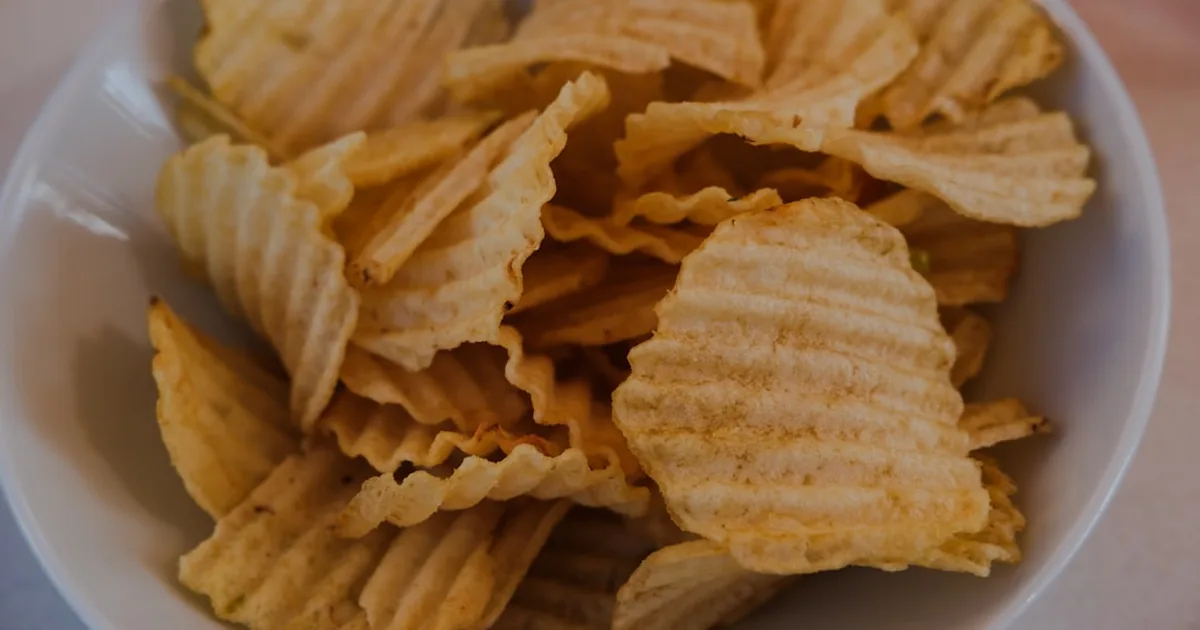
Pringles Original is halal — and it is the only UK Pringles with no flavour-enhancer question at all. Every flavoured UK variety we verified in August 2026 contains E621 (MSG) together with E627/E631 or E635 in the seasoning. What the older warnings miss is the other half of the label: every one of those flavours is marked suitable for vegetarians, which changes the ruling for most Muslims.
So the real question is not “does it contain E631?” — for flavoured Pringles the answer is almost always yes. The question is what your standard makes of enhancers whose source is declared vegetarian but not halal-certified. This guide gives you the verified flavour-by-flavour table, both answers, and the regional differences.
The E631 Question
E631 (disodium inosinate) is a nucleotide-based flavour enhancer. On its own it has little taste, but combined with MSG or E627 (disodium guanylate) it dramatically boosts the savoury, umami quality of seasoned snacks. Pringles UK labels spell these out by chemical name — “Flavour Enhancers (Monosodium Glutamate, Disodium Guanylate, Disodium Inosinate)” — rather than E-numbers.
E631 can be produced from pork, from fish, or by yeast/microbial fermentation. UK labels do not declare the source. That is where the vegetarian label does the work:
- Vegetarian-labelled pack → the enhancers cannot be meat- or fish-derived. Under the mainstream Hanafi/Maliki/Shafi’i position, that manufacturer declaration is sufficient — the product is acceptable.
- No vegetarian label, no certification → the source is genuinely unknown. Treat as mushbooh.
- HMC-strict standard → only formal certification counts; every uncertified flavoured Pringles is mushbooh regardless of the label.
Every flavoured UK Pringles we verified carries the vegetarian mark, so for UK cans the practical difference is between those two standards — not between halal and haram. Nothing pork-derived is listed on any UK Pringles label we checked.
Pringles Flavour-by-Flavour: UK Status
Verified against rendered Ocado and Waitrose listings, August 2026 (Kellanova’s UK site blocks automated access; both retailers reproduce the full ingredient panel). Formulations change — always cross-check the tube in your hand.
| Flavour | Flavour Enhancers (verified) | Status |
|---|---|---|
| Original | None | Halal — vegan-labelled |
| Sour Cream & Onion | E621 + E627 + E631 | Mainstream: acceptable (vegetarian label) / Strict: Mushbooh |
| Cheese & Onion | E621 + E635 | Mainstream: acceptable / Strict: Mushbooh |
| Texas BBQ | E621 + E635 | Mainstream: acceptable / Strict: Mushbooh |
| Prawn Cocktail | E635 — no actual prawn | Mainstream: acceptable / Strict: Mushbooh |
| Salt & Vinegar | E621 + E627 + E631 | Mainstream: acceptable / Strict: Mushbooh |
| Paprika | E621 + E627 + E631 | Mainstream: acceptable / Strict: Mushbooh |
| Smokey Bacon | E621 + E627 + E631 — no pork; imitation flavour | Mainstream: acceptable / Strict: Mushbooh |
| Hot & Spicy | E621 + E627 + E631 + E471 — dairy seasoning | Mainstream: acceptable (vegetarian-class label) / Strict: Mushbooh |
| Hot Kickin’ Sour Cream | E621 + E627 + E631 + E471 — dairy seasoning | Mainstream: acceptable / Strict: Mushbooh |
Three corrections to claims you may have read elsewhere (including, until this update, on this page):
- Salt & Vinegar and Paprika are not clean. Both list E621, E627, and E631 on the current UK label. Older guides that clear them are out of date.
- Smokey Bacon contains no pork. The seasoning is yeast powder, dextrose, enhancers, and unspecified flavourings — under a suitable-for-vegetarians mark. It is an imitation flavour. Some Muslims avoid pork-imitation flavours as a matter of personal comfort; that is a preference, not an ingredient ruling.
- The “Hot” range is now verified (Bestway Wholesale listings, August 2026): Hot & Spicy and Hot Kickin’ Sour Cream both carry E621 + E627 + E631 with unstated enhancer sources, plus emulsifier E471 and milk-derived seasoning — the same mainstream-acceptable / strict-Mushbooh split as Sour Cream & Onion.
US-market flavours (Ranch, Jalapeño, Pizza, Loaded Baked Potato) are separate recipes — see the next section.
Every flavoured variety also contains a milk derivative (lactose, whey, sour cream powder, or milk proteins), and all varieties including Original contain the emulsifier E471 — plant-derived on the vegan-labelled Original; source unstated elsewhere, covered by the vegetarian label under the mainstream rule.
UK vs US: The Recipe Difference
Pringles are not a single global product. Kellanova manufactures Pringles in different facilities with recipes adapted for local regulations, taste preferences, and ingredient availability.
In the United States, disodium inosinate and disodium guanylate appear by chemical name in many of the same flavours — but US packs generally carry no vegetarian declaration, which removes the source assurance UK buyers get. Without that label or certification, flavoured US Pringles sit in mushbooh territory, and US-only flavours (Ranch, Pizza, and the rest) need a per-label check.
In the UK, the vegetarian mark plus the spelled-out enhancer names make the label easy to read once you know what to look for.
What About UAE, Gulf and Malaysian Pringles?
Kellanova produces Pringles for certified halal markets. In Malaysia, Pringles carry JAKIM certification; some Gulf Cooperation Council (GCC) market cans carry halal logos from recognised Gulf bodies. Certified cans mean the enhancer sources and the production line have been independently audited — the strongest assurance available.
The critical point: these are not the product on UK or US shelves. A can from Tesco carries no certification; a can from a Kuala Lumpur supermarket may. If you are in the UAE or Malaysia, look for the JAKIM or ESMA logo on the can. If it is present, the product is certified. If not, apply the same label check as anywhere else.
How Manufacturing Varies by Country
The potato-based dough (dehydrated potato, corn flour, wheat flour, rice flour) is consistent across markets and is not the concern. The seasoning sachets are where regions differ: a certified flavour supplier may serve the Malaysian line while the UK line uses an uncertified (but vegetarian-declared) one. The same flavour name cannot be treated as universally halal or haram without knowing where the can was produced and what its label declares.
How we reached this verdict
Our process for Pringles:
- Label verification: UK ingredient panels for eight flavours were read from rendered Ocado and Waitrose product pages in August 2026 — every enhancer listed in the table above appears verbatim on the fetched label. Flavours we could not fetch are marked “check the label”, not guessed.
- E-code cross-reference: E621, E627, E631, and E635 were checked against our E-codes database for source classifications.
- Vegetarian declarations: recorded from the same retailer panels — every flavoured UK variety we verified carries “Suitable for Vegetarians”; Original carries “Suitable for Vegans”.
- Certification check: Kellanova holds no halal certification for the UK Pringles range. JAKIM/GCC certification applies only to cans produced for those markets.
Madhab note
The rulings in this article follow the site’s standard framework:
Source-ambiguous enhancers (E621, E627, E631, E635) on a vegetarian-labelled pack: the manufacturer’s vegetarian declaration rules out meat and fish sources. The Hanafi/Maliki/Shafi’i mainstream (Darul Ifta Birmingham, IslamQA case 245452) accepts this as sufficient — acceptable. The HMC-strict / Hanbali-leaning view requires independent certification — mushbooh.
E471 (mono- and diglycerides): plant-derived on the vegan-labelled Original. On the flavoured varieties the source is unstated; the vegetarian label covers it under the same mainstream rule.
Prawn Cocktail: contains no actual prawn, so the shellfish question (halal under the majority position, disliked in parts of the Hanafi school) does not arise — the seasoning is the only consideration.
Imitation pork flavours (Smokey Bacon): permissible by ingredients when nothing pork-derived is present; avoiding the imitation is a personal preference some scholars encourage, not an ingredient ruling.
Summary: Pringles at a Glance
| Question | Answer |
|---|---|
| Is Pringles Original halal? | Yes — vegan-labelled, no flavour enhancers |
| Do flavoured UK Pringles contain E631 or E635? | Yes — every flavour we verified |
| Are they haram, then? | No pork is listed on any UK label; all are vegetarian-labelled — mainstream: acceptable, strict: mushbooh |
| Is Salt & Vinegar the clean one? | No — it lists E621, E627, and E631 (verified August 2026) |
| Does Smokey Bacon contain pork? | No — imitation flavour under a vegetarian label |
| Are Pringles halal in the UAE or Malaysia? | Certified cans exist for those markets — look for the JAKIM/ESMA logo |
| What should I check on the label? | The enhancer names, the vegetarian mark, and any halal logo |
If you require a named halal credential rather than a vegetarian label, our rundown of UK snacks with the halal credential named for each pick files nothing under crisps: the candidates either name no certifier or carry E635 on the panel. Sweets, noodles and jerky are what stand.
The One-Tube Rule
If you need a simple takeaway: Original is the only UK Pringles with no enhancer question at all — vegan-labelled, enhancer-free, no judgement call required. Every other tube involves the vegetarian-label ruling above, so know which standard you follow before it goes in the trolley.
The wider lesson applies well beyond Pringles. Flavour enhancers — especially the E62x/E63x series — are routinely added to savoury snacks with no origin stated on the pack. Getting into the habit of scanning for E627, E631, and E635 (and their spelled-out chemical names) on any seasoned product, then checking for the vegetarian mark, is one of the most practical skills a Muslim consumer can build. For the crisps aisle as a whole, see the UK crisp flavour guide.
Use the E-codes database to look up any E-code — including E627, E631, and the full E6xx flavour enhancer series — and see full sourcing details and halal rulings.
Scan a full ingredient list with the ingredient scanner — upload a photo of the Pringles label or any other product and get an instant E-code breakdown.
Ingredients change. Be first to know.
Brands reformulate without warning. We track every E-code update and halal certification — one short weekly email.
Related Articles
 Shopping Guides
 Which Crisp Flavours Are Haram? UK Brand-by-Brand Guide (2026)
We verified 30+ UK crisp flavours against current official labels. Fewer are haram than you think — Walkers is now enhancer-free, but flavoured Pringles still use E631/E635. Full brand guide: Walkers, Pringles, Tyrrells, Kettle, McCoy's.
 Shopping Guides
 The Complete Guide to Halal Crisps and Savoury Snacks (2026)
Every snack category covered: potato crisps, Doritos, Pringles, popcorn, rice cakes, nuts and crackers. Brand verdicts across Walkers, Tyrells, Kettle, Doritos, Cheetos, Pringles, Popchips and more.
 Shopping Guides
 Halal Lunchbox Guide for Muslim Kids at UK Schools (2026)
Flavoured crisps, yogurt tubes, gummy snacks and cereal bars hide haram ingredients. Aisle-by-aisle guide to halal-safe lunchbox staples, with branded alternatives per category.