
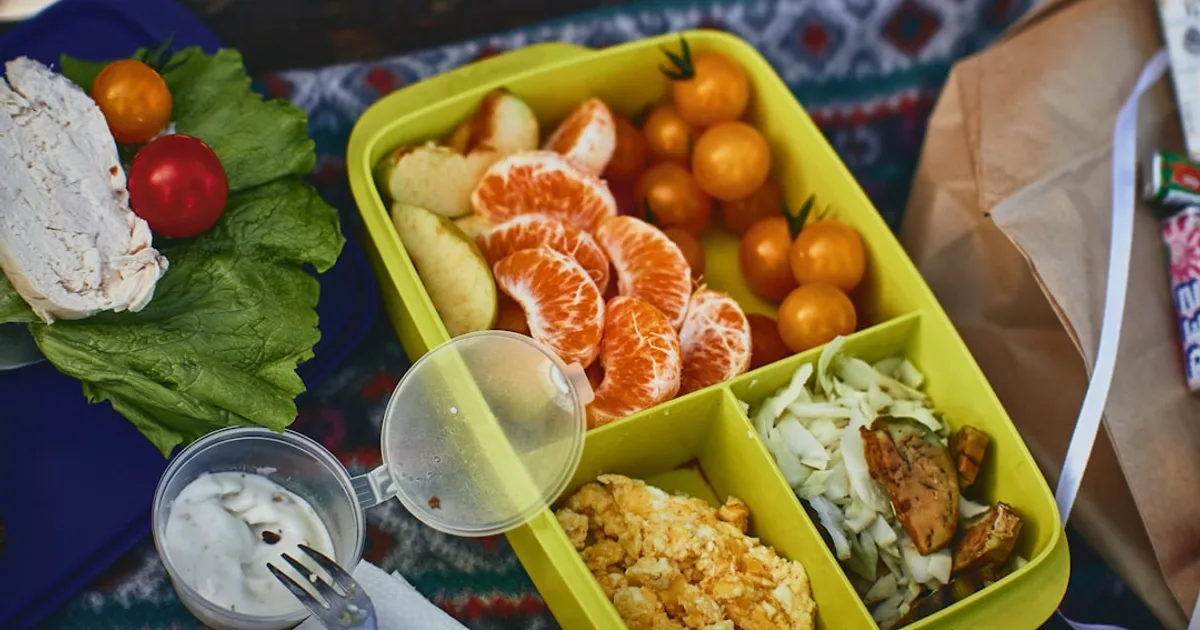
Good news first: that bag of Walkers Cheese & Onion in your trolley is cleaner than most halal guides suggest — the current recipe lists no E631 and carries a vegetarian label. But the crisps aisle is the easy part. Haram ingredients turn up across every aisle of the lunchbox section: in gummy fruit snacks, yogurt tubes, cereal bars and even fruit roll-ups.
The core rule for halal lunchboxes is straightforward: plain flavours are safer than flavoured, fresh is safer than processed, and the vegetarian-labelled option is usually your lowest-risk starting point. This guide covers each lunchbox category, names the specific E-codes to look for, and gives you branded alternatives you can find in Tesco, Sainsbury’s, Asda and Waitrose today — checked against current UK labels ahead of the new school year.
If you want the meal-planning side — sandwiches, school dinners, the weekly shop — pair this with our halal school lunch planning guide. For the snack aisle specifically, the gelatine-free and E120-free snack label checks post gives you the three-check routine in a shorter format.
Why Packed Lunchboxes Are a Separate Problem
School-provided halal meals are covered by a different set of checks — the school kitchen, the catering contract, the certifier. Your packed lunchbox bypasses all of that. Every item is chosen by you, often in a hurry, from shelves that mix halal-safe and haram products without any visual difference.
The other complication is that children’s snack products are specifically engineered to appeal to kids — bright colours (often E120, carmine), fruit-flavoured gummies (almost always pork gelatine) and cheesy flavours (frequently E631). The items most likely to end up in a lunchbox are exactly the ones most likely to contain haram ingredients.
The Five Haram Ingredients to Watch
Before going aisle by aisle, memorise these five. They cover the vast majority of lunchbox problem ingredients in UK supermarkets.
E120 — Cochineal / Carmine: Red dye from crushed cochineal beetles. Haram. Found in: Fruit Winders, some yogurt tubes, some fruit squashes. Look for “carmine” or “cochineal” in the allergen block.
E441 — Gelatine: Usually pork-derived in UK snack products unless stated otherwise. Haram unless certified halal. Found in: Haribo, Jelly Babies, most gummy sweets, marshmallows, some cereal bars with marshmallow pieces.
E631 — Disodium Inosinate: Flavour enhancer. Can be derived from pork or fish. Haram if pork-derived; the label will not tell you which source. Found in: cheese-flavoured crisps, chicken-flavoured crisps, some instant noodle sachets. Full breakdown in our E627 and E631 crisps explainer.
E120 + E441 combination: Some products combine both. Any product with both should be avoided outright.
Rennet (animal): Used in cheese products. If the label says “Suitable for Vegetarians” it confirms microbial or vegetable rennet — safe. If there is no vegetarian statement and it is a processed cheese product, treat with caution.
Use the E-codes database to look up any E-code you are unsure about.
Crisps and Savoury Snacks
This is the category where parents make the most mistakes. The rule here is simple: plain flavours only.
Why Flavoured Crisps Can Be a Problem
Flavoured crisps historically leaned on E631 and E627 — flavour enhancers whose animal source is not declared on UK labels. The picture has improved: the current Walkers core range lists no E631, E627, or MSG, and every core flavour carries a vegetarian label (verified against walkers.co.uk, August 2026). Other brands and imported crisps still use these enhancers, so the label check remains essential.
| Product | Status | Note |
|---|---|---|
| Walkers Ready Salted | Halal | No flavour enhancers |
| Walkers Lightly Salted | Halal | Minimal ingredients |
| Walkers Cheese & Onion | Halal-suitable | No E631 in current recipe — milk-based seasoning, vegetarian label |
| Walkers Prawn Cocktail | Halal-suitable | No E631, no actual prawn — vegetarian label |
| Walkers Roast Chicken | Halal-suitable | No E631, no actual chicken — vegetarian label |
| Pringles Original | Halal | No E631 in Original — ingredient-verified, no halal certification on UK cans; check label each purchase |
| Pringles Sour Cream & Onion | Mushbooh | Contains E621/E627/E631 — vegetarian-labelled; acceptable under the mainstream view, mushbooh under the strict view |
| Sensations Thai Sweet Chilli | Check label | Formulation varies |
| Sensations Sea Salt | Halal | Check label — formulation changes |
| Tyrells Lightly Sea Salted | Halal | Simple ingredients |
| Tyrells Veg Crisps | Halal | No flavour enhancers |
| Popchips Sea Salt | Halal | Widely available, clean label |
The safe shortcut: Buy plain, sea-salted, or lightly salted varieties from any brand. Add a small separate pot of hummus, salsa or dip for flavour. For a flavour-by-flavour breakdown across every major UK brand, use the crisp flavour audit.
Sweets and Gummy Snacks
This is the highest-risk lunchbox category. The vast majority of children’s gummy sweets sold in UK supermarkets contain pork gelatine (E441).
Products to Avoid
- Haribo (entire range): All standard UK Haribo products contain pork gelatine. There is a Halal-certified Haribo range sold in specialist shops — but the supermarket version is not it.
- Maynards Bassetts Wine Gums: Pork gelatine.
- Rowntree’s Randoms: Contain gelatine.
- Fruit Winders: Contain E120 (carmine) in most varieties. Some are labelled “no artificial colours” and may be E120-free — check per flavour, every time.
- Jelly Babies (Bassetts): Pork gelatine.
- Starmix / Tangfastics: Haribo. Pork gelatine.
Safe Alternatives
| Brand / Product | Status | Notes |
|---|---|---|
| Bebeto (any variety) | Halal | Certified halal (Turkish Standards Institution) — halal beef gelatine, no pork gelatine |
| Sweetzone jelly sweets / fruit chews | Halal | HMC-certified per Sweetzone’s statement — check the pack for lines outside the certified ranges |
| Candy Kittens | Halal | Vegan, no gelatine — check individual flavours |
| Swizzels Love Hearts | Halal | No gelatine, no E120 |
| Swizzels Refreshers | Halal | No gelatine — check current label |
| Rowntree’s Jelly Tots | Halal | Gelatine-free, ingredient-verified — no formal halal certification |
| Polo Mints | Halal | No gelatine; Nestlé UK states the E471 is plant-derived |
| Skittles (UK) | Halal | Gelatine-free and E120-free; labelled suitable for vegetarians — no formal UK halal certification |
| Starburst (UK pack) | Halal | Gelatine-free since the 2020 UK reformulation, labelled suitable for vegetarians — US packs still contain pork gelatine, so check the pack origin |
| Haribo (supermarket) | Haram | Pork gelatine |
Practical tip: Bebeto sweets are sold in Asda, Tesco and most Poundland / B&M stores; Sweetzone is in most Asian grocers and many corner shops. Keep a bag in the house as your default sweet treat. The discount stores are worth a dedicated read — our Farmfoods, B&M and Home Bargains halal guide covers their sweet-aisle wins and traps. Our UK halal gummy sweets audit covers every certified brand we could verify, and the gummy sweets halal problem explains why gelatine dominates this aisle.
Yogurt, Yogurt Tubes and Pouches
Flavoured yogurt products for children — tubes, pouches and squeezy formats — hide two common haram ingredients: gelatine (E441) added as a texture agent, and carmine (E120) used for red/pink colours.
Yogurt Tubes (e.g. Frube, Frubes)
Frubes (Yoplait) currently do not list gelatine or E120. However, they do contain E472b (lactic acid esters of mono- and diglycerides of fatty acids), which is mushbooh — source can be animal or plant. Check the current label before buying, as formulations change.
Safer Yogurt Options
| Product | Status | Notes |
|---|---|---|
| Yeo Valley Kids Organic Pouch | Halal | No gelatine, no E120 — plain or strawberry |
| Alpro Soya Plain Pouch | Halal | Vegan, no animal derivatives |
| Alpro Kids Vanilla Pouch | Halal | Vegan — check label for flavour variants |
| Collective Dairy Straight Up | Halal | Clean ingredients, vegetarian-suitable |
| ONKEN Natural Set Yogurt | Halal | Portion into a small pot |
| Frubes (current formula) | Mushbooh | E472b source unconfirmed |
| Müller Kids Corner | Mushbooh | Some varieties contain E120 |
| Petits Filous (standard) | Mushbooh | Contains E120 in some flavours |
Practical shortcut: Decant a plain Yeo Valley or Alpro pouch. Add a squeeze of honey or a few drops of vanilla extract at home. Zero label anxiety.
Cereal Bars and Biscuit Snacks
Cereal bars target the lunchbox market directly — and they contain a surprising number of problem ingredients, including gelatine binders in some “fruit and nut” bars, E120 in strawberry or raspberry varieties, and E471 from animal sources in some chocolate-coated bars.
| Product | Status | Notes |
|---|---|---|
| Lotus Biscoff Original | Halal | Vegan-certified, clean label |
| Nakd Bars (all varieties) | Halal | Vegan, no additives — just fruit and nuts |
| Kallo Rice Cakes | Halal | Plain or lightly salted |
| Nairn’s Oat Biscuits | Halal | Check label — some flavours add E471 |
| Cadbury Mini Rolls | Mushbooh | Contains E471 (source unclear) |
| Kellogg’s Rice Krispies Squares | Mushbooh | Some varieties contain gelatine (marshmallow pieces) |
| Nature Valley Bars | Mushbooh | Some varieties contain E471 |
| Ella’s Kitchen Smoothie Bars | Halal | Suitable for toddlers and young children |
| Bear Yoyo Rolls | Halal | 100% fruit, no additives |
For the biscuit tin more broadly — including which McVitie’s and Fox’s varieties pass — see the UK biscuits halal audit.
Drinks
Most school lunchbox drinks are fine — water, pure juice, or diluted squash. The risk area is flavoured drinks and some fruit squashes that use E120 or artificial sweeteners with uncertain sourcing.
Safe choices: Water. Pure apple juice carton. Innocent Kids Juice Pouch (no additives). Highland Spring still water.
Check carefully: Any red or pink squash may contain E120. Ribena is fine (no E120). Some supermarket own-brand red squashes — check the label.
Avoid: Energy-style children’s drinks. Drinks with artificial colours listed without source clarity.
Main / Sandwich Fillings
Sandwiches are generally lower risk, but two ingredients create problems.
E471 in bread: Mono- and diglycerides of fatty acids may be animal-derived. Hovis and Warburtons standard loaves contain E471. The safest option is bread labelled “Suitable for Vegans” — vegan E471 must come from plant sources.
Processed meat: Any ham, salami or pepperoni is haram unless certified halal. If your child wants a meat sandwich, use halal-certified chicken or beef slices from a halal butcher or an HMC-certified brand.
Safe fillings: Cream cheese (vegetarian-labelled), tuna mayo, egg mayo, hummus and cucumber, peanut butter, halal chicken breast, mozzarella (vegetarian-labelled).
| Filling | Status | Notes |
|---|---|---|
| Philadelphia Cream Cheese | Mushbooh | Rennet type not consistently disclosed; no halal certification |
| Princes Tuna | Halal | No additives of concern |
| Cheestrings | Halal | Vegetarian-labelled (rules out animal rennet) — ingredient-verified, no formal certification |
| Cathedral City Sliced Cheddar | Mushbooh | Uses animal rennet in at least some varieties; check each pack for a vegetarian label |
| Dairylea Dunkers | Mushbooh | Contains E471 — source unconfirmed |
| Standard supermarket ham | Haram | Pork |
| Pepperami (standard) | Haram | Pork |
Cheese is the category where a brand name is not enough — the same brand can use animal rennet in one variety and microbial rennet in another. The per-pack “Suitable for Vegetarians” label is the check that matters, every time.
Age-by-Age Focus Guide
Reception to Year 2 (Ages 4–7)
The priority at this age is simplicity: fewer ingredients means fewer problem E-codes. Stick to plain crisps, fresh fruit, a plain yogurt pouch, Nakd bar or Lotus Biscoff, and water. Avoid all gummy sweets at this age — the gelatine risk is not worth it, and small children are less able to tell you what they ate.
Year 3 to Year 6 (Ages 7–11)
Children at this age start sharing snacks with friends. Talk to your child about the key rules: no gummy sweets from friends (unless they are Bebeto or certified halal), no crisps that are not plain flavour. Give them a small laminated card with the “never” list: Haribo, Fruit Winders, cheese-flavoured crisps, wine gums, and any US-import sweets (American Starburst still contains pork gelatine even though the UK version does not).
Year 7 to Year 11 (Ages 11–16)
Secondary school children buy snacks from the school canteen or local shops. The checklist approach works best here: teach them to look for E441, E120 and E631 on labels. Install the HalalCodeCheck E-code lookup as a home screen shortcut on their phone.
Quick-Scan Checklist for Parents
Print this and stick it to your kitchen cupboard:
Always safe (no E-code checks needed):
- Fresh fruit, raw veg sticks
- Plain / Ready Salted / Lightly Salted crisps
- Nakd bars, Bear Yoyo rolls, Lotus Biscoff
- Plain yogurt pouches (Yeo Valley, Alpro)
- Bebeto sweets, Swizzels Love Hearts, Jelly Tots
- Water, pure juice cartons
Always check first:
- Any flavoured crisps (look for E631)
- Any yogurt tube or pouch with colour (look for E120)
- Any fruit roll-up or fruit strip (look for E120)
- Any cereal bar with marshmallow or fruit pieces (look for E441)
- Any bread or wrap (look for E471 — prefer vegan-labelled)
Never without formal halal certification:
- Gummy sweets (unless Bebeto/Candy Kittens/certified)
- Any meat product
- Any product labelled Haribo
Where you live shapes how much of this list the supermarket covers. In commuter-family cities the answer is usually a supermarket-plus-independents mix — our Milton Keynes halal food guide is the worked example.
How we reached this verdict
This guide draws on:
- Ingredient list analysis: Current UK formulations from Tesco, Sainsbury’s, Asda and Waitrose (re-checked July 2026 for the new school year). Formulations change — always check the current label.
- HalalCodeCheck E-codes database: 372+ E-codes with halal status classifications. Each E-code status is derived from scholarly consensus and manufacturer source disclosure where available.
- HMC (Halal Monitoring Committee) and HFA (Halal Food Authority) certification databases for branded products carrying formal certification.
- Vegetarian Society UK guidance: “Suitable for Vegetarians” labelling rules out animal gelatine and animal rennet, making it a useful proxy where halal certification is absent.
- Manufacturer responses: Where source ambiguity exists (E471, E631), status is recorded as Mushbooh unless the manufacturer confirms plant or synthetic origin in writing.
No product is guaranteed halal without a formal halal certification. This guide gives you the tools to make informed decisions — it is not a substitute for certified halal labelling.
Madhab note
This guide follows the mainstream Sunni Hanafi position, which is the dominant madhab in the UK Muslim community:
- E120 (carmine/cochineal): Haram. Derived from insects (cochineal beetles). The Hanafi school considers insects to be haram with very narrow exceptions — cochineal does not fall within them.
- E441 (gelatine): Haram if pork-derived. Halal if from a certified halal animal slaughtered correctly. Gelatine from fish is permissible.
- E631 (disodium inosinate): Mushbooh. The Hanafi position treats unknowingly consumed haram as sinful only if you could have known — which you can, by checking. Where the source is unknown and could be pork, it should be avoided.
- E471 (mono/diglycerides): Mushbooh under Hanafi opinion. Some scholars permit it if plant-derived; others require confirmation. Vegan-labelled E471 is considered acceptable by most contemporary UK scholars.
Shafi’i and Maliki scholars may apply slightly different rulings on some additives. If you follow a different madhab, consult your local scholar for specific guidance.
Summary: Key Questions at a Glance
| Question | Answer |
|---|---|
| Are Fruit Winders halal? | Most varieties contain E120 (carmine) — Haram. Check each flavour. |
| Are Haribo halal? | No. Supermarket Haribo contains pork gelatine. |
| Are Walkers crisps halal? | Plain/Ready Salted: Halal. Cheese, Chicken, Prawn Cocktail: Mushbooh (E631). |
| Are Frubes halal? | Mushbooh — contains E472b, source unconfirmed. |
| Are Bebeto sweets halal? | Yes — certified halal (Turkish Standards Institution). |
| Are Cheestrings halal? | Vegetarian-labelled, which rules out animal rennet — ingredient-verified, no formal HMC/HFA cert. |
| Is Lotus Biscoff halal? | Yes — no animal fat or gelatine; vegan-friendly recipe. |
| Are Nakd bars halal? | Yes — vegan, fruit and nut only. |
Use the E-codes database to look up any E-code you spot on a lunchbox snack label. If you have a full ingredient list, scan it with the ingredient scanner to get an instant halal verdict across every additive at once.
Ingredients change. Be first to know.
Brands reformulate without warning. We track every E-code update and halal certification — one short weekly email.
Related Articles
 Shopping Guides
 Is Pringles Halal? Every Flavour Checked by Region (2026)
Pringles Original is halal and vegan-labelled. Every flavoured UK variety we verified contains E621 with E627/E631 or E635 — but all carry vegetarian labels. Flavour-by-flavour table for UK, US and certified Gulf/Malaysian versions.
 Shopping Guides
 The Complete Guide to Halal Crisps and Savoury Snacks (2026)
Every snack category covered: potato crisps, Doritos, Pringles, popcorn, rice cakes, nuts and crackers. Brand verdicts across Walkers, Tyrells, Kettle, Doritos, Cheetos, Pringles, Popchips and more.
 Shopping Guides
 Halal School Snacks UK: 3 Label Checks Before You Buy (2026)
Three label checks — E441 gelatine, E120 carmine, E471 emulsifiers — catch most haram risks in UK lunchbox snacks. Here is what to look for, aisle by aisle.