
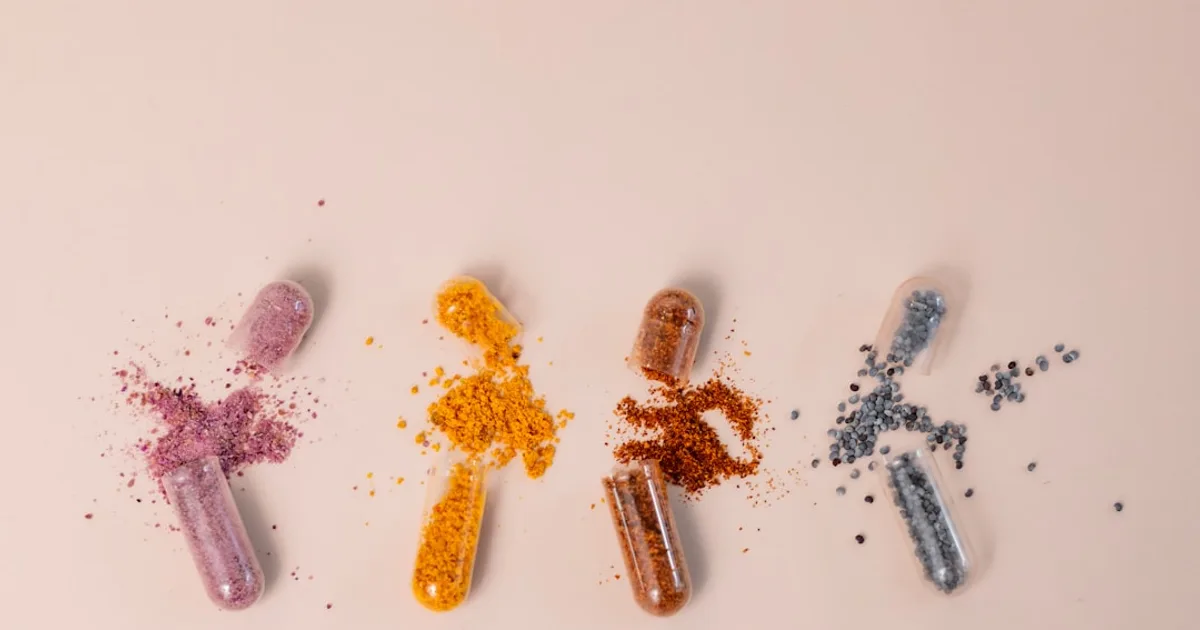
You already know to check E numbers on your food. But when did you last read the full ingredient list on your multivitamin?
The assumption most people make — that vitamins and supplements contain only the named nutrient — is incorrect. Every tablet, capsule, softgel, and chewable supplement contains a list of excipients: binders, fillers, coatings, flow agents, lubricants, and colourants that enable the product to be manufactured, stored, and absorbed consistently. Many of these excipients carry E numbers. Some of those E numbers are animal-derived. And unlike food products, supplements are not subject to the same public scrutiny over ingredient transparency.
The E Numbers That Appear in Tablets and Capsules
The following E numbers appear regularly in vitamin and supplement formulations. Most consumers never check for them.
| E Number | Name | Used For | Halal Status |
|---|---|---|---|
| E441 | Gelatine | Capsule shell | Haram if porcine; halal if certified halal bovine or fish |
| E904 | Shellac | Tablet coating/glaze | Haram (insect-derived) |
| E120 | Carmine (cochineal) | Capsule shell colouring | Haram (insect-derived) |
| E470b | Magnesium stearate | Tablet flow/lubricant agent | Mushbooh (animal or plant fat) |
| E471 | Mono- and diglycerides of fatty acids | Tablet coating, emulsifier | Mushbooh (source usually unstated) |
| E422 | Glycerol | Soft gel filler, humectant | Mushbooh (can be animal-derived) |
| E464 | Hydroxypropyl methylcellulose (HPMC) | Plant capsule shell | Halal ✓ |
| E551 | Silicon dioxide | Anti-caking agent | Halal ✓ (mineral) |
| E172 | Iron oxides | Capsule and tablet colouring | Halal ✓ (mineral) |
| E322 | Lecithin | Emulsifier in softgels | Halal ✓ if soy/sunflower; check if egg-derived |
| E500 | Sodium bicarbonate | Tablet disintegrant | Halal ✓ (mineral) |
| E460 | Microcrystalline cellulose | Tablet filler/binder | Halal ✓ (plant) |
E470b — Magnesium Stearate: The Most Common Hidden Concern
Magnesium stearate (E470b) is present in almost every tablet supplement on the market. It is a manufacturing flow agent — it lubricates tablet presses, prevents powders from sticking to machinery, and ensures consistent dosing during high-speed production. Without it, most tablet manufacture at commercial scale would not be viable.
It is also the most frequently overlooked halal concern in vitamins, for two reasons:
First, it is ubiquitous. Check any tablet supplement — multivitamin, vitamin C, zinc, iron, calcium — and you will find magnesium stearate in the ingredient list, almost without exception.
Second, the source is almost never declared. Magnesium stearate is produced by combining magnesium with stearic acid. Stearic acid is a fatty acid that occurs naturally in both animal fat and plant oils. The animal sources include beef tallow and pork fat. The plant sources include palm oil, coconut oil, and soy oil.
Both are commercially used. Neither is labelled as such on the supplement package.
How to Determine the Source
There are three practical approaches:
1. Contact the manufacturer. Ask specifically: “Is the magnesium stearate in [product name] derived from animal or vegetable sources?” Reputable manufacturers will answer. Some will state “vegetable-sourced stearic acid” as a matter of policy.
2. Look for vegetarian/vegan suitability markers. Products certified as suitable for vegetarians or vegans must use plant-derived excipients — including magnesium stearate. This is not halal certification, but it verifiably excludes animal-fat-derived magnesium stearate.
3. Check for halal certification. Halal certification from HMC, HFA, or IFANCA covers excipients as well as active ingredients. A halal-certified product has had its magnesium stearate source verified as part of the audit.
In the absence of any of the above, magnesium stearate must be treated as mushbooh — potentially animal-derived.
E904 Shellac — Haram Tablet Coating
Shellac (E904) is the dried secretion of the female lac insect (Kerria lacca). It is harvested by scraping the resinous deposit these insects produce on tree branches in South and Southeast Asia. Shellac is used as a glazing agent on tablet supplements — it creates a smooth, glossy coating that protects the tablet, masks taste, and gives a professional appearance.
The halal ruling on shellac is clear: it is haram. Insects are not permissible as food in Islam under mainstream Sunni jurisprudence, and shellac is derived directly from an insect’s secretion. HMC, HFA, and the major Islamic scholarly bodies in the UK and internationally take this position.
Shellac appears on supplement labels as “E904”, “shellac”, or sometimes hidden within “glazing agent” or “coating”. Some manufacturers list it only in the ancillary excipients section of the product datasheet rather than the main label.
Vegetarian-certified products will not contain shellac — lacquer from insects is classified as an animal product for vegetarian certification purposes.
For more detail, see our E904 shellac guide.
E120 Carmine — Haram Coloured Capsule Shells
Carmine (E120, also called cochineal) is a red dye derived from the dried bodies of the cochineal insect (Dactylopius coccus). It produces a vivid red to pink colour and is heat-stable — making it popular in food and supplement manufacturing as a natural colourant.
In supplements, E120 appears in:
- Coloured capsule shells (red, pink, maroon gel caps)
- Coloured tablet coatings
- Gummy supplements
The ruling is consistent: E120 is haram — insect-derived, not permissible. If a supplement has red or pink capsule shells and the ingredient list includes E120 or “carmine” or “cochineal extract”, it is not halal.
This concern extends beyond supplements — see our E120 carmine guide for the full picture across food products.
Safer alternatives: Iron oxide pigments (E172) are mineral-derived and halal. They produce brown, red, yellow, and black shades. Many responsible manufacturers have switched from carmine to iron oxides for capsule colouring.
E422 Glycerol — Overlooked Softgel Filler
Glycerol (glycerin, E422) is used as a humectant and filler in softgel capsules and some tablet formulations. It keeps softgels pliable and prevents them from drying out and cracking.
Glycerol can be derived from:
- Animal fat (including pork fat) — common in pharmaceutical-grade glycerol historically
- Palm oil or other vegetable oils — increasingly common as the industry moves toward plant sources
- Synthetic production — from propylene (petroleum-derived)
Pharmaceutical-grade glycerol increasingly comes from plant (typically palm) or synthetic sources in the UK and EU, but this is not universal. As with magnesium stearate, the label rarely specifies source.
Vegetarian and vegan certified products use plant-derived or synthetic glycerol. Halal certification covers glycerol source. In the absence of either, treat as mushbooh.
E441 Gelatine — The Capsule Shell Itself
E441 is gelatine — the protein derived from animal collagen. In supplements it appears as the capsule shell material for hard and soft capsules. The halal considerations around gelatine capsules are extensive and covered in full in our are gelatine capsules halal guide.
Brief summary: gelatine is haram if porcine. Halal if from halal-certified bovine or fish source. HPMC (E464) is the plant-based capsule alternative — halal.
Practical Checking Protocol for Supplement Shoppers
When checking a supplement for halal compliance, work through the label in this order:
Step 1 — Capsule shell check: Is the product in a capsule? If yes, what material? “HPMC”, “hydroxypropyl methylcellulose”, “vegetable capsule” = halal. “Gelatine” unspecified = avoid. “Softgel” unspecified = likely porcine.
Step 2 — Active ingredient check: Is the active ingredient from an animal source? (Collagen, omega-3, D3 from lanolin, etc.) If yes, confirm source.
Step 3 — Excipient scan: Read the full excipient/other ingredient list. Flag: E904, E120, E441 (if porcine), E470b, E471, E422. These require source confirmation.
Step 4 — Vegetarian/vegan marker: Does the product carry a “suitable for vegetarians” or “vegan” mark? If yes, this eliminates animal-fat-derived excipients, shellac, and carmine — significantly simplifying your check.
Step 5 — Halal certification: Does the product carry HMC, HFA, IFANCA, or JAKIM certification? If yes, all of the above has been audited. Purchase with confidence.
Rather than run this protocol over every bottle on the shelf, you can start from a shortlist that already clears it — our roundup of multivitamins screened for these additives covers daily formulas built on HPMC shells and vegetable-sourced excipients, with none of the shellac, carmine, or unverified stearates flagged above.
How We Reached This Verdict
E number classifications in this guide are based on:
- HMC (Halal Monitoring Committee) UK — comprehensive E number halal status database
- HFA (Halal Food Authority) UK — ingredient and excipient classifications
- IFANCA (Islamic Food and Nutrition Council of America) — certified product standards and excipient guidance
- European Food Safety Authority (EFSA) — technical documentation on approved food additives and their permitted sources
- British Pharmacopoeia — excipient specifications for pharmaceutical and supplement manufacturing
- Vegetarian Society UK — approved ingredient list (used as proxy for plant-sourced excipient confirmation)
The rulings on E904 and E120 as haram (insect-derived) are consistent across HMC, HFA, Darul Iftaa Birmingham, and the major contemporary Islamic scholar bodies in the UK and internationally.
Look up any specific E number from your supplement’s label in the HalalCodeCheck E-codes database for an instant verdict. To scan your full supplement ingredient panel, use the ingredient scanner — upload a photo and get a halal status check across every listed ingredient.
For the complete picture of supplement halal concerns beyond E numbers, read the halal supplements complete guide.
Ingredients change. Be first to know.
Brands reformulate without warning. We track every E-code update and halal certification — one short weekly email.
Related Articles
 E-Code Guides
 Is Propylene Glycol (E1520) Halal? The Flavour Solvent Explained
Propylene glycol (E1520) is halal. It is a synthetic diol made from petroleum-derived propylene oxide, contains nothing animal-derived and does not intoxicate. The word 'glycol' is not 'alcohol' in the fiqh sense. Where it does matter: as the carrier in flavourings that may also contain ethanol.
 E-Code Guides
 Is E471 in Baby Food Safe? What Muslim Parents Need to Know (2026)
E471 (mono- and diglycerides) appears in baby rusks, formula, and cereals. Source is rarely disclosed. This guide explains the halal status and which UK brands contain it.
 E-Code Guides
 E951 Aspartame: Is It Halal? Diet Coke, Sugar-Free & More (2026)
E951 aspartame is halal — it's a synthetic amino acid sweetener with no animal derivatives. But check the capsule carrier in supplement form.