
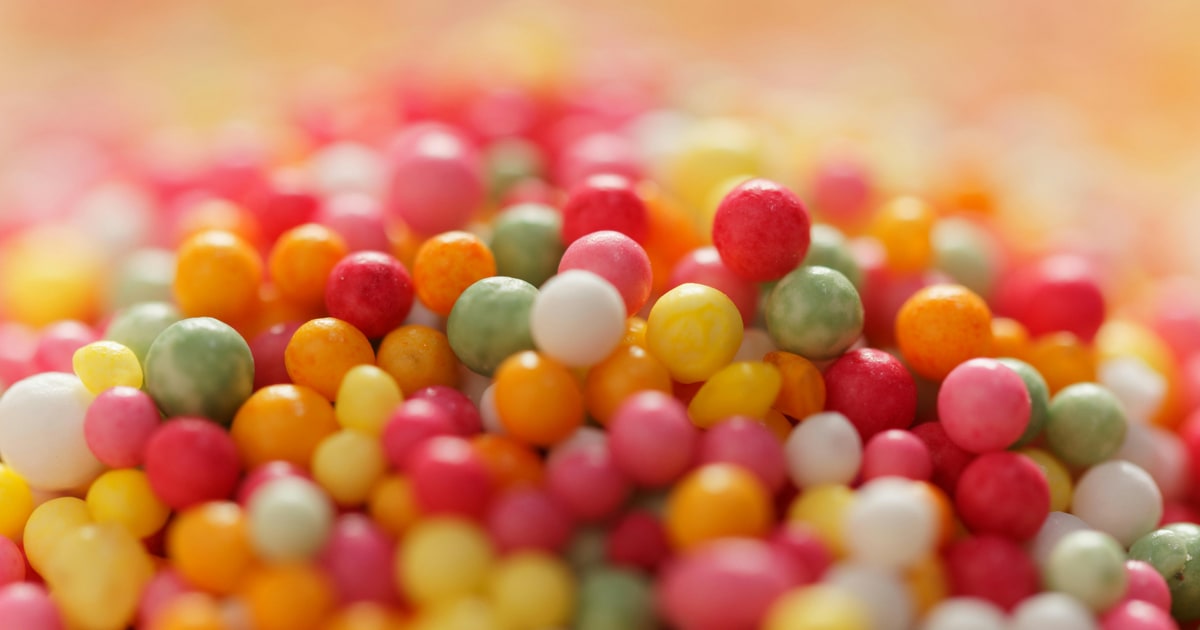
The shiny, glass-like surface on a jelly bean is not just aesthetically pleasing — it is functional. It prevents the sweets from sticking together, protects them from moisture, and gives that satisfying crack when you bite through it. That glossy finish most often comes from E904: shellac. And shellac comes from insects.
What Shellac Is and Where It Comes From
Shellac is a natural resin secreted by the female lac insect (Kerria lacca, formerly Laccifer lacca), a scale insect native to South and Southeast Asia. The insects live on host trees and produce the lac resin as a protective casing for their eggs. Harvesting shellac involves scraping this resin from the tree branches.
The raw lac resin is then processed — washed, filtered, and refined — to produce dewaxed shellac flakes, which can be dissolved in alcohol to create the liquid shellac glazing agent used in food and pharmaceutical applications.
Shellac has been used in food glazing for over a century. It was one of the first natural food glazing agents, predating synthetic alternatives. Today it is used in food production primarily as a glazing agent (to create a shiny surface) and as a coating agent in pharmaceuticals.
The Distinction Between Shellac and Carmine
When discussing insect-derived food additives, E120 (carmine) and E904 (shellac) are often mentioned together, but they involve a different relationship to the insect:
- E120 (carmine) — extracted from the dried and crushed bodies of cochineal insects. The substance is from the insect itself.
- E904 (shellac) — a secretion produced by the lac insect. The resin is secreted by the insect, not extracted from its body.
This distinction is theologically significant for some scholars, as Islamic jurisprudence treats secretions and body matter differently in some schools of thought. Honey is the paradigm case — bees produce honey as a secretion, and honey is explicitly mentioned as permissible in the Quran. Some scholars draw an analogy between honey and shellac on the basis that both are insect secretions rather than insect body matter.
The Scholarly Positions
The permissibility of shellac is genuinely debated, and credible scholars hold both positions:
Prohibition position — Many contemporary halal certification bodies and scholars prohibit shellac on the grounds that it derives from insects, and the general principle in Islamic food law is that insects are impermissible. The argument is that the source (an impermissible creature) renders the derivative product impermissible regardless of whether it comes from the body or a secretion. JAKIM (Malaysia’s Department of Islamic Development) and some South Asian scholarly bodies take this position.
Permissibility position — Some scholars permit shellac by analogy with honey. The reasoning is that Islamic law explicitly permits honey despite it being produced by bees, which are insects. The analogy holds that permissibility follows from the secretion being distinct from the insect body. Certain Middle Eastern halal standards have accepted this position.
The practical ruling for UK Muslim consumers — Most UK-based halal certification bodies, including the HFA and HMC, do not certify products containing E904 shellac. Avoiding shellac is therefore the conservative, unambiguous choice and the one that aligns with the guidance most accessible to Muslims in the UK.
Products That Commonly Contain E904 Shellac
Jelly Belly jelly beans — The most widely recognised case. Jelly Belly uses “confectioner’s glaze” on its standard jelly beans, which is a shellac-based coating. This is one of the most commonly discussed E904 examples in the halal food community. Jelly Belly does produce some products without shellac, but you need to check specific product lines.
Some chocolate-coated confectionery — The shiny outer shell on certain chocolate sweets and dragées (sugar-coated chocolates) uses shellac. Products like Raisinets and some generic chocolate-raisin products use this coating.
Some Haribo products — While Haribo’s UK porcine gelatine issue is the primary concern, some Haribo products in certain markets use shellac glazing. Always check the specific UK label.
Pharmaceutical tablets — This is one of the most widespread uses of shellac. Enteric-coated tablets (designed to resist stomach acid and dissolve in the intestine) are frequently coated with shellac. Extended-release medication coatings often use shellac. Vitamins, iron supplements, and many over-the-counter medications may use shellac in their coating. The label on medication will list it in the “inactive ingredients” or “excipients” section.
Some fresh fruit coatings — Shellac is approved for use as a coating on fresh fruit (apples, citrus, pears) to extend shelf life and improve appearance. This use is permitted in the UK and EU. The fruit will not have any label declaring the coating, though retailers are technically required to be able to provide information about food additives used on fresh produce.
Chocolate-covered nuts and raisins — Some of these products use shellac to give the chocolate coating its shine and to prevent the chocolates from sticking together in the bag.
How to Identify Shellac on Labels
Shellac appears under various names on food and pharmaceutical labels:
- E904 — the EU food additive number
- Shellac — the common name
- Lac resin — an alternative name
- Confectioner’s glaze — frequently used in US-origin products and on products sold in the UK
- Resinous glaze — another alternative
- Pharmaceutical glaze — used on medication labels
- Natural glaze — a vague term sometimes used
The term “confectioner’s glaze” is particularly important to recognise because it sounds innocuous and does not immediately suggest an insect connection. It is the primary way shellac is described on products imported from the United States, where this labelling convention is common.
Alternatives to Shellac Glazing
Several non-insect glazing agents are used in food production as alternatives to shellac:
- Carnauba wax (E903) — derived from the carnauba palm tree. Entirely plant-based and halal.
- Beeswax (E901) — derived from honeybees. Generally considered halal, though as with honey, some stricter standards require verification.
- Synthetic glazing agents — various synthetic waxes and coatings are also used.
When choosing sweets or confectionery, looking for products that list E903 (carnauba wax) rather than E904 (shellac) as their glazing agent is one way to navigate this issue.
Checking Medications
For medications, E904 shellac is genuinely difficult to avoid, as it has specific functional properties (particularly enteric coating) that are hard to replicate with alternatives in pharmaceutical applications. Most Islamic scholars recognise that medical necessity creates different rules than food choices, and many would permit medication use where shellac is unavoidable and no suitable alternative exists. This is a matter worth discussing with a scholar you trust, particularly for ongoing medication use.
E-Code Quick Reference
| E-Code | Name | Halal Status |
|---|---|---|
| E904 | Shellac | Debated (avoid by precaution) |
| E120 | Carmine/Cochineal | Haram (insect body-derived) |
| E903 | Carnauba wax | Halal (plant-derived) |
| E901 | Beeswax | Generally halal |
| E910 | L-Cysteine (old code) | See E920 |
If ruling out the glazed stuff leaves your sweet tin looking bare, that gap is easy to fill — our roundup of halal gummy sweets you can order online sticks to certified brands that avoid shellac and use carnauba wax or no glaze at all.
E904 shellac also appears in vitamin and supplement tablets as a tablet coating or glaze. For a full guide to E numbers hidden in supplements — including shellac, carmine, and magnesium stearate — see E Numbers in Vitamins and Supplements.
Ingredients change. Be first to know.
Brands reformulate without warning. We track every E-code update and halal certification — one short weekly email.
Related Articles
 E-Code Guides
 E133 Brilliant Blue FCF: Is This Food Dye Halal?
E133 Brilliant Blue FCF is halal — it's a synthetic petroleum-derived food dye with no animal components. But check what it's used in.
 E-Code Guides
 Is Propylene Glycol (E1520) Halal? The Flavour Solvent Explained
Propylene glycol (E1520) is halal. It is a synthetic diol made from petroleum-derived propylene oxide, contains nothing animal-derived and does not intoxicate. The word 'glycol' is not 'alcohol' in the fiqh sense. Where it does matter: as the carrier in flavourings that may also contain ethanol.
 E-Code Guides
 Is Sodium Citrate (E331) Halal? The Short Answer (2026)
Sodium citrate (E331) is a fully synthetic acidity regulator made from citric acid and sodium hydroxide. No animal source, no alcohol — halal across all four Sunni madhabs.