
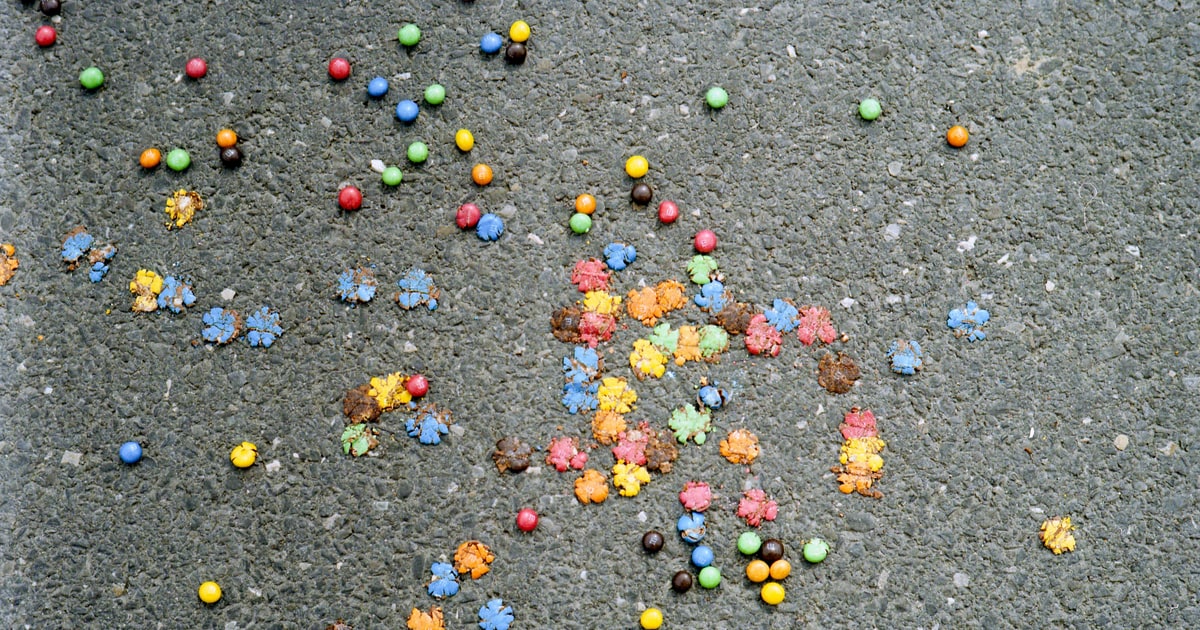
Are M&Ms Halal?
The M&M’s question used to hinge on gelatine. It doesn’t any more — Mars removed pork gelatine from UK M&M’s years ago. In 2026 the question hinges on a single word buried mid-way through the colours list on the back of the pack: carmine.
The verdict: UK M&M’s are best avoided — the current plain milk chocolate ingredient panel lists carmine (E120), an insect-derived colourant that the majority of Sunni scholars rule Haram. US M&M’s, which use synthetic dyes instead, are Mushbooh — no haram ingredient declared, but no certification either. And Gulf-market M&M’s are a different case again. Same brand, three different answers.
What Changed on the UK Label
Checked against current UK supermarket listings (July 2026), plain milk chocolate M&M’s list: sugar, cocoa mass, skimmed milk powder, cocoa butter, starch, whey permeate, milk fat, palm fat, glucose syrup, shea fat, gum arabic, dextrin, soya lecithin, colours (E100, carmine, E133, E160a, E160e, E170), and carnauba wax.
Two things stand out:
- Carmine is in the plain variant — not just red or seasonal lines, as older guides (including an earlier version of this one) assumed. Mars’s own FAQ notes red M&M’s contain a non-vegetarian colouring in European markets.
- The label says “Carmine”, not “E120”. If you scan for E-numbers you will miss it.
E120 is a red pigment made from dried cochineal insects. The majority ruling across the Hanafi, Shafi’i and Hanbali schools is that insects are Haram to consume — the ruling our E120 database page documents in full. Mars’s UK position matches the label: the company has stated UK M&M’s are “not suitable for a halal diet” because of animal-derived additives.
There is no gelatine in current UK M&M’s — that reformulation stands. The other colours in the shell (E133, E100 curcumin, E160 carotenes, E170 calcium carbonate) are mineral, plant or synthetic in origin and not the problem.
The US Version: Cleaner Label, Still Uncertified
US M&M’s take a different colour route: synthetic FD&C dyes — Red 40, Yellow 5 and 6, Blue 1 and 2 — with no carmine and no gelatine on the panel (checked against US retail listings, July 2026). That makes the American plain, peanut and Minis lines ingredient-cleaner than their UK equivalents.
They are still not halal: Mars’s FAQ states plainly that M&M’s are not certified halal or kosher, and undisclosed flavour carriers and supply-chain sourcing keep the US product at Mushbooh. Worth watching: US regulatory pressure to phase out synthetic dyes could push American formulations toward natural colourants — which is how carmine usually arrives. Re-check the panel each time.
Gulf, Malaysia and Indonesia
- UAE and Saudi Arabia — both operate halal import regimes: Saudi’s SFDA requires recognised halal certification for products containing animal-derived ingredients, and the UAE runs a national halal mark scheme. Mars has stated that where it produces halal-certified products, the packaging indicates it. In practice, M&M’s on Gulf shelves are covered by these regimes — but we found no published certificate for M&M’s specifically, so treat the halal mark on the pack as the deciding evidence.
- Malaysia — widely described as JAKIM-certified online, but we could not verify a JAKIM directory listing, and imported stock without the Malaysian halal logo circulates. Check for the logo on the specific pack.
- Indonesia — from 17 October 2026, imported food must hold BPJPH halal certification to stay on sale. Whether Mars certifies M&M’s for Indonesia or withdraws them will settle the question there.
The pattern matches what we see across confectionery: the same product name can be Haram in Manchester, Mushbooh in Chicago and halal-marked in Dubai. Our Malaysia gummy candy investigation and US candy audit show the same market-by-market splits.
Which Varieties Are Which?
| Variety | UK | US |
|---|---|---|
| Plain Milk Chocolate | ❌ Carmine on current panel | ⚠️ Mushbooh — synthetic dyes, no cert |
| Peanut | ❌ Same shell colour system | ⚠️ Mushbooh |
| Crispy / Minis (UK launch 2024) | ❌ Same colour system — verify your pack | ⚠️ Mushbooh |
| Fudge Brownie | — | ⚠️ Mushbooh — no gelatine or carmine on verified panels |
| Seasonal / limited editions | ❌ Check each — colour systems vary | ⚠️ Check each |
No 2024–2026 variant has reintroduced gelatine on either side of the Atlantic, based on the panels we checked.
Halal Alternatives
If you want the candy-shell chocolate experience with certification behind it: Zaini (halal-certified European chocolate), Choc-o-lait buttons, Nomo (vegan — no animal-derived colourants by definition), and the halal-labelled own-brand ranges in larger Tesco and Sainsbury’s stores. Our halal chocolate guide covers the wider aisle.
How we reached this verdict
We checked the following Tier-1 sources before publishing this update (July 2026):
- Current UK retail ingredient panels — Ocado’s live listing for M&M’s milk chocolate (carmine listed in colours); Tesco’s listing shows the same panel. No gelatine listed.
- Mars — the mms.com FAQ (“M&M’S are not certified as Halal or Kosher… they do not contain any pork-based ingredients”; red M&M’s noted as unsuitable for vegetarians in EU markets) and Mars’s statement to UAE press that UK M&M’s are not suitable for a halal diet, while halal-certified products are indicated on packaging.
- US retail panels — CVS/Walmart listings for plain and Fudge Brownie M&M’s: FD&C synthetic dyes, no carmine, no gelatine.
- Regulatory context — SFDA halal-certification requirements for imported food with animal-derived ingredients; UAE MoIAT halal mark scheme; Indonesia’s BPJPH deadline for imported products (October 2026).
- Sunni fatwa on E120 — Darul Iftaa rulings that carmine is impermissible to consume (insects as khaba’ith), consistent with our E120 database verdict.
Halal-status blogs claiming M&M’s are “IFANCA/ESMA certified” in Gulf markets provide no certificate numbers and are not treated as evidence here.
Madhab note
The E120 verdict is school-divergent. The Hanafi, Shafi’i and Hanbali schools rule insects (other than locusts) Haram to eat, making carmine impermissible — the majority position we publish. The Maliki school permits eating insects if not harmful, under which carmine would be acceptable; a few contemporary scholars also argue for permissibility. Muslims following the Maliki position may reach a different conclusion on UK M&M’s; on the majority position, they are to be avoided.
Summary
| Question | Answer |
|---|---|
| UK M&M’s | Avoid — carmine (E120) on the current plain milk chocolate panel; no certification |
| US M&M’s | Mushbooh — synthetic dyes, no gelatine, but not certified |
| Gulf M&M’s | Halal import regimes apply — look for the halal mark on the pack |
| Gelatine | Removed from UK formulation; none found in current US or UK panels |
| Certified alternatives | Zaini, Choc-o-lait, Nomo, supermarket halal-labelled ranges |
Want the chocolate without the carmine question hanging over it? Our ranked guide to chocolate we’ve checked to the certificate rather than the label sticks to brands whose certification we could actually trace.
Standing in the sweets aisle with something else? Look the additive up in our E-codes database or scan the label with the ingredient checker.
Ingredients change. Be first to know.
Brands reformulate without warning. We track every E-code update and halal certification — one short weekly email.
Related Articles
 Shopping Guides
 Is Milka Chocolate Halal? Complete EU & UK Guide (2026)
Milka chocolate is Mushbooh — it contains E476 (PGPR) and E471 with undisclosed animal fat sources and no halal certification in UK or EU.
 Shopping Guides
 Is Biscolata Halal? Turkish Chocolate Brand Ingredients Checked
Biscolata is Mushbooh — the Turkish chocolate biscuit brand uses E471 with no halal certification for export markets, though Turkish production may meet local standards.
 Shopping Guides
 Is Terry's Chocolate Orange Halal? Ingredients Checked
Terry's Chocolate Orange is Mushbooh — it contains E476 (PGPR) with undisclosed glycerol source. No halal certification. The Dark version has the same concern.