
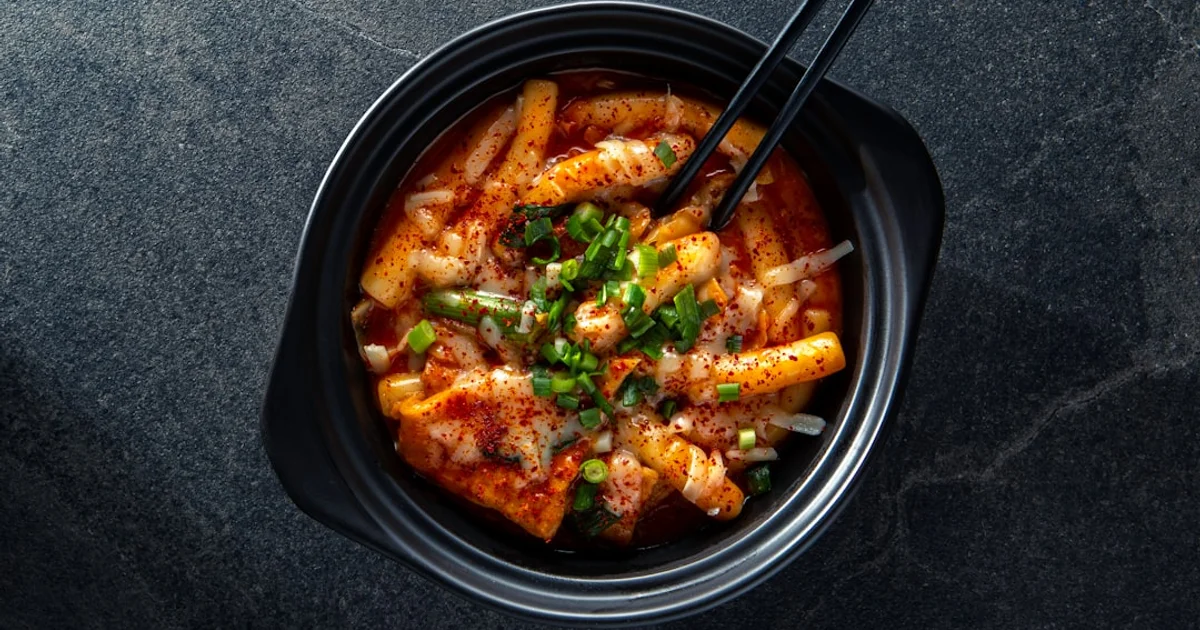
Tteokbokki — also transliterated as topokki — is Korea’s most recognisable street food: chewy rice cakes braised in a sweet-spicy sauce built on gochujang, usually with fish cake and a scattering of green onion. Strip it down to its core components and there’s nothing inherently haram about the dish. The risk sits in specific commercial ingredients, not the recipe itself.
The Core Recipe Is Halal by Design
Traditional tteokbokki is built from garaetteok (plain rice cake, made from rice flour, water, and salt), an anchovy or kelp broth base, gochujang (fermented red chilli paste), eomuk (Korean fish cake), sugar, and green onion. None of this requires Islamic slaughter to be permissible — mainstream Sunni scholarship across all four madhabs treats fish and seafood as halal without a slaughter requirement, which covers both the anchovy broth and the fish cake at the ingredient level. Rice cakes are a plain grain product with no animal content.
Where the Real Risk Sits
| Ingredient | Halal concern | Notes |
|---|---|---|
| Rice cake (garaetteok) | None | Plain grain product |
| Anchovy/kelp broth | None | Fish and seaweed, halal without slaughter requirement |
| Gochujang | Varies by brand | Traditional recipe has no alcohol; some commercial brands add alcohol or rice wine |
| Fish cake (eomuk) | Varies by brand | Fish itself is halal; processing line and additives vary by manufacturer |
| Sugar, green onion | None | Standard ingredients |
The two ingredients worth checking are gochujang and fish cake, and specifically the brand, not the dish concept. Traditional, home-fermented gochujang has no alcohol in its base recipe — chilli powder, glutinous rice, fermented soybean, and salt. Some mass-market commercial gochujang brands add alcohol as a preservative or incorporate rice wine during fermentation to adjust flavour and extend shelf life. Fish cake follows a similar pattern: the core ingredient (fish) is fine, but manufacturing lines, additives, and cross-contamination risk vary by producer.
How to Make Sure Your Tteokbokki Is Halal
- Check the gochujang jar’s ingredient list for “alcohol,” “rice wine,” or “mirin” before buying a specific brand.
- Look for halal-certified Korean gochujang and fish cake brands, increasingly available as Korean food halal certification (through KMF — Korea Muslim Federation) has expanded.
- If eating out, ask whether the restaurant uses a specific commercial gochujang brand, and whether their fish cake is made on a shared line with pork products.
- Making it at home gives you full control — a traditional recipe with verified halal gochujang and fish cake removes the guesswork entirely.
Summary
| Question | Answer |
|---|---|
| Is tteokbokki halal? | Core recipe yes — check the specific gochujang and fish cake brand |
| Does gochujang contain alcohol? | Not traditionally, but some commercial brands add it — check the label |
| Is the fish cake halal? | Fish itself is halal; processing and additives vary by brand |
| Safest option | Homemade with verified ingredients, or KMF-certified Korean brands |
Look up any E-code from a packaged product in the E-codes database.
To scan a full ingredient list for halal status in seconds, use the ingredient scanner.
How we reached this verdict
We checked the following Tier-1 sources before publishing this verdict:
- Recipe and ingredient sources: standard tteokbokki recipes confirm the core ingredients (rice cake, anchovy/kelp broth, gochujang, fish cake) with no alcohol in the traditional base recipe.
- Consumer reporting on commercial gochujang: multiple sources confirm that some store-bought gochujang brands are flagged as not halal by home cooks and halal-food communities, without a single consistent industry-wide standard.
- Sunni fatwa scholarship across the four madhabs: fish and seafood are halal without requiring Islamic slaughter under all four Sunni madhabs; alcohol as a named or disclosed preservation/fermentation ingredient in a specific brand’s gochujang is Haram under unanimous Sunni scholarship when present.
Madhab note
The four Sunni madhabs broadly converge on the rules applied in this guide:
- Fish and seafood without Islamic slaughter — halal across Hanafi, Maliki, Shafi’i, and Hanbali rulings; some Hanafi scholars distinguish specific sea creatures beyond fish, not a concern for the eomuk/anchovy components here.
- Alcohol used in fermentation or as a preservative in a specific commercial product — Haram across all four madhabs where confirmed present as a named ingredient; the traditional recipe itself carries no such concern.
If your madhab differs on any of these specifics, consult a competent scholar in your tradition for a binding ruling.
Ingredients change. Be first to know.
Brands reformulate without warning. We track every E-code update and halal certification — one short weekly email.
Related Articles
 Food & Ingredients
 Is Trader Joe's Vanilla Bean Paste Halal? The Alcohol Question Explained
Both Trader Joe's Vanilla Bean Paste and the Bourbon version contain ethyl alcohol from the concentrated vanilla extract. Here's why that's Mushbooh rather than a clean Halal, and what changes when it's baked.
 Food & Ingredients
 Is Piaren Ah Manuk Halal? Sabah's Grated Coconut Chicken Curry Explained
Piaren Ah Manuk is a chicken curry from Sabah's Iranun and Bajau communities, made with a rempah spice paste, grated coconut, and coconut milk. Here's why it's halal and where to find it in Malaysia.
 Food & Ingredients
 Is Shallot Halal? Raw Shallots vs Crispy Fried Shallot Products (2026)
Raw shallot is a plain vegetable with no halal concern at all. Packaged crispy fried shallots are usually clean too — shallots and palm oil — but check for animal-derived flavour powders on specific brands.