
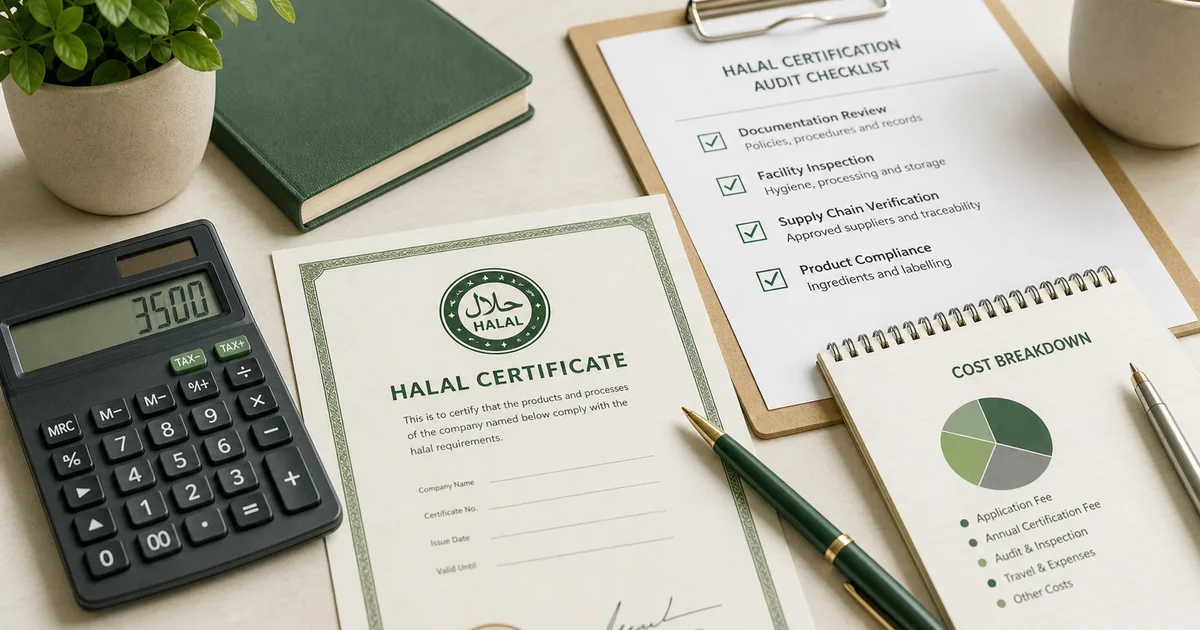
Cost is the first question food businesses ask — and the most opaque to answer. Certifying bodies in the UK, US, and Australia rarely publish price lists. Fees are negotiated based on business size, product scope, and whether travel is required for audits. This creates a frustrating information gap for businesses trying to budget before they commit to an application.
This guide cuts through that opacity. The figures below are best used as budgeting bands, not as published tariffs. In most cases, official certifier websites direct applicants to contact them for an individual quote rather than publishing a stable fee schedule. Your actual cost will depend on scope, complexity, and whether the body you need is recognised by your buyer or target market.
At a Glance
Typical starting point
Small restaurant or catering scopes can begin in the low hundreds per year; manufacturers usually start higher.
Biggest cost drivers
Number of product lines, number of facilities, export recognition requirements, and audit travel.
Most important question
Which certifier does your buyer or target market actually recognise?
Usually negotiable
Multi-year terms, phased product scope, travel timing, and bundled multi-site audits.
Best first action
Define exactly which products, sites, and markets need to be included before you request quotes.
| Topic | Summary |
|---|---|
| Typical starting point | Small restaurant or catering scopes can begin in the low hundreds per year; manufacturers usually start higher |
| Biggest cost drivers | Number of product lines, number of facilities, export recognition requirements, and audit travel |
| Most important question | Which certifier does your buyer or target market actually recognise? |
| Usually negotiable | Multi-year terms, phased product scope, travel timing, and bundled multi-site audits |
| Best first action | Define exactly which products, sites, and markets need to be included before you request quotes |
The Three Cost Components
Every halal certification programme has three potential cost elements. Not all apply to every applicant, but you should budget for all three.
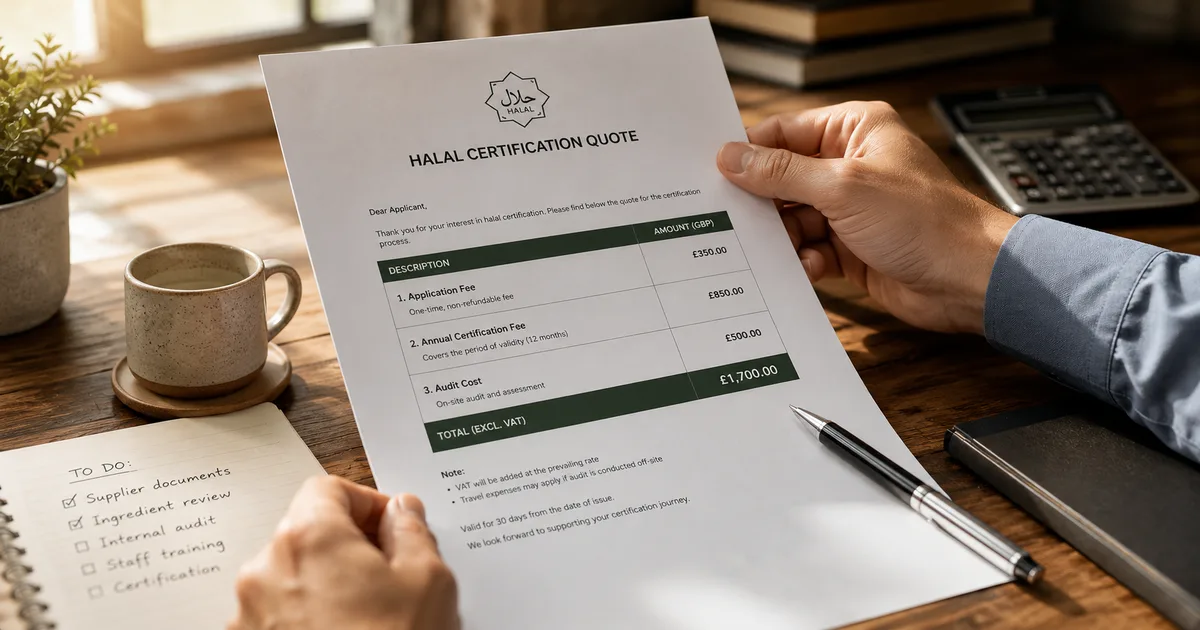
1. Application fee (one-off): Payable at initial application. Typically £50–£500, depending on the body. This covers administrative processing and is not refunded if certification is denied.
2. Annual certification fee: The main recurring cost. Paid annually for the right to hold the certificate and use the body’s logo. This is the figure that varies most by business type.
3. Audit costs: Either included in the annual fee (common for smaller businesses) or charged separately. Separate audit fees typically reflect auditor day rates (£200–£600 per day in the UK) plus travel and accommodation if the facility is not local.
UK Cost Breakdown
The two principal UK certifying bodies — HFA (Halal Food Authority) and HMC (Halal Monitoring Committee) — both operate fee structures that scale with business complexity. HFCE (Halal Food Council of Europe) and other bodies operate in the UK market as well. Public fee schedules remain limited, so the bands below should be treated as planning ranges rather than official tariffs.
Small independent restaurant
1 site
Estimated annual cost: £200–£600
Typical body: HFA
Small restaurant with HMC certification
Estimated annual cost: £600–£1,500
Typical body: HMC
Restaurant group or chain
3–10 sites
Estimated annual cost: £1,000–£3,000
Typical body: HMC or HFA
Small food manufacturer
1–5 product lines
Estimated annual cost: £500–£2,000
Typical body: HFA or HMC
Mid-size food manufacturer
10–30 lines
Estimated annual cost: £1,500–£4,000
Typical body: HMC, HFA, or HFCE
Large food manufacturer
50+ lines, multi-site
Estimated annual cost: £3,000–£8,000+
Typical body: HMC, HFA, IFANCA
| Business type | Estimated annual cost | Typical body |
|---|---|---|
| Small independent restaurant (1 site) | £200–£600 | HFA |
| Small restaurant with HMC certification | £600–£1,500 | HMC |
| Restaurant group or chain (3–10 sites) | £1,000–£3,000 | HMC or HFA |
| Small food manufacturer (1–5 product lines) | £500–£2,000 | HFA or HMC |
| Mid-size food manufacturer (10–30 lines) | £1,500–£4,000 | HMC, HFA, or HFCE |
| Large food manufacturer (50+ lines, multi-site) | £3,000–£8,000+ | HMC, HFA, IFANCA |
These ranges include the annual audit for smaller businesses. Larger manufacturers with multiple sites should expect audit costs to be quoted separately.
What drives you to the higher end of each range:
- Multiple production facilities requiring separate audits
- Products requiring ingredient-level supplier verification across complex supply chains
- Export requirements (certification to JAKIM or BPJPH standards requires additional documentation)
- Unannounced audit requirements (HMC requires these for its higher-tier certifications)
US Cost Breakdown
US halal certification has a wider range of certifiers than the UK, but one pattern is consistent: most bodies quote by scope rather than publishing a single tariff. The most dependable way to budget is by business profile, not by assuming a public fee card.
Small domestic-only food business
Indicative annual budget: $500–$2,000
Notes: Best fit for a narrow product range and local or domestic buyer recognition needs.
Export-focused manufacturer
Indicative annual budget: $1,500–$5,000+
Notes: Common where a more widely recognised certifier is needed for import-market acceptance.
Multi-site or complex-scope operator
Indicative annual budget: $3,000+ and often quote-based
Notes: Multiple facilities, more formulations, or institutional requirements tend to push pricing upward.
| Business profile | Indicative annual budget | Notes |
|---|---|---|
| Small domestic-only food business | $500–$2,000 | Best fit for a narrow product range and local or domestic buyer recognition needs |
| Export-focused manufacturer | $1,500–$5,000+ | Common where a more widely recognised certifier is needed for import-market acceptance |
| Multi-site or complex-scope operator | $3,000+ and often quote-based | Multiple facilities, more formulations, or institutional requirements tend to push pricing upward |
For US businesses, the cost question is closely tied to recognition. Export-oriented businesses often pursue certifiers with stronger international acceptance, while domestic-only businesses may be able to work with a more limited-scope body at a lower entry cost.
What usually pushes US costs upward:
- Export-oriented certification where recognition outside the US matters
- Larger product ranges with multiple formulations
- Multi-state or multi-site operations
- Institutional or military procurement requirements needing tighter documentation
Australian Cost Breakdown
Australian halal certification is heavily shaped by the export sector, especially meat and higher-volume supply chains. As in the US, public online tariffs are limited, so the most defensible approach is to budget by export exposure and operational complexity.
Domestic small to mid-size packaged-food operation
Indicative annual budget: AUD $600–$1,500
Notes: Typical where scope is limited and export-meat complexity does not apply.
Export-oriented food manufacturer
Indicative annual budget: AUD $800–$3,000+
Notes: Recognition requirements for Malaysia, Indonesia, or GCC markets often push the budget higher.
Meat or high-complexity export operation
Indicative annual budget: Often above AUD $3,000 and quote-based
Notes: Shared infrastructure, export compliance, and slaughter oversight can materially increase cost.
| Business profile | Indicative annual budget | Notes |
|---|---|---|
| Domestic small to mid-size packaged-food operation | AUD $600–$1,500 | Typical where scope is limited and export-meat complexity does not apply |
| Export-oriented food manufacturer | AUD $800–$3,000+ | Recognition requirements for Malaysia, Indonesia, or GCC markets often push the budget higher |
| Meat or high-complexity export operation | Often above AUD $3,000 and quote-based | Shared infrastructure, export compliance, and slaughter oversight can materially increase cost |
What usually pushes Australian costs upward:
- Export certification for meat, poultry, or prepared foods
- Destination-market recognition requirements
- Site complexity, especially where halal and non-halal lines share infrastructure
- Documentation burdens tied to export and government-recognised schemes
What You Can Usually Negotiate
Not every part of a halal certification quote is fixed. The certifier’s standard still has to be met, but the commercial structure around it often has room to move.
You can often negotiate:
- Phased scope — certifying the core products first instead of every SKU at once
- Multi-year agreements — some bodies discount longer commitments
- Audit timing — aligning inspections with existing production schedules to reduce wasted auditor time
- Bundled site pricing — especially where multiple facilities operate under one group
- Travel-heavy audit costs — if you can cluster audit work efficiently
You usually cannot negotiate:
- The underlying audit standard
- Documentation requirements
- Export recognition rules imposed by destination markets
- Renewal and surveillance requirements once the scope is approved
The most effective cost lever is usually not aggressive price negotiation. It is preparation. A business that turns up with clean supplier files, stable formulations, and a clearly defined scope almost always gets through the process faster and more cheaply than one that asks the certifier to untangle the complexity for them.
What Affects Your Price
When a certifying body quotes you a fee, these are the variables they are pricing:
Number of product lines in scope: Each product line added to the certification scope increases documentation requirements and audit complexity. Some bodies charge per-product-line fees on top of the base annual rate.
Number of facilities: Each production site, warehouse, or storage facility within the scope requires its own audit. Multiple sites mean multiple audit visits.
Local vs travel audit: If your facility is within easy distance of the certifying body’s auditors, the audit cost is absorbed. Remote facilities incur travel and accommodation costs that are either passed through directly or built into the quote.
Export requirements: Certification that needs to satisfy JAKIM (Malaysia), BPJPH (Indonesia), or GCC requirements involves additional documentation and may require the certifying body to hold a recognised mutual agreement with those authorities. This adds cost.
Annual vs multi-year agreements: Some bodies offer slightly reduced rates for two- or three-year commitments. This is worth asking about, but weigh it against the inflexibility if your product range changes significantly.
Complexity of your supply chain: A manufacturer using exclusively certified halal ingredient suppliers is faster to audit than one whose supply chain requires ingredient-level investigation. Your pre-application preparation (see how to get halal certification) directly affects audit time and therefore cost.
Is Halal Certification Worth the Cost?
The UK Muslim consumer market is estimated at over £20 billion annually. The global halal food market exceeds $2 trillion. These are not niche figures.
For most food businesses, the return calculation is straightforward:
- Channel access: Halal retailers, supermarket halal ranges, and specialist food service buyers often will not list uncertified products, regardless of how clean the formulation is.
- Buyer qualification: Certification reduces the time spent defending your halal claim buyer by buyer, tender by tender.
- Export readiness: Muslim-majority country exports are often blocked without recognised certification.
- Risk reduction: Certification gives your business an auditable framework rather than leaving halal claims to ad hoc internal judgment.
- Commercial positioning: In trust-sensitive categories, certification strengthens buyer confidence and can support premium placement.
The payback period for most small UK restaurants is weeks, not years — a single new contract with a halal food delivery platform or a catering event will typically recover the annual certification cost.
How We Reached This Verdict
Cost figures in this guide are based on: published certifier guidance where available; official certifier application and contact flows showing that many bodies quote individually rather than publish a tariff; direct scheme and market information from bodies active in the UK, US, and Australia; conversations with food businesses that have been through the certification process; and independent trade research on halal compliance and export access.
Treat every figure here as an indicative budgeting range, not a fixed tariff. Before you make a commercial decision:
- Ask the certifier for a written quote dated for your exact scope
- Confirm whether audit travel is included or billed separately
- Check whether export recognition for JAKIM, BPJPH, or GCC markets changes the fee
- Verify whether each additional site or SKU triggers a separate charge
That last step matters more than the headline number. Two businesses with the same turnover can receive very different quotes if one has a cleaner supply chain and narrower certification scope.
Common Questions
Is halal certification tax deductible?
In the UK, halal certification fees are generally treated as a legitimate business expense and deducted as a cost of trade. The same broad principle usually applies in the US and Australia where ordinary operating compliance costs are normally deductible. Tax treatment depends on your business structure and jurisdiction, so confirm the position with your accountant before relying on it.
Can a small business afford halal certification?
Usually, yes. Small UK restaurants and caterers can sometimes enter certification in the low hundreds per year, while small manufacturers usually budget higher. The main question is not only affordability, but whether the certifier is recognised by the buyers and markets you actually want to reach.
Is there a free halal certification option?
No credible third-party certifier runs a genuinely free halal certification scheme. Audits, documentation review, and annual surveillance all create real costs. Some bodies may offer introductory discounts or lighter pricing for very small businesses, but ongoing fees are part of legitimate certification.
How much does HMC certification cost?
HMC does not publish a universal flat-rate public tariff for every applicant. Costs depend on the business type, number of lines, audit complexity, and inspection requirements. In practice, restaurants and food service operators should expect an individually scoped quote, while manufacturers and meat processors should expect higher pricing where monitoring and operational complexity increase.
Next Steps
- Define which products, sites, and markets actually need to be covered.
- Shortlist certifiers based on buyer recognition, not just headline price.
- Build your quote request pack before you contact any body: product list, supplier declarations, facility count, and export targets.
Best follow-on reads for business users:
- Full process: step-by-step halal certification guide for businesses
- Certifier comparison: UK halal certification bodies compared
- Standard differences: HMC vs HFA — which UK body to choose
- Restaurant-specific budgeting and audits: halal certification for restaurants
Before asking for quotes, audit your formulation: Use the E-codes database to identify additives that may slow or block approval, and scan a product label if you need a faster first-pass check.
Halal Certification Hub
Need the bigger picture, not just this one article?
Browse the full halal certification hub for step-by-step guidance on costs, certification bodies, logos, audits, labelling, and international trade requirements.
Visit the certification hubIngredients change. Be first to know.
Brands reformulate without warning. We track every E-code update and halal certification — one short weekly email.
Partner with HalalCodeCheck
Reach halal-conscious buyers and food businesses at the moment they decide
Our audience uses HalalCodeCheck to verify ingredients, compare certification bodies, and choose products with confidence. That means you can reach both high-intent shoppers and serious food-business decision-makers across the UK, US, Canada, Australia, and Europe.
- Featured product & brand placements
- Certification guide sponsorships & category features
- Search, tool, and directory visibility
Sponsored placements and partnerships by arrangement
Related Articles
 Halal Certification
 Halal Certification for Restaurants: The Full UK Process (Step by Step 2026)
How UK restaurants get HMC or HFA halal certification — the full step-by-step process, supplier requirements, what inspectors check, and how much it costs.
 Halal Certification
 How to Get Halal Certification: Complete Guide for Food Businesses (UK, USA & Australia 2026)
Step-by-step halal certification process for food manufacturers, restaurants, and importers in the UK, USA, and Australia. Certifying bodies, costs, and audit requirements explained.
 Halal Certification
 Halal Food Labelling Law: UK, EU, US & Export Market Rules Compared (2026)
Halal is not a uniformly protected legal term across food markets. This guide compares UK, EU, US, and key export-market rules, what businesses must disclose, and what certification adds legally.