
Walk into a UK shop and you may see a green crescent, a bold green “HFA” mark, an unfamiliar overseas logo, or just the word “halal” with no certifier named. The real question is not whether the label sounds reassuring. It is which body stands behind it, what standard they apply, and whether you can verify the claim.
This guide focuses first on the bodies that actually certify halal products and premises in the UK. It also explains where organisations like the MCB fit in, because they appear in public halal discussions even though they are not packaging-level certifiers in the same sense as HMC or HFA.
At a Glance
HMC
UK certifier
Core distinction: No stunning, hand slaughter, continuous monitoring
Best use: Readers who require the strictest mainstream UK standard
HFA
UK certifier
Core distinction: Allows some reversible stunning and mainstream production models
Best use: Readers comparing broader UK supermarket and chain-restaurant certification
HFCE
European certifier
Core distinction: Appears on some imported European products sold in the UK
Best use: Checking export-oriented packaged goods
Halal Trust
Smaller UK certifier
Core distinction: Lower national recognition than HMC or HFA
Best use: Regional checks where the logo appears locally
MCB
Muslim umbrella body, not a certifier
Core distinction: Guidance and policy voice rather than packaging certification
Best use: Understanding public halal positions, not verifying a label claim
JAKIM / SANHA / IFANCA / MUI
International certifiers
Core distinction: Common on imported products sold in the UK
Best use: Verifying overseas brands and imports
| Body | What it is | Core distinction | Best use |
|---|---|---|---|
| HMC | UK certifier | No stunning, hand slaughter, continuous monitoring | Readers who require the strictest mainstream UK standard |
| HFA | UK certifier | Allows some reversible stunning and mainstream production models | Readers comparing broader UK supermarket and chain-restaurant certification |
| HFCE | European certifier | Appears on some imported European products sold in the UK | Checking export-oriented packaged goods |
| Halal Trust | Smaller UK certifier | Lower national recognition than HMC or HFA | Regional checks where the logo appears locally |
| MCB | Muslim umbrella body, not a certifier | Guidance and policy voice rather than packaging certification | Understanding public halal positions, not verifying a label claim |
| JAKIM / SANHA / IFANCA / MUI | International certifiers | Common on imported products sold in the UK | Verifying overseas brands and imports |
If you want the shortest practical rule: name the certifier, check the logo, and verify the listing on the certifier’s own site.
Key Logos You’ll See
HMC
Strict UK no-stunning certifier
HFA
Broader UK mainstream certifier

HFCE
European certifier seen on some imported goods
For imported products sold in UK halal shops or international aisles, you may also see JAKIM, IFANCA, SANHA, MUI, or Australian halal certification marks. Those logos matter too, but they reflect the certifier in the product’s origin market rather than a UK domestic body.
Why the UK Has Multiple Certifiers
Unlike some Muslim-majority countries with government-mandated national halal standards (Malaysia’s JAKIM, Indonesia’s BPJPH), the UK has no government body for halal certification. The Food Standards Agency oversees food labelling and safety but does not set or enforce halal standards.
This means the halal certification market operates privately. Any organisation can, in principle, offer halal certification. The result is a fragmented landscape where consumers must understand which bodies are credible, independent, and operate to standards that align with their religious requirements.
HMC — Halal Monitoring Committee
Founded: 2003, Leicester, UK
Logo: Green crescent with “HMC” text in white; “Halal Monitoring Committee” full text often present
Website: halalmc.com
Standard: Strictest mainstream UK standard
HMC was founded specifically to provide a stricter alternative to then-existing certification schemes. Their core standards:
No pre-slaughter stunning. HMC prohibits all electrical, mechanical, and gas stunning. This is their defining position — shared by no other major UK certifier at their scale.
Hand slaughter mandatory. Every animal must be slaughtered by hand by a trained Muslim slaughterman. Industrial mechanical poultry slaughter is not permitted.
Individual tasmiyah. Bismillah Allahu Akbar must be said for each individual animal, not once per shift or production run.
Continuous monitoring. HMC inspectors are physically present at certified production sites during slaughter — not just for periodic audits. This is the “Monitoring” in their name and distinguishes them from certifiers who rely on scheduled inspections.
Major brands and restaurants certified by HMC:
- Morley’s locations should be checked against the current HMC directory rather than assumed group-wide
- Selected Nando’s restaurant locations where HMC-certified supply is used
- Ayah Halal (online halal butcher)
- Various independent halal restaurants across Birmingham, Bradford, Manchester, London
Verification: HMC maintains a searchable supplier database at halalhmc.org — you can verify whether a specific business or product is currently certified. For packaged meat you can go one step deeper and check any UK meat pack’s slaughterhouse via the oval code against the HMC-certified list.
HFA — Halal Food Authority
Founded: 1994, UK
Logo: Green “HFA” text, sometimes with “Halal Food Authority” full text
Website: halalfoodauthority.com
Standard: Broader standard; mainstream industry friendly
HFA is the older of the two major certifiers and has achieved wider penetration with mainstream food businesses.
Reversible stunning permitted. HFA allows electrical water-bath stunning for poultry (at approved voltages) and non-penetrative captive bolt for cattle, provided the animal is confirmed alive at slaughter and the blood drains fully.
Mechanical poultry slaughter permitted. High-volume automated slaughter lines are permitted provided a Muslim operator and tasmiyah at line start.
Periodic audits. HFA conducts inspection visits but does not maintain continuous on-site presence in the same way as HMC.
Major brands and restaurants certified by HFA:
- KFC UK locations where halal-certified HFA supply is currently listed
- Subway UK (selected locations)
- Iceland halal lines where HFA-certified supply is used
- Various supermarket own-brand halal products
- Other mainstream chains or suppliers should always be checked against HFA’s current listing rather than older claims
Verification: HFA maintains a restaurant and product finder at halalfoodauthority.com.
Halal Trust
A smaller UK certifier operating primarily in certain regions. Less prominent than HMC or HFA in terms of national brand recognition. If you encounter a Halal Trust logo, research their current standards on their website before relying on it.
HFCE — Halal Food Council of Europe
Role: Certifier based in Belgium; certifies European-produced products for halal markets
Products: European-made food products exported to Muslim-majority markets; some sold in the UK
HFCE certifies products produced in various European countries. Their logo may appear on European-produced packaged goods sold in UK halal food shops and online retailers. HFCE standards permit some forms of stunning — check their published standards if this is relevant to your position.
International Certifiers Whose Logos Appear on UK Products
Several internationally recognised halal authorities certify products that are then sold in the UK:
JAKIM — Department of Islamic Development Malaysia
Malaysia’s national halal authority. JAKIM certification is government-backed and internationally recognised as a rigorous standard. Products from Malaysia carrying the JAKIM logo (a green circular design with “Halal” in Arabic and Latin script) are certified to Malaysian national halal standards. JAKIM prohibits stunning in the versions of their standard most relevant to UK product imports.
SANHA — South African National Halal Authority
South African certifier; their logo appears on South African food products sold in UK. SANHA is a credible certifier with internationally recognised standards.
MUI — Majelis Ulama Indonesia (Indonesian Ulema Council)
The Islamic scholars’ council in Indonesia. Their certification appears on Indonesian products and some international products. Indonesia now has the separate BPJPH government body, but MUI certification remains widely recognised.
IFANCA — Islamic Food and Nutrition Council of America
American certifier; logo appears on some US-produced products sold in UK. Their standards permit some forms of stunning in line with the majority scholarly position.
Halal Australia (HCA) — Halal Certification Authority, Australia
Australian certifier; appears on Australian exported products including halal meat and packaged goods.
MCB — Muslim Council of Britain
Role: Umbrella body for Muslim organisations; not a food certifier
Website: mcb.org.uk
The MCB represents the broad Muslim community in the UK, with over 500 affiliated organisations including mosques, schools, and charities. On halal food specifically, the MCB issues guidance and policy positions — for example, on school meals, hospital food, and labelling standards.
Critically: The MCB does not issue halal certification logos that appear on food packaging in the mainstream sense. If you see an MCB logo on a food product, understand that this is an endorsement or affiliation — not the same category of slaughter-site certification as HMC or HFA.
How to Verify Any Halal Claim
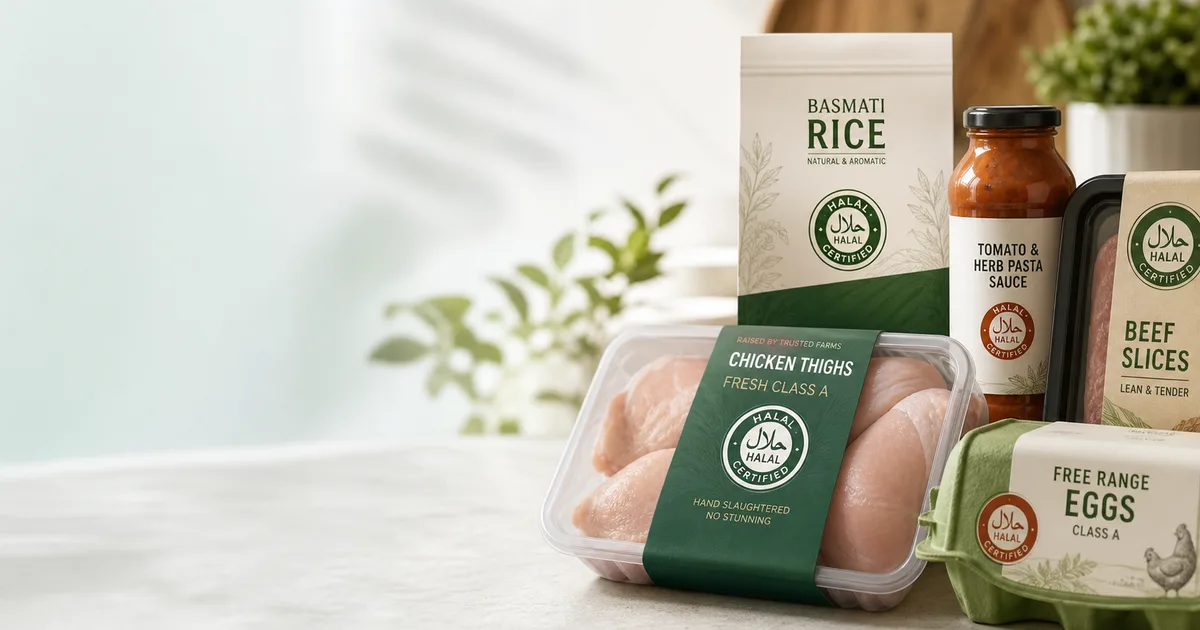
The rise of fraudulent or misleading halal claims is a documented problem in the UK food industry. Cases have been reported where businesses claim halal certification without it, use expired certifications, or display logos they are not entitled to use.
Verification steps:
- Identify the name of the certifying body — it should be printed clearly on the packaging
- Visit the certifier’s official website and use their business/product search function
- Search for the specific business name, product name, or certification number
- If you cannot find the business listed, the claim is not verified
Both HMC and HFA maintain online searchable databases specifically for this purpose. Use them first:
Red flags:
- “Halal” label with no named certifying body
- A certifier name that does not appear in any search results
- A certification logo that looks similar to HMC or HFA but is subtly different
- A restaurant claiming “we use halal meat” with no certifier named
Choosing Which Standard to Follow
The choice between HMC and HFA (and other certifiers) is ultimately a question of which scholarly position on stunning you follow:
- If you follow the opinion that any pre-slaughter stunning is impermissible → HMC
- If you accept reversible stunning under controlled conditions → HFA or equivalent
Neither position is fringe. Both represent genuine scholarly reasoning within the Islamic tradition. Consult your imam or trusted scholar if you want guidance specific to your school of thought and personal situation.
Common Questions
How many halal certification bodies are there in the UK?
The UK has multiple halal certification bodies operating independently. The two largest and most widely recognised are HMC and HFA. Smaller UK certifiers, European bodies, and mosque-linked or regional schemes also exist, which is why naming the certifier matters more than relying on the word “halal” alone.
Which halal certification is most trusted in the UK?
That depends on what standard you are trying to follow. HMC is widely seen as the strictest mainstream UK certifier because it prohibits stunning and uses continuous monitoring. HFA has broader mainstream business penetration and certifies many chains and packaged products. “Most trusted” is therefore partly a question of consumer confidence and partly a question of scholarly position on stunning.
Does the MCB certify halal food?
No, not in the same way as HMC, HFA, or other product and premises certifiers. The MCB is an umbrella organisation that issues guidance and public positions on halal-related issues, but it is not a mainstream packaging-level halal certifier whose logo readers should expect to use as a product-verification shortcut.
How We Reached This Verdict
This guide draws on the published standards, public directories, and explanatory material of HMC, HFA, HFCE, and other recognised certifiers that appear on UK products. It also reflects the practical distinction UK consumers must make between a real certifier, a regional or smaller certification logo, and a community body that discusses halal without acting as a packaging-level certifier. Chain and restaurant examples should always be treated as time-sensitive and verified against the certifier’s current listing.
Next Steps
If you are trying to act on this:
- For the HMC vs HFA decision: HMC vs HFA — which UK halal certification should you trust?
- For full business process and audits: How to get halal certification — the complete business guide
- For pricing and budgeting: Halal certification cost breakdown
- For the full cluster: Halal certification hub — all guides
Halal Certification Hub
Need the bigger picture, not just this one article?
Browse the full halal certification hub for step-by-step guidance on costs, certification bodies, logos, audits, labelling, and international trade requirements.
Visit the certification hubIngredients change. Be first to know.
Brands reformulate without warning. We track every E-code update and halal certification — one short weekly email.
Partner with HalalCodeCheck
Reach halal-conscious buyers and food businesses at the moment they decide
Our audience uses HalalCodeCheck to verify ingredients, compare certification bodies, and choose products with confidence. That means you can reach both high-intent shoppers and serious food-business decision-makers across the UK, US, Canada, Australia, and Europe.
- Featured product & brand placements
- Certification guide sponsorships & category features
- Search, tool, and directory visibility
Sponsored placements and partnerships by arrangement
Related Articles
 Halal Certification
 HMC vs HFA: Which UK Halal Certification Should You Trust? (2026)
HMC and HFA are the UK's main halal certifiers. This guide explains their key differences on stunning, slaughter method, and which restaurants and brands each certifies.
 Halal Certification
 Halal Certification Logos Explained: JAKIM, MUIS, IFANCA, HFA, HMC (2026)
What do JAKIM, MUIS, IFANCA, HFA, and HMC mean on food packaging? This guide shows the most important halal certification marks, explains what each body covers, and how to verify a logo is genuine.
 Shopping Guides
 Best Halal Meal Kits UK 2026 — Which Are Actually Certified
Most UK halal meal kit brands don't name a certifying body. We checked six directly — one names HMC, one admits its kitchen isn't certified, the rest are unverified claims.