
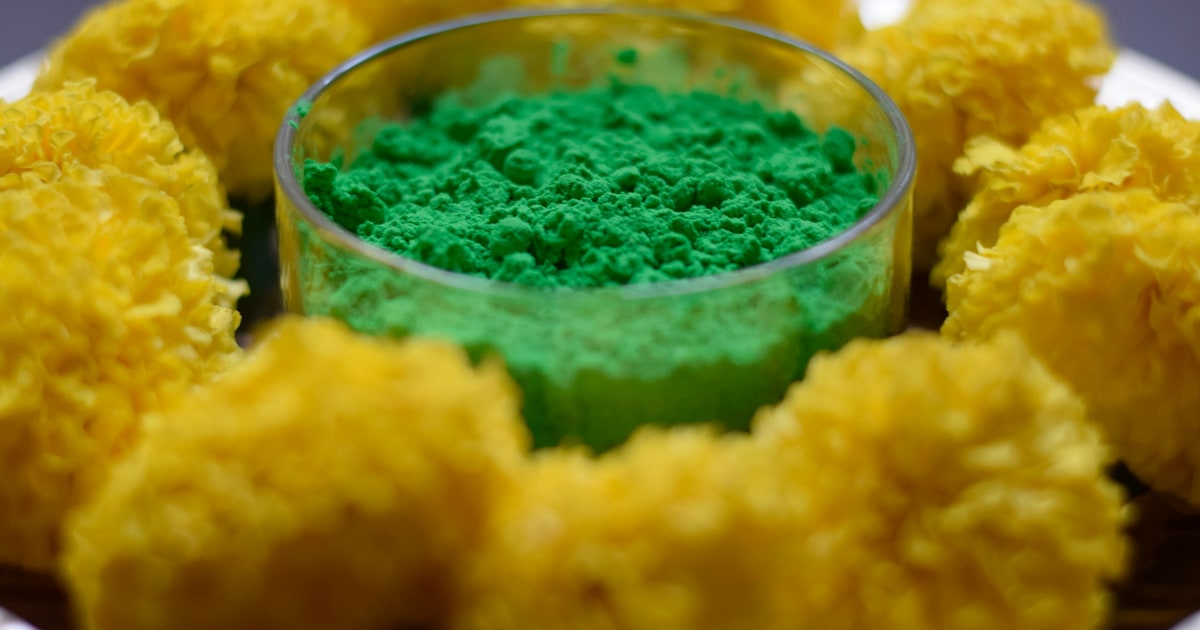
Walk through any confectionery aisle and you’re surrounded by an extraordinary palette of colours — violets, reds, yellows, greens, and every shade between. Each colour in manufactured food comes from somewhere, and for halal-conscious shoppers the critical question is: what exactly is that somewhere?
The good news is that food colouring is, by and large, a halal-safe category. The bad news is there is one major exception that catches many Muslims off guard precisely because it’s marketed as “natural.”
The Halal Status of Food Colourings: The Quick Answer
- Synthetic dyes (most colour E-codes): Halal — no animal derivatives
- Plant-derived natural colourings (turmeric, anthocyanins, beetroot): Halal
- E120 (carmine/cochineal): Haram — derived from insects
- E160a (beta-carotene): Mushbooh — check the carrier
Synthetic Dyes: All Halal
The majority of food colourings approved in the UK and EU are synthetic — manufactured through chemical processes from non-animal starting materials (typically petroleum derivatives). Despite their artificial origin, they are entirely halal because they contain no prohibited substances and are not derived from animals.
The “Southampton Six” — six artificial colours that must carry a warning label in the EU about potential effects on children’s activity and attention — are a source of concern for some parents, but all six are halal:
- E102 (Tartrazine) — yellow-orange; synthetic; Halal
- E104 (Quinoline Yellow) — greenish-yellow; synthetic; Halal
- E110 (Sunset Yellow FCF) — orange-yellow; synthetic; Halal
- E122 (Carmoisine/Azorubine) — red; synthetic azo dye; Halal
- E124 (Ponceau 4R) — red; synthetic azo dye; Halal
- E129 (Allura Red AC) — orange-red; synthetic; Halal
Natural Plant-Based Colourings: Generally Halal
The food industry has moved strongly toward “natural” colourings in response to consumer demand, and most natural alternatives are plant-derived and halal.
E100 — Turmeric (Curcumin)
Extracted from the rhizome of the turmeric plant (Curcuma longa). A well-known spice in South Asian and Middle Eastern cuisine. Halal.
E101 — Riboflavin (Vitamin B2)
Produced by microbial fermentation. Yellow-orange colour. Halal.
E102 — Tartrazine
Synthetic, as above. Halal.
E160b — Annatto
Extracted from the seeds of the Bixa orellana tree. Produces orange-yellow colour; used in cheddar cheese and butter. Halal.
E163 — Anthocyanins
Extracted from grape skins, elderberries, red cabbage, or purple sweet potato. Produces pink-to-purple shades. Halal.
E162 — Beetroot Red (Betanin)
Extracted from red beetroot. Deep red-purple colour. An excellent halal-friendly alternative to carmine in products where a natural red is desired. Halal.
E161 — Xanthophylls
Yellow pigments from plants and algae. Halal.
The Exception: E120 (Carmine) — Haram
E120 is the food additive code for carmine, also known as cochineal or carminic acid. Unlike the dyes above, E120 does not come from a plant — it is extracted from the crushed and dried bodies of the cochineal insect (Dactylopius coccus).
The cochineal is a scale insect farmed primarily in Peru, Bolivia, and the Canary Islands. Producing one kilogram of carmine requires approximately 70,000–100,000 insects. The insects are harvested, dried, and crushed, and the carminic acid is then extracted and processed into a stable red pigment.
Islamic dietary law prohibits the consumption of insects (with the exception of locusts). E120, being directly derived from insect bodies, is therefore haram.
It is also the most counterintuitive of haram ingredients for many shoppers, because:
- It is marketed as a “natural” colouring
- It replaced synthetic dyes that some consumers perceived as undesirable
- It produces an exceptionally vibrant, stable red that is hard to replicate
E120 appears on labels as: E120, Carmine, Cochineal, Carminic acid, CI 75470, Natural Red 4.
Commonly found in: strawberry and raspberry yoghurts, red and pink sweets, maraschino cherries, some beverages.
The Grey Area: E160a (Beta-Carotene)
E160a — Beta-Carotene occupies a more complex position than the others.
Beta-carotene itself is a naturally occurring pigment found in carrots, sweet potatoes, and many other orange-yellow plant foods. In its pure form, it is entirely plant-derived and halal.
The complication arises in how commercial beta-carotene is prepared for use as a food additive. Because beta-carotene is fat-soluble rather than water-soluble, it must be suspended in a carrier before it can be dispersed into food products. Some manufacturers prepare beta-carotene using:
- Vegetable oil carriers — halal
- Gelatin capsules or gelatin-based emulsions — mushbooh or haram depending on gelatin source
The label will simply say “E160a” or “beta-carotene” without specifying whether the carrier is gelatin-based. For products certified halal, this will have been verified. For uncertified products, it’s worth treating E160a as mushbooh and checking with the manufacturer if the product is consumed regularly.
The Caramel Colours: E150a-d
The four caramel colour additives (E150a, E150b, E150c, E150d) are produced by heating sugars. They contain no animal derivatives and are halal, though E150c and E150d use ammonia and/or sulfite compounds in their production process. These processing agents do not affect the halal status.
Complete Reference Table
| E-code | Name | Source | Halal Status |
|---|---|---|---|
| E100 | Curcumin (Turmeric) | Plant | Halal |
| E101 | Riboflavin | Fermentation | Halal |
| E102 | Tartrazine | Synthetic | Halal |
| E104 | Quinoline Yellow | Synthetic | Halal |
| E110 | Sunset Yellow | Synthetic | Halal |
| E120 | Carmine (Cochineal) | Insect | Haram |
| E122 | Carmoisine | Synthetic | Halal |
| E123 | Amaranth | Synthetic | Halal |
| E124 | Ponceau 4R | Synthetic | Halal |
| E129 | Allura Red | Synthetic | Halal |
| E131 | Patent Blue V | Synthetic | Halal |
| E132 | Indigotine | Synthetic | Halal |
| E133 | Brilliant Blue | Synthetic | Halal |
| E140 | Chlorophylls | Plant | Halal |
| E150a-d | Caramel colours | Heated sugar | Halal |
| E160a | Beta-Carotene | Plant (check carrier) | Mushbooh |
| E160b | Annatto | Plant | Halal |
| E160c | Paprika extract | Plant | Halal |
| E161 | Xanthophylls | Plant/algae | Halal |
| E162 | Beetroot Red | Plant | Halal |
| E163 | Anthocyanins | Plant | Halal |
Practical Guidance
When checking food colourings on labels:
- Look for E120 first — it’s the only commonly used food colour that is definitively haram. If it’s listed as E120, carmine, cochineal, or carminic acid, the product is not halal.
- E160a deserves a second look — particularly in soft gels, supplements, or products where a gelatin-based carrier seems plausible. If in doubt, contact the manufacturer.
- Everything else in the colour E-codes (E100–E163 range) is halal unless there is a specific reason to investigate further.
- Use HalalCodeCheck — scan the ingredient list with the app to flag any problematic E-codes automatically.
Summary
| Factor | Detail |
|---|---|
| Safe food colourings | Nearly all — E100, E101, E102, E104, E110, E122, E124, E129, E160b, E162, E163, and more |
| Haram food colouring | E120 (carmine/cochineal) — insect-derived |
| Mushbooh food colouring | E160a (beta-carotene) — check carrier |
| Key label names for E120 | E120, Carmine, Cochineal, Carminic acid, CI 75470 |
| Verdict | Food colourings are mostly halal — E120 is the major exception |
Ingredients change. Be first to know.
Brands reformulate without warning. We track every E-code update and halal certification — one short weekly email.
Related Articles
 E-Code Guides
 Is Propylene Glycol (E1520) Halal? The Flavour Solvent Explained
Propylene glycol (E1520) is halal. It is a synthetic diol made from petroleum-derived propylene oxide, contains nothing animal-derived and does not intoxicate. The word 'glycol' is not 'alcohol' in the fiqh sense. Where it does matter: as the carrier in flavourings that may also contain ethanol.
 E-Code Guides
 Is E471 in Baby Food Safe? What Muslim Parents Need to Know (2026)
E471 (mono- and diglycerides) appears in baby rusks, formula, and cereals. Source is rarely disclosed. This guide explains the halal status and which UK brands contain it.
 E-Code Guides
 E Numbers to Avoid for Children: Haram, Harmful and Questionable Additives (2026)
The E numbers children should avoid span two concerns: those that are haram and those with documented health effects. This guide covers both with a full list for parents.