
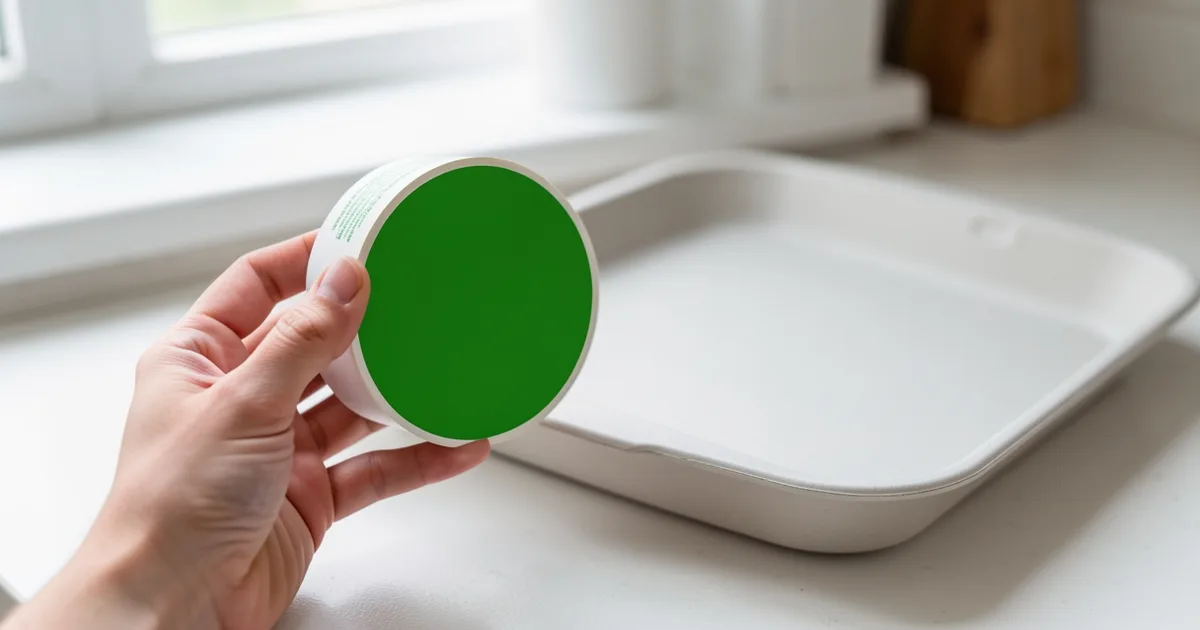
A roll of generic halal stickers is a labelling accessory. Anyone can stick it on anything, and it is not evidence that a product was ever assessed. A Reddit user on r/dubai recently flagged a Noon.com listing that appears to be a generic ‘Halal’ sticker roll for people to apply themselves. We could not confirm that the listing is still live.
The useful question for shoppers is not about one listing. It is how to tell a real halal claim from one that is simply printed or stuck on afterwards.
At a Glance
| Question | Short answer |
|---|---|
| Does a halal sticker prove certification? | No |
| Is the UAE National Halal Mark mandatory? | Optional, according to MoIAT |
| Who registers halal certifiers in the UAE? | MoIAT |
| Where do you check a certifier? | MoIAT’s registered halal certification bodies directory |
| Does the UAE scheme restrict unauthorised use of halal marks? | Yes |
What Was Flagged on Noon
The trigger was a post on r/dubai. Its title expressed shock at a Noon.com listing, and its caption describes a ‘Halal’ certification sticker roll that appears to be a generic sticker for consumers to apply to products themselves. The title and caption are all we have to go on. The content of the image in the post could not be read, so we cannot describe the listing’s wording, price or seller.
We also looked for a Noon UAE page titled ‘Generic Sticker Roll’. It said: “This product is not available.” That means we cannot verify the listing, and it may have been removed. We cannot see who bought such a roll or why, and we will not guess. Nothing here suggests wrongdoing by Noon or by any seller.
Who is affected
The people with something at stake are shoppers. If you buy food or other products that carry a peel-off halal sticker, the sticker alone tells you very little. It might have been applied by a producer with a valid certificate. It might have been applied by someone else. The sticker looks the same either way.
What to do now
- Treat a loose or added-on sticker as a claim, not as proof.
- Look for a certifier’s name and check it, using the steps below.
- If you are unsure about a product, ask the retailer for the certificate.
Why Stickers Like This Exist
Generic halal stickers are not unusual. Rolls are sold openly in other markets. Amazon UK search results include listings that describe 1,000 round halal labels per roll for food packaging, with permanent adhesive. A UK printer, Planglow, lists a halal roll sticker, also 1,000 per roll and made in the UK. It describes the round sticker as a way to “highlight products adhering to Islamic law”.
Those listings present the rolls as labels for food packaging or for highlighting products. We are not saying any seller of these rolls is misleading anyone.
The point for shoppers is narrower. Whatever wording is printed on a sticker, a sticker’s wording is not a certificate. A certificate comes from a certification body, covers a defined scope and carries dates. A roll of labels has none of those things.
What UAE Rules Say About Halal Marks
In the UAE, the halal system is run by the Ministry of Industry and Advanced Technology (MoIAT). Its halal programme page lists the legislation and standards behind it, including Board of Directors Decision 36 of 2014 on the national halal mark, UAE.S 2055-1 (general requirements for halal food) and UAE.S 2055-2 (requirements for halal certification bodies).
MoIAT describes the Halal National Mark as optional, but products that wish to stress Sharia compliance are required to obtain certification. So the absence of the National Mark is not by itself a red flag. What matters is who stands behind the claim.
The UAE scheme text, which refers to ESMA, is direct on misuse:
- It says labels shall carry the National Halal Mark or another halal mark approved by ESMA under mutual agreement with the country concerned.
- It says: “Any unauthorized use of halal certificate or halal mark, other than its intended purpose, is strictly prohibited.”
- It also strictly prohibits products bearing any other sign, slogan, label, mark, symbol, illustration or descriptive information indicating halal conformity that is not in accordance with the scheme.
On the certifier side, MoIAT publishes a list of approved accreditation bodies for halal, including ENAS, EIAC, UKAS, JAS-ANZ and GAC. It also publishes a Registered Halal Certification Bodies page. Entries show an issue date, an expiry date, a status, the fields covered and the accreditation body.
MoIAT’s Halal Service Directory is open data. It covers approved accreditation bodies, registered halal certification bodies and approved halal slaughterhouses, with status filters for Active, Expired and Suspended.
Third-party guidance points the same way. A summary on halalstandards.org says an unlabelled food, a halal claim, a halal certificate and the UAE Halal National Mark are different things. Another site, productregistrationuae.com, says a halal logo should only be used after formal approval and only for products, sites and processes covered by a valid certificate. It adds that an overseas certificate does not guarantee UAE acceptance, so the issuing body’s current MoIAT registration, scope, validity and product list must be checked. Both are secondary sources, and MoIAT’s own pages come first.
What each claim proves
| Claim on pack | What it proves | What to check |
|---|---|---|
| Loose or peel-off ‘Halal’ sticker | Nothing on its own | Who applied it; ask for the certificate |
| Printed ‘halal’ wording | A claim by the producer or seller | Whether a certifier is named |
| UAE Halal National Mark | A mark under the UAE scheme | The certificate behind it, with its scope and dates |
| Another certifier’s logo | A claim of certification by that body | The body’s current status on the MoIAT registered list |
| Overseas certificate | Certification by a foreign body | MoIAT registration, scope, validity and product list |
How to Check a Halal Claim Yourself
- Look for a printed mark on the original packaging. A mark printed on the pack is different from a peel-off sticker added afterwards, which could have been applied by anyone. Treat an added-on sticker as a claim to be checked.
- Identify the certifier named. Note the name of the body on the pack or certificate. If no certifier is named anywhere, you have a claim you cannot trace to a body.
- Check the certifier on the MoIAT registered certification bodies page. Look at the status, the issue and expiry dates, the fields covered and the accreditation body. Halalstandards.org advises checking MoIAT’s live directory rather than relying on a logo or an old certificate.
- For meat, check the slaughterhouse too. The halalstandards.org summary says to verify the processing or slaughter establishment separately in MoIAT’s approved halal establishment list. The Halal Service Directory includes approved halal slaughterhouses.
- Ask the retailer for the certificate. Check that it names the certifier, that its scope covers the product in your hand and that it is in date. If the retailer cannot supply one, you cannot confirm the claim.
- Raise doubts with the seller. As a general suggestion, contact the retailer’s help centre. Noon’s page lists help.noon.com and [email protected] for support.
These checks work for any halal claim, not just the one in this story.
Summary
| Question | Answer |
|---|---|
| Is a halal sticker the same as certification? | No. It is a label anyone can apply |
| Is the National Halal Mark compulsory? | Optional per MoIAT; certification is needed to stress Sharia compliance |
| What does the UAE scheme text say about misuse? | Unauthorised use of a halal mark or certificate is strictly prohibited |
| Where do I verify a certifier? | MoIAT’s registered halal certification bodies page and Halal Service Directory |
How We Reached This Verdict
This is not a verdict on any specific product, brand or seller. It explains how to judge a halal claim. We used these sources:
- Reddit post on r/dubai: used only as the trigger. Its title and caption flagged a Noon listing that appears to be a generic self-applied sticker roll. We took nothing else from it.
- Noon UAE page for a ‘Generic Sticker Roll’: shows the product as unavailable, so the listing could not be verified.
- MoIAT halal programme page: the Halal National Mark being optional, certification being required to stress Sharia compliance, and the list of legislation and standards.
- MoIAT registered halal certification bodies page and Halal Service Directory: what each entry shows, and the Active, Expired and Suspended status filters.
- MoIAT approved accreditation bodies for halal page: the accreditation bodies named above.
- UAE scheme text (PDF hosted on puntofocal.gob.ar): the label requirements and the prohibitions on unauthorised use.
- Amazon UK search results and Planglow’s halal roll sticker page: context on how similar rolls are sold in other markets.
Madhab note
This is a labelling and verification issue rather than a dispute between schools. Scholars do differ on questions such as stunning and source-ambiguous additives, but a halal claim that nobody can trace is a matter of trust whichever view you follow. This post does not rule on any product; for personal rulings, consult a competent scholar in your tradition.
Look up any E-code from a packet in the E-codes database.
To scan a full ingredient list for halal status in seconds, use the ingredient scanner.
Halal Certification Hub
Need the bigger picture, not just this one article?
Browse the full halal certification hub for step-by-step guidance on costs, certification bodies, logos, audits, labelling, and international trade requirements.
Visit the certification hubIngredients change. Be first to know.
Brands reformulate without warning. We track every E-code update and halal certification — one short weekly email.
Partner with HalalCodeCheck
Reach halal-conscious buyers and food businesses at the moment they decide
Our audience uses HalalCodeCheck to verify ingredients, compare certification bodies, and choose products with confidence. That means you can reach both high-intent shoppers and serious food-business decision-makers across the UK, US, Canada, Australia, and Europe.
- Featured product & brand placements
- Certification guide sponsorships & category features
- Search, tool, and directory visibility
Sponsored placements and partnerships by arrangement
Related Articles
 Halal Certification
US Halal Label Rules: What FDA and USDA Actually Require
The US has no federal halal definition or certification. A halal label is a private claim that must be truthful. Here is what FDA and USDA rules mean for you.
 Halal Certification
 in Australia: AFIC, ICCV, HCA and the Approved Bodies List (2026)
How halal certification works in Australia — the major certifiers (AFIC, ICCV, HCA), the government's export-only approval program, and how to verify any halal claim.
 Halal Certification
UK Halal Certification Bodies: HMC, HFA, HFCE and Other Logos Explained (2026)
Compare UK halal certification bodies and logos. HMC, HFA, HFCE, Halal Trust, MCB, and international certifiers explained — what they do, how standards differ, and how to verify claims.