
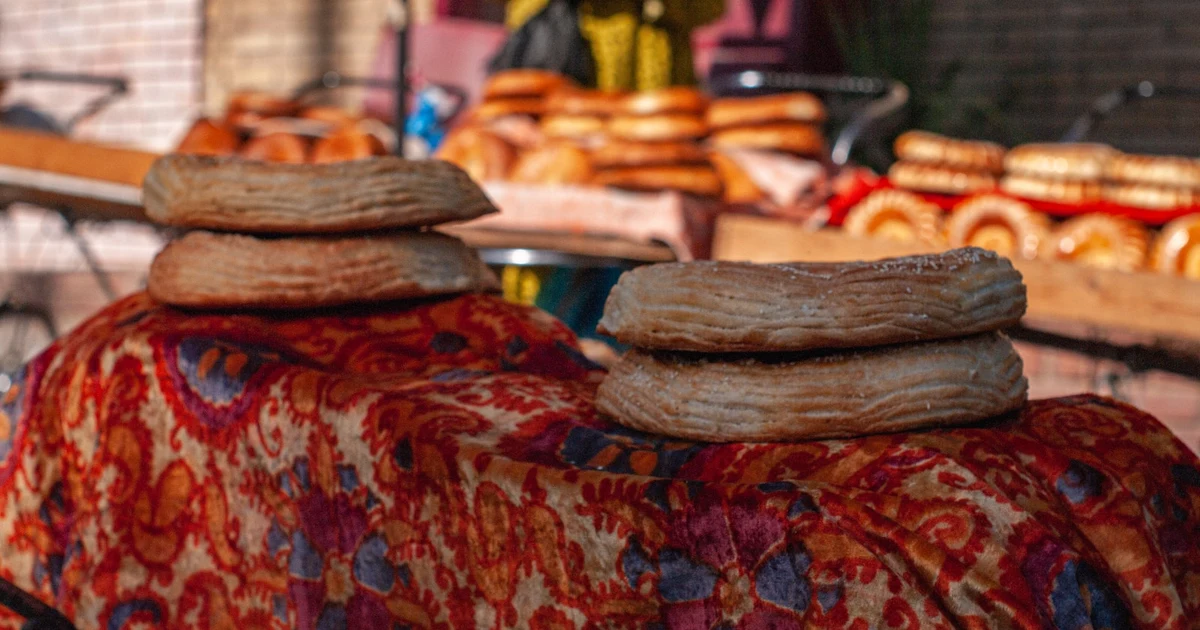
The short version: most food in Uzbekistan is halal by default — the country is around 90% Muslim, meat is slaughtered to Islamic norms, and pork is rare on mainstream shelves. The real work is checking imported products, where Russian, Turkish, Korean and European packaging can hide pork gelatine, carmine, alcohol or animal-derived emulsifiers.
Uzbekistan also now has an official Halal certification system: under Cabinet of Ministers Resolution No. 57 (1 February 2025), products certified to international standards may carry the “Halal” mark from 1 May 2025. This guide explains what that mark means, how to read the Russian-language labels you will see most often, and which E-codes deserve a second look.
Halal Certification in Uzbekistan
Until recently, Uzbekistan had no formal national halal scheme — food was simply assumed halal because the population is overwhelmingly Muslim. That changed in 2025. Here is the current framework:
| Element | Detail |
|---|---|
| Governing regulation | Cabinet of Ministers Resolution No. 57, 1 February 2025 |
| ”Halal” mark permitted from | 1 May 2025 |
| Standards-and-regulation body | Uzbek Agency for Technical Regulation (formerly Uzstandart; now O’ZTTSA / UZSTANDARD) |
| Religious oversight | Committee on Religious Affairs |
| Standard used | SMIIC (Standards and Metrology Institute for Islamic Countries), e.g. OIC/SMIIC 1 |
| International accreditation | First HAK-accredited (Turkey) Halal centre opened October 2025 |
What to look for: the official “Halal” mark on certified packaging. Because certification is voluntary, not mandatory, many perfectly halal local products carry no mark at all — so absence of the mark is not a red flag. The mark is most useful on processed and exported goods, where it confirms the producer has been independently audited against SMIIC standards.
Checking Imported Products — The Real Risk
The biggest halal trap in Uzbekistan is not local food; it is imports. Uzbek supermarkets stock a large volume of products from Russia, Turkey, South Korea, Kazakhstan and the EU, and many of these were never made with a Muslim market in mind.
Common import categories worth scrutinising:
- Russian and Kazakh confectionery, sausages and dairy — gelatine sweets, processed meats with pork content, alcohol in some flavourings.
- Korean and Chinese snacks and instant noodles — flavour enhancers, animal-derived broth powders, occasional pork fat.
- European chocolate, biscuits and yoghurts — emulsifiers (E471, E476), gelatine, carmine in pink/red products.
- Turkish goods — generally lower risk and often halal-certified, but still read the label.
A product being pork-free is not the same as halal. Gelatine and emulsifiers such as E471 can be derived from animal fat without any pork wording on the front of the pack. The ingredient list is the only reliable check.
How to Read a Russian-Language Label
Most packaging in Uzbekistan is printed in Russian and/or Uzbek. The ingredient list is the line you need. Look for the heading «Состав» (ingredients) and scan for these words:
| Russian | English | Halal concern |
|---|---|---|
| желатин | gelatine | Haram unless beef/halal-certified |
| свинина / свиной | pork / pork-derived | Haram |
| сало / свиной жир | lard / pork fat | Haram |
| кармин / кошениль | carmine / cochineal (E120) | Haram |
| спирт / этанол / алкоголь | spirit / ethanol / alcohol | Haram |
| эмульгатор Е471 | emulsifier E471 | Mushbooh (source unstated) |
| ароматизатор | flavouring | Mushbooh if source unstated |
Two more useful Russian phrases: «пригодно для вегетарианцев» (suitable for vegetarians) is a helpful proxy that rules out many animal-derived E-codes, and «халяль» is the Cyrillic spelling of the Halal mark you may see on certified goods.
E-Codes That Catch Shoppers Off Guard in Uzbekistan
E-codes are global, but a handful appear repeatedly on the imports common in Uzbek stores.
E441 — Gelatine (Haram unless certified)
E441 is the single most common issue on imported sweets, marshmallows, gummies and some yoghurts from Russia and Europe. Unless the label specifically says «говяжий желатин» (beef gelatine) with halal certification, treat it as pork-derived and avoid.
E120 — Cochineal / Carmine (Haram)
E120 is an insect-derived red colouring. It turns up in imported strawberry yoghurts, fruit drinks, sausages and pink sweets. On Russian labels it appears as кармин or кошениль.
E471 — Mono and Diglycerides of Fatty Acids (Mushbooh)
E471 is everywhere in imported baked goods, margarine, ice cream and chocolate. It is Mushbooh because the fat source is rarely stated. A vegetarian-suitable or halal mark on the same product confirms a plant source.
E476 — Polyglycerol Polyricinoleate (Mushbooh)
E476 appears in imported chocolate. It is usually plant-derived (castor oil) but Mushbooh because glycerol can come from animal fat. Prefer halal-certified chocolate.
E631 — Disodium Inosinate (Mushbooh)
E631 is a flavour enhancer common in imported Korean and Chinese instant noodles and snack seasonings. It is Mushbooh as it may be derived from meat or fish; pair it with a vegetarian or halal mark to be safe.
Where and How to Shop Halal in Uzbekistan
Local markets and butchers (lowest risk)
The traditional bazaars (bozor) — Chorsu in Tashkent, and local markets in every city — sell fresh meat slaughtered to Islamic norms, plus fruit, vegetables, bread (non) and dairy. This is the most reliable halal shopping there is, and it requires no label-reading at all.
Supermarkets (read the imports)
Chains such as Korzinka, Makro and Havas stock both local and imported goods side by side. Local own-brand and Uzbek-made products are low risk; the imported aisles (confectionery, sausages, snacks, sauces) are where you should apply the label checks above.
Restaurants and street food
Mainstream Uzbek cuisine — plov (osh), shashlik, lagman, samsa, manti — is halal by default. The rare exceptions are venues catering to tourists or non-Muslim communities that may serve pork or alcohol; these are usually clearly signposted.
How to Check Any Imported Product in 30 Seconds
- Look for the «халяль» / Halal mark. If present and from a certified producer, you are done.
- Find the «Состав» (ingredients) line. Scan for желатин, свинина, кармин, спирт.
- Note any E-codes and look up the ones you do not recognise (E441, E471, E476, E120, E631 are the usual suspects).
- Use «пригодно для вегетарианцев» as a fast proxy — it rules out most animal-derived E-codes.
- When unsure, check the E-code or scan the full list rather than guessing from the front of the pack.
Summary
| Question | Answer |
|---|---|
| Is local food in Uzbekistan halal? | Yes — ~90% Muslim country, meat slaughtered to Islamic norms, pork rare |
| What is the certification body? | Uzbek Agency for Technical Regulation (UZSTANDARD) + Committee on Religious Affairs |
| When did the Halal mark start? | 1 May 2025, under Resolution No. 57 |
| Where is the real risk? | Imported products (Russian, Korean, European) — gelatine, carmine, E471 |
| Best low-risk shopping? | Local bazaars and Uzbek-made products |
Look up any E-code from a Russian-language label in the E-codes database.
To scan a full ingredient list for halal status in seconds, use the ingredient scanner.
Travelling or shopping in another majority-import market? See our Halal Food in Canada guide for the same label-reading approach applied to Western retailers.
How we reached this verdict
We checked the following Tier-1 sources before publishing this guide:
- Uzbekistan government and regulators: Cabinet of Ministers Resolution No. 57 (1 February 2025); the Uzbek Agency for Technical Regulation (O’ZTTSA / UZSTANDARD, successor to Uzstandart) as the standards-and-certification authority; the Committee on Religious Affairs as religious oversight. Reported by kun.uz, HalalFocus and Food Compliance International.
- International standards bodies: SMIIC (Standards and Metrology Institute for Islamic Countries) — Uzbekistan is a member via UZSTANDARD, and the national scheme prioritises SMIIC standards (OIC/SMIIC 1). Turkey’s Halal Accreditation Agency (HAK) accredited Uzbekistan’s first internationally recognised Halal centre in October 2025.
- Sunni fatwa scholarship across the four madhabs for the E-code and ingredient rulings: IslamQA, Darul Iftaa Birmingham and AskImam (Hanafi-leaning); Dar al-Ifta al-Misriyyah and NU (Shafi’i/Maliki-leaning); Saudi Permanent Committee and IslamQA Saudi (Hanbali-leaning).
Madhab note
The four Sunni madhabs broadly converge on the rules applied in this guide:
- Pork-derived sources (pork gelatine, lard, свиной жир) — Haram across all four madhabs.
- Alcohol-based ingredients (спирт / этанол) — Haram across all four madhabs as an intoxicant.
- Source-ambiguous E-codes (E471, E476, E631) — manufacturer plant-source disclosure (a vegetarian-suitable label) is treated as sufficient under the Hanafi/Maliki/Shafi’i mainstream rule (Darul Ifta Birmingham, IslamQA case 245452); the HMC-strict / Hanbali-leaning view requires formal independent certification.
- Insect-derived dyes (E120 carmine/cochineal) — Hanafi, Shafi’i and Hanbali generally treat as haram; some Maliki scholars permit small insects.
If your madhab differs on a specific ruling, the relevant section above flags the school-specific position. For binding rulings on borderline products, consult a competent scholar in your tradition.
Ingredients change. Be first to know.
Brands reformulate without warning. We track every E-code update and halal certification — one short weekly email.
Related Articles
 Shopping Guides
 Halal Shopping at Coles: Aisle-by-Aisle Australia Guide (2026)
Coles stocks halal-certified meat from accredited abattoirs but own-brand packaged goods require E-code checking — here's what to look for in each aisle.
 Shopping Guides
 Halal Shopping at Carrefour: France, UAE & Turkey Guide (2026)
Carrefour's halal status varies by country — UAE stores stock certified halal products throughout, while French stores require label-by-label checking.
 Shopping Guides
 Halal Food in Saudi Arabia: Imported Brands & Label Guide (2026)
Saudi Arabia applies strict halal import standards — but expat workers and tourists still encounter label-reading challenges with imported packaged foods.