
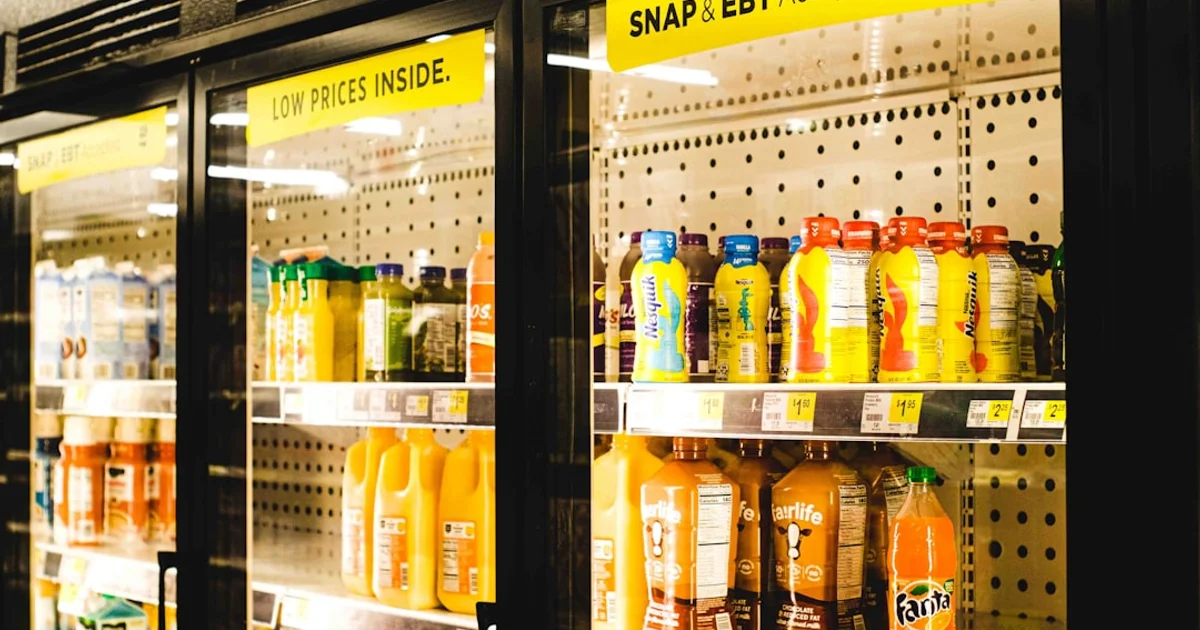
Egypt’s biggest halal drinks question has nothing to do with certificates. It is a green can. Birell — the malt drink poured at weddings, iftars and football matches — is made by a Heineken-owned brewery, tastes like beer, and is marketed as 0.0% alcohol. Whether it is halal is a genuine question of fiqh, not labelling, and the Egyptian fatwa authority has answered it.
This guide starts there, then covers the rest of the fridge: Fayrouz, the colas, the juices, and the one beverage company on Egypt’s own halal registry.
Birell and the Dar al-Ifta Ruling
Birell is produced by Al Ahram Beverages Company, which Heineken acquired in 2002. It is sold as a “non-alcoholic malt beverage” at 0.0% ABV; one third-party alcohol-content database lists a figure closer to 0.5%, which is the international threshold below which a drink may be labelled non-alcoholic. Al Ahram also brews Stella, an ordinary alcoholic beer, which is haram without discussion — the two are frequently confused abroad.
Dar al-Ifta al-Misriyyah, Egypt’s official fatwa body, addressed low-alcohol beer directly. Its reasoning distinguishes two ideas: istihala (a substance transformed so completely that its impure nature is gone) and istihlak (a concentration so negligible it has no effect). For beer-style drinks with negligible alcohol it applies the second: the Prophetic rule that “any beverage that intoxicates in large quantities is unlawful in small quantities” only bites where a large quantity would intoxicate. A drink that cannot intoxicate at any volume is permissible.
That makes Birell permissible under Egypt’s own fatwa authority — a position shared by Al-Azhar-aligned scholars and several Gulf muftis who have issued similar rulings on zero-alcohol beers.
The dissent is real too. Saudi-Salafi bodies and some Hanbali scholars advise avoiding beer-style drinks produced by brewing and de-alcoholisation, on two grounds: residual alcohol may exceed the “cannot intoxicate” bar, and imitating the form of khamr is disliked. If you follow that view, Fayrouz — below — is the cleaner choice.
Fayrouz: Malt Without Fermentation
Fayrouz (Al Ahram Beverages, launched 1997) is a sparkling flavoured malt drink — pineapple, apple, peach, raspberry. Its position is stronger than Birell’s: the brand states that its production avoids fermentation entirely, so no alcohol is produced and nothing needs removing. On composition it is malt extract, sugar, fruit flavouring and carbonated water.
That is a brand statement; we found no published third-party halal certificate for Fayrouz. But because the istihlak question doesn’t arise, Fayrouz is halal by composition under all four madhabs, and it is the drink the stricter view can accept where Birell is contested.
Coca-Cola, Pepsi and Spiro Spathis
The colas were settled in Egypt long before halal certification existed. In 1951 the Egyptian Department of Fatwas asked whether Pepsi and Coca-Cola were prohibited; the Ministry of Public Health examined both and found neither contained alcohol, narcotics or pepsin. Both are bottled locally today.
Standard Coca-Cola, Diet Coke, Coke Zero, Sprite, and Fanta Orange contain no animal-derived ingredients and are widely accepted as halal. Some red-coloured fruit-flavoured variants may contain E120 (cochineal) — check the label.
Full Coca-Cola brand guide →Pepsi, Diet Pepsi, and Pepsi Max contain no animal-derived ingredients and are generally considered halal. E150d (caramel colour) is plant-derived.
Full Pepsi brand guide →Spiro Spathis — Egypt’s first soda, established in Cairo in 1920 and now made by MYMCO — is a plain carbonated flavoured drink with no halal-relevant ingredient. Uncertified, halal by composition.
Juice: Juhayna and the EOS Registry
Egypt operates a national “Halal Mark” registry through the Egyptian Organization for Standardization (EOS). As our Egypt dairy guide found, Juhayna Food Industries — juices and dairy, founded 1983 — is the only dairy or beverage processor on it. Beyti (the Almarai/PepsiCo joint venture), Faragello and the smaller juice brands do not appear.
Absence from the registry is not a haram verdict: fruit juice, sugar and citric acid have no halal concern. It simply means Juhayna is the one juice brand whose halal claim is backed by Egypt’s own state mark rather than by composition alone.
Energy Drinks and Flavoured Milks
Energy drinks in Egypt are the international brands, and the verdicts travel with them:
Red Bull contains taurine, an amino acid that may be animal-derived or synthetic. Red Bull GmbH does not disclose the source on UK labelling, and no halal certification is held for UK products. Until taurine sourcing is confirmed or certification obtained, UK Red Bull is Mushbooh.
Full Red Bull brand guide →The E120 carmine question in red-coloured energy drinks is covered in our energy drinks guide. Flavoured milk drinks (Juhayna, Beyti, Almarai) fall under the dairy guide’s E471 reading rule.
Summary
| Question | Answer |
|---|---|
| Is Birell halal? | Permissible per Dar al-Ifta (negligible, non-intoxicating alcohol); stricter Saudi-Salafi view avoids |
| Is Fayrouz halal? | Halal by composition — brand states no fermentation; uncertified |
| Is Stella halal? | No — alcoholic beer from the same brewery |
| Coca-Cola / Pepsi in Egypt | Permissible since the 1951 Ministry of Health finding; see brand pages |
| Certified juice | Juhayna — the only beverage maker on the EOS Halal Mark registry |
Check any additive from an Egyptian label in the E-codes database, or scan the Arabic ingredient panel with the ingredient scanner. For alcohol in food more broadly, see Is Alcohol in Food Halal?.
How we reached this verdict
Sources checked September 2026:
- Dar al-Ifta al-Misriyyah: fatwa “Is it allowed to drink a beer which contains a very low percentage of alcohol” (dar-alifta.org) — istihala/istihlak reasoning and the non-intoxicating conclusion.
- Birell: Al Ahram Beverages product marketing (0.0% non-alcoholic malt beverage); Heineken’s 2002 acquisition of Al Ahram; third-party alcohol-content listing for the 0.5% figure.
- Fayrouz: brand and trade-show descriptions (launched 1997; production avoids fermentation). No certificate found.
- Colas: the 1951 Egyptian Ministry of Public Health finding on Pepsi and Coca-Cola; existing HalalCodeCheck brand verdicts rendered above.
- Juhayna / EOS registry: as documented in our Egypt dairy guide (EOS “Winning Mark — Halal Products” registry check).
- Spiro Spathis: company history (Cairo, 1920; MYMCO).
Madhab note
- Intoxicants (khamr) — haram in any quantity across all four madhabs.
- Negligible, non-intoxicating alcohol (istihlak) — permissible per Dar al-Ifta and the Hanafi/Shafi’i mainstream; the Hanbali/Saudi-Salafi view advises avoidance of beer-style drinks produced by brewing.
- Imitating the form of khamr — disliked (makruh) by some scholars even where the drink itself is lawful.
- Fruit juice, malt, carbonated water — no halal concern in any madhab.
For binding rulings, consult a competent scholar in your tradition.
Ingredients change. Be first to know.
Brands reformulate without warning. We track every E-code update and halal certification — one short weekly email.
Related Articles
 Shopping Guides
 Halal Chocolate in Switzerland: Lindt, Frey, Toblerone and the Liqueur Praline Problem
No mainstream Swiss chocolate bar carries halal certification, and Lindt says so itself. The real Swiss issue is alcohol: kirsch and Marc de Champagne fillings are a whole supermarket category. Swiss packs must warn you, which makes them easier to read than most.
 Shopping Guides
 Halal Beverages in Finland: What Muslim Consumers Need to Know (2026)
Most Finnish mainstream beverages — Hartwall, Karjala, Lapin Kulta — are alcoholic and Haram. Here is what Muslim consumers and tourists in Finland check when buying drinks, and where to find halal-safe options.
 Shopping Guides
 Halal Shopping at Coles: Aisle-by-Aisle Australia Guide (2026)
Coles stocks halal-certified meat from accredited abattoirs but own-brand packaged goods require E-code checking — here's what to look for in each aisle.