
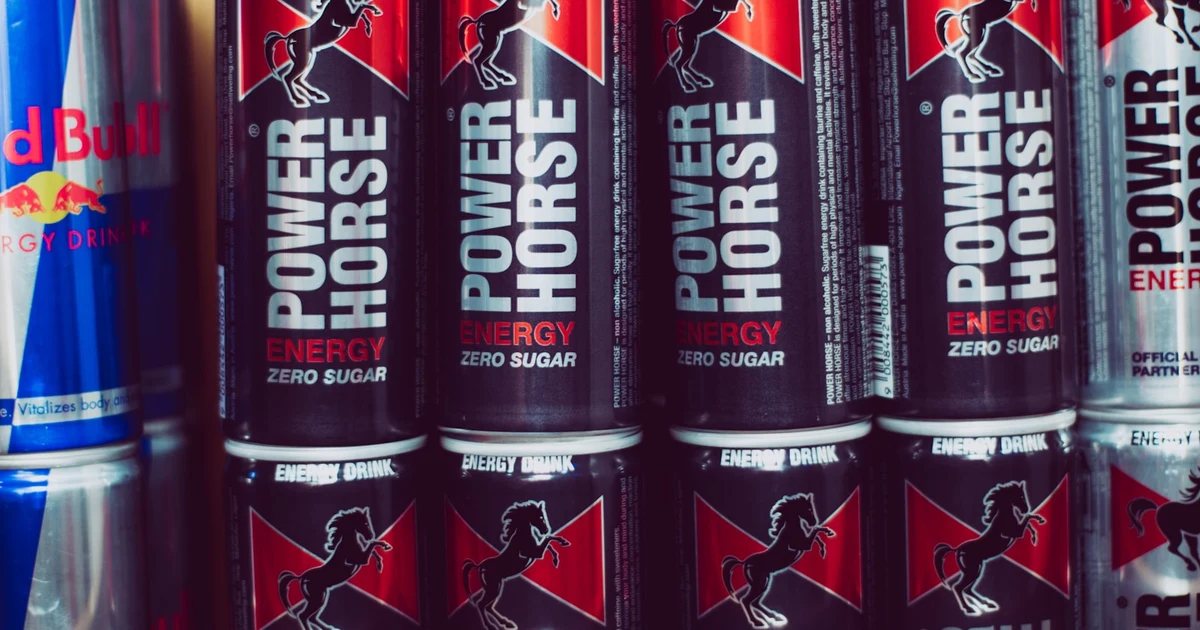
Energy drinks line entire supermarket fridges, and a significant number of them are consumed by Muslim teenagers and adults who assume they are halal. Some are. Some are not. The line between acceptable and unacceptable is often a single E-number buried in a long ingredients list.
The concerns with energy drinks fall into three categories: insect-derived colouring (E120), trace alcohol from fermentation flavourings, and flavour enhancers with ambiguous sources (E621 and E635).
The E120 Problem in Flavoured Energy Drinks
E120 is cochineal — a red dye made from crushed cochineal insects. It is Haram under all mainstream scholarly positions. It appears in food and drink products to produce red, pink, and orange shades.
The original, unflavoured versions of major energy drink brands do not contain E120. Red Bull Original, Monster Original, and Lucozade Original Energy are coloured with plant-based or synthetic alternatives. However, the flavoured variants — watermelon, strawberry, cherry, tropical, and similar — are a different matter.
Flavoured energy drinks from multiple brands have contained E120 in their red and pink varieties at various points. The formulations change and vary by market, so the only reliable check is the current ingredients panel on the can in your hand.
When looking at the label of a flavoured energy drink, search for:
- E120
- Cochineal
- Carmine
- Carminic acid
- “Natural colour” followed by E120 in brackets
If any of these appear, the drink is Haram regardless of anything else on the label.
The Alcohol Question in Energy Drinks
This is a more complex area where scholarly opinion matters.
Some energy drink flavourings are produced through fermentation processes that leave trace levels of alcohol in the finished product — typically below 0.1% by volume. This is common in both fruit flavourings and some natural flavour complexes.
The main scholarly positions are:
- A significant number of scholars hold that trace alcohol present as a by-product of flavour production (not added as ethanol) is permissible, particularly when it is non-intoxicating at any realistic consumption level.
- Other scholars apply a stricter view and consider any alcohol content problematic, regardless of source or quantity.
- The Islamic Food and Nutrition Council of America (IFANCA), HFA (Halal Food Authority, UK), and JAKIM (Malaysia) have all certified certain products containing trace fermentation alcohol, applying the first position.
If you follow a stricter position on alcohol, the safest approach is to drink only halal-certified energy drinks where the certifying body has verified the flavouring sources.
E621 (MSG) in Energy Drinks
Monosodium glutamate (E621) appears in a small number of savoury-style or sports/gaming-focused energy drinks rather than mainstream canned varieties. Where it does appear, it is classified as Mushbooh.
MSG can be produced by fermenting plant-based sources (sugar cane, beet molasses, tapioca starch) or by using animal-derived substrates in the fermentation medium. Without source confirmation from the manufacturer, the animal-origin risk cannot be ruled out.
The presence of E621 in a drink does not make it automatically Haram, but it moves it into uncertain territory. A halal certification that covers E621 resolves this, as the certifying body will have verified the production source.
E635 (Disodium Ribonucleotides) in Energy Drinks
E635 is a flavour enhancer — a blend of E627 (disodium guanylate) and E631 (disodium inosinate) — that intensifies savoury and umami flavours. It appears in some gaming-focused and sports nutrition drinks.
E635 is classified as Mushbooh because both component E-numbers can be produced from animal-derived sources, including pork-derived yeast extract. Plant-based and fish-based production routes also exist. Without certification, the source is unknown.
If you see E635, E627, or E631 on an energy drink label, treat the product as uncertain and look for a halal-certified alternative.
Mainstream Energy Drinks: Quick Reference
This table reflects general formulation patterns, not a guarantee — always verify the current label:
| Brand / Variant | E120 risk | Trace alcohol risk | Certified halal? |
|---|---|---|---|
| Red Bull Original | Low (synthetic colour) | Low | No |
| Red Bull Summer/Fruit editions | Check label | Possible in flavourings | No |
| Monster Original | Low | Low | No |
| Monster flavoured varieties | Check label | Possible | No |
| Lucozade Energy Original | Low | Low | No |
| Lucozade Sport / flavoured | Check label | Possible | Some variants |
| Boost Energy | Low | Low | Some variants halal-certified |
| Prime Energy | Check label | Possible | No |
| Branded halal-certified drinks | Verified | Verified | Yes |
How to Find Halal-Certified Energy Drinks
Halal-certified energy drinks exist and are increasingly available in the UK. Look for:
- HFA (Halal Food Authority) certification mark — a UK-based certifying body
- JAKIM certification — Malaysian authority, trusted internationally
- HMC (Halal Monitoring Committee) — stricter UK body, also trusted
Several brands targeting Muslim consumers explicitly carry halal certification. These are available in many UK corner shops and online.
When a drink carries a genuine certification mark, the certifying body has reviewed the ingredients including colouring sources, flavourings, and fermentation processes. This is the highest assurance you can have short of knowing every ingredient source yourself.
What to Check in Under a Minute
- Find the ingredients list on the can.
- Look for E120, cochineal, carmine, or carminic acid — if present, it is Haram.
- Check for E635, E627, or E631 — if present, the drink is Mushbooh without certification.
- Look for a halal certification mark on the front or back of the can.
- If the drink is unflavoured/original variety from a major brand, the colouring risk is lower but not zero — still check.
The energy drinks category is one where a halal certification mark genuinely matters. The ingredient complexity, the number of flavoured variants, and the frequent reformulations make it impractical to rely on memory. Check the label every time.
To look up any E-code on a label, use the E-codes database. To scan a full ingredients list from a photo, try Verify Ingredients.
How we reached this verdict
We checked the following Tier-1 sources before publishing this verdict:
- Halal certification bodies (HMC, HFA, JAKIM, MUI): Where the ingredient appears in certified products, the certifying body’s audit covers source verification; where it appears in uncertified products, manufacturer disclosure is required.
- Manufacturer statements: Public ingredient lists, vegetarian / vegan suitability labels, customer-service correspondence on source disclosure.
- Sunni fatwa scholarship across the four madhabs:
- Hanafi-leaning bodies: IslamQA Hanafi, Darul Iftaa Birmingham (Mufti Mohammed Haroon Hussain), AskImam.org (Mufti Ebrahim Desai), Daruliftaa.com (Mufti Taqi Usmani), Wifaqul Ulama, Darul Iftaa New York.
- Shafi’i / Maliki-leaning bodies: NU (Nahdlatul Ulama, Indonesia), Dar al-Ifta al-Misriyyah (Egypt), e-fatwa.com (UAE), al-Azhar.
- Hanbali / Saudi-Salafi-leaning bodies: Saudi Permanent Committee for Scholarly Research, IslamQA Saudi.
Madhab note
The four Sunni madhabs broadly converge on the rules applied in this guide:
- Pork-derived sources (pig fat, pig gelatine, pig-derived enzymes) — Haram across all four madhabs.
- Alcohol-based ingredients (intoxicants, residual fermentation alcohol that intoxicates) — Haram across all four madhabs.
- Source-ambiguous E-codes (E471, E476, E631, E627, E635, E920) — require source verification across all four schools; manufacturer plant-source disclosure (vegetarian-suitable label) is treated as sufficient under the Hanafi/Maliki/Shafi’i mainstream rule (Darul Ifta Birmingham, IslamQA case 245452); HMC-strict / Hanbali-leaning view requires formal independent certification.
- Istihāla (transformation) — Hanafi and Maliki accept istihāla strongly, so spirit vinegar (alcohol → vinegar) is halal. Most Shafi’i scholars permit spirit vinegar specifically. Some Hanbali scholars are more cautious on transformed haram products.
- Insect-derived dyes (E120 cochineal/carmine) — Hanafi, Shafi’i, and Hanbali generally treat as haram; some Maliki scholars permit small insects.
- Non-zabihah meat (Ahl al-Kitāb / People-of-the-Book slaughter) — Maliki and classical Shafi’i/Hanbali generally accept; Hanafi-Deobandi tradition more restrictive.
If your madhab differs on a specific ruling, the relevant section above flags the school-specific position. For binding rulings on borderline products, consult a competent scholar in your tradition.
Ingredients change. Be first to know.
Brands reformulate without warning. We track every E-code update and halal certification — one short weekly email.
Related Articles
 Ingredients
 E120 in Fruit Yogurt: Is Your Child's Strawberry Yogurt Halal?
E120 (cochineal) is made from crushed insects and is Haram. It appears in many fruit yogurts sold in UK supermarkets. Here's how to spot it and find safe alternatives.
 Ingredients
 Are Graham Crackers Halal? Honey Maid Ingredients Checked (2026)
Honey Maid Graham Crackers contain no E471, no gelatine, and plant-based oil — a genuinely clean list. No halal certification exists, so this stays Mushbooh, not confirmed halal.
 Shopping Guides
 UK Yogurt Halal Audit: Gelatin, Carmine and E-Codes Checked (2026)
Gelatin in set-style yogurts and carmine (E120) in strawberry variants are the main risks. Full audit of Activia, Müller, Yeo Valley, Total Greek, Onken, Alpro and supermarket own-brand.