
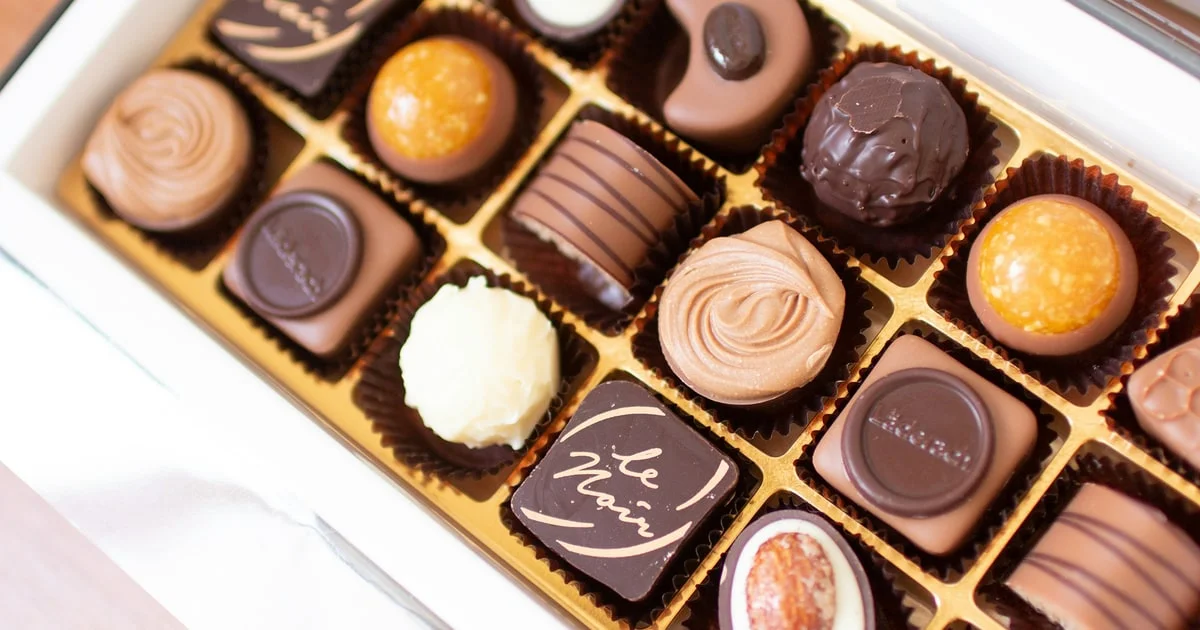
Switzerland is the country most associated with chocolate, and one of the harder places to buy it with confidence. Not because of hidden additives. Because of alcohol, and because almost nothing on the shelf is certified.
The good news is that Swiss labelling makes the alcohol question unusually easy to answer. Once you know what to look for, you can clear a shelf in seconds.
Who Makes What
Swiss chocolate is more concentrated than the brand names suggest. Several of the biggest sellers are supermarket exclusives.
| Brand | Owner | Where you find it |
|---|---|---|
| Lindt | Lindt & Sprüngli | Everywhere. The overall market leader |
| Frey | Delica, part of the Migros group | Migros only |
| Halba | Coop | Coop only |
| Cailler | Nestlé, made at Broc | Everywhere |
| Toblerone | Mondelēz, made in Bern | Everywhere |
| Ragusa, Torino | Camille Bloch | Everywhere |
| Läderach | Läderach | Own stores |
| Sprüngli | Confiserie Sprüngli, a separate company from Lindt & Sprüngli | Own boutiques |
That last row surprises people. Confiserie Sprüngli and Lindt & Sprüngli are legally separate businesses. Shared history, shared name, different companies.
The Certification Picture Is Thin
Lindt is not halal certified, and says so. Its own FAQ pages across several regional sites state that Lindt products are not halal certified, on the basis that the company does not hold the certification needed to guarantee products meet halal standards. That is a manufacturer statement, not an inference, and it is the clearest answer available from any Swiss maker.
Toblerone is the one certification story, and it is old. In April 2018 the Bern factory obtained halal certification, and Mondelēz confirmed the production process had not been altered. The news triggered a boycott campaign in Germany and Austria, which is why most people have heard of it.
Two caveats matter more than the headline. No source we checked names the certifying body. And Mondelēz Switzerland’s current site describes the Bern plant without mentioning halal certification at all. Eight years on, that is a news fact rather than a verified current status. If Toblerone matters to you, look for a mark on the pack.
Frey, Halba, Camille Bloch, Läderach and Sprüngli: we found no halal certification for any of them. That is an absence of evidence after checking the obvious primary sources, not proof that none exists.
Cailler is often claimed to be certified. We could not confirm it. Nestlé does appear as a client of Switzerland’s halal certifier, but the certificate scope is not published and Cailler is not named. The “Cailler is halal” claims circulating come from consumer scanner apps, which are not certification bodies. Do not rely on them.
Switzerland Does Have a Certifier
Halal Certification Services GmbH is registered in Rheinfelden, Aargau, not Zurich as is sometimes assumed. It has operated since 2009 and claims recognition from JAKIM in Malaysia, MUIS in Singapore, MUI in Indonesia and CICOT in Thailand, along with World Halal Food Council membership.
Its named clients are revealing: Nestlé, Nespresso, Maggi, Emmi, Barry Callebaut, Merck and others.
Barry Callebaut is the interesting one. It is the world’s largest business-to-business chocolate and couverture maker, Swiss-headquartered, and it supplies chocolate to manufacturers rather than shoppers. So certified Swiss chocolate does exist, in industrial form, feeding products made elsewhere. It just does not arrive as a bar with a Swiss brand on it.
The same pattern appears at Chocolat Bernrain in Kreuzlingen, a contract manufacturer that says it can produce kosher and halal chocolate to a client’s specification, on request. That is a business-to-business service for brand owners. It is not something you can buy in Migros.
The Real Swiss Problem: Alcohol
This is where Swiss chocolate differs from British or German chocolate, and it is not a marginal issue. Coop runs a supermarket shelf category called “Pralinen mit Alkohol”, pralines with alcohol. An entire category.
Named products that contain alcohol:
- Lindt Kirschstengeli — a liquid kirsch filling, and a Swiss institution
- Lindt Goldstücke in Cognac, Kirschwasser, Williams pear and apricot brandy versions
- Lindt Eierlikör Pralinen — egg liqueur
- Lindt Mini Pralinés assortments, where some pieces contain Marc de Champagne
- Läderach runs a dedicated alcohol praline range, including Marc de Champagne truffles and mixed selections labelled “mit Alkohol”
- Sprüngli Kirschstängeli
Marc de Champagne truffles work out at roughly three percent alcohol in the finished sweet, because the filling is a small proportion of a high-strength spirit. That is not a trace.
The Swiss Label Makes This Easy
Here is the practical gift. Swiss packs carry a prominent notice:
Diese Spezialität enthält Alkohol
That is “this specialty contains alcohol”, displayed on the front, and the ingredient list then names the actual spirit: Marc de Champagne, Kirschwasser, Cognac, Williams-Birnenbrand, Marillenbrand or Eierlikör.
Most markets bury alcohol inside a flavouring. Switzerland puts it on the front of the box. If a Swiss praline box carries no such notice and names no spirit, the alcohol question is answered.
Additives Are the Smaller Worry
Contrary to what you might expect from a British or American shelf, E471 is not the typical emulsifier in Swiss bar chocolate. The two ingredient lists we pulled, a Frey bar and a Camille Bloch Ragusa, both use lecithin instead, which is soy or sunflower derived and raises no animal question.
That is two products rather than a survey, so read the pack. But the steer is right: in plain Swiss chocolate, expect lecithin.
Two things we could not establish, and will not guess at. No Swiss maker publishes a position on rennet in its milk components. Milk chocolate is built on milk powder and butterfat rather than cheese, so rennet has no obvious route in, but no manufacturer confirms it and we are not going to assert it for them. Likewise, we found no Swiss manufacturer statement on gelatine in any filled line.
How to Shop the Swiss Chocolate Aisle
- Check the front of the box for the alcohol notice. This eliminates the liqueur pralines in one look, and it is the single biggest risk in this market.
- Prefer plain bars over filled pralines. The alcohol lives in the fillings, and plain Swiss bars are short ingredient lists built on cocoa, sugar, milk powder, butterfat and lecithin.
- Do not rely on scanner apps for a certification claim. Several circulate claims about Swiss brands that no certifier confirms.
- Treat Toblerone’s certification as unverified until you see a current mark on the pack.
- Remember Frey is Migros-only and Halba is Coop-only. If you are comparing what a friend in another canton bought, they may not have had access to the same brand.
Summary
| Question | Answer |
|---|---|
| Is any mainstream Swiss bar halal certified? | None we could verify |
| Is Lindt certified? | No, by Lindt’s own statement |
| Is Toblerone certified? | Certified in April 2018, certifier unnamed, current status unverified |
| What is the main risk? | Alcohol in praline fillings, an entire retail category |
| Can I spot it on the pack? | Yes. Swiss packs carry a front-of-pack alcohol notice and name the spirit |
| Is E471 a concern here? | Less than elsewhere. Swiss bars typically use lecithin |
| Is there a Swiss certifier? | Yes, in Rheinfelden, but it certifies industrial and ingredient suppliers rather than retail bars |
Ingredients change. Be first to know.
Brands reformulate without warning. We track every E-code update and halal certification — one short weekly email.
Related Articles
 Shopping Guides
 Halal Chocolate in Turkey: Why Ülker Has No GİMDES Certificate and What TSE Actually Means
Turkey has real halal certification infrastructure, and since June 2023 certifiers must be state-accredited. But two different bodies both brand themselves TSE, Ülker holds no GİMDES certificate, and Şölen's published certificate expired in July 2026.
 Shopping Guides
 Is Milka Chocolate Halal? Complete EU & UK Guide (2026)
Milka chocolate is Mushbooh — it contains E476 (PGPR) and E471 with undisclosed animal fat sources and no halal certification in UK or EU.
 Shopping Guides
 Halal Shopping at Coles: Aisle-by-Aisle Australia Guide (2026)
Coles stocks halal-certified meat from accredited abattoirs but own-brand packaged goods require E-code checking — here's what to look for in each aisle.