
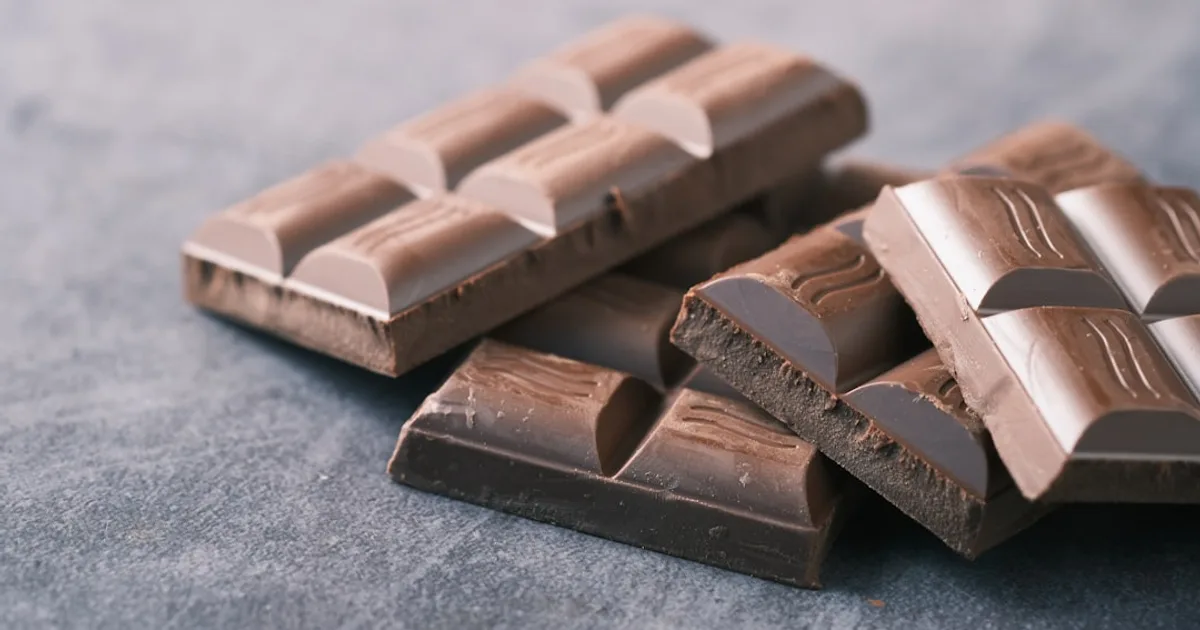
Three ingredients flag almost every chocolate concern for UK Muslims: E471, E476, and vanilla extract. Get those three right and you can navigate every chocolate format confidently — bars, hot drinks, baking blocks, spreads, and white chocolate.
The short version: most mainstream UK chocolate is mushbooh rather than definitively halal or haram. E476 (PGPR) is halal — it is derived from castor oil, not animal fat, despite what the name suggests. E471 is mushbooh — the source is not always disclosed on the label. Vanilla extract typically contains alcohol as a carrier. Below is a format-by-format breakdown with real brand verdicts.
Section 1: Chocolate Bars — What to Check
E476 (PGPR): The One That Looks Scary but Is Fine
Polyglycerol polyricinoleate sounds like it comes from an animal. It does not. PGPR is derived from castor oil (from castor beans) and is used as an emulsifier in cheap chocolate to reduce viscosity and cut costs. It is plant-based and considered halal by all major Islamic scholarly bodies.
You will see E476 in budget bars including own-brand supermarket chocolate, Cadbury Roses, and value baking chocolate. It is not a concern for halal consumers.
E471: The One That Is Actually Uncertain
Mono- and diglycerides of fatty acids (E471) is a different story. E471 can be derived from:
- Plant oils (palm, sunflower, soya) — halal
- Animal fat (including pork lard) — haram
- Mixed sources — mushbooh
UK manufacturers are not required to disclose the source of E471 on the label. When a chocolate bar simply says “emulsifier (E471)”, you cannot determine the source from the label alone. This makes E471 the primary mushbooh concern in UK chocolate.
Vanilla Extract vs. Vanillin: A Critical Difference
- Vanilla extract — real vanilla beans extracted using ethanol (alcohol). The finished extract is approximately 35% alcohol by volume. Using it in food carries an alcohol residue.
- Vanillin — synthetic vanilla flavour. No alcohol in production or the final ingredient. Considered halal.
- Natural flavouring — ambiguous. Could be either. Contact the manufacturer if in doubt.
Cadbury’s standard chocolate uses “flavouring” without specifying vanilla extract or vanillin. Thorntons and premium ranges are more likely to use vanilla extract. Always check — the word “extract” on the label is the trigger.
Summary: What to Look For on a Chocolate Bar Label
- E471 listed? → Mushbooh unless manufacturer confirms plant source
- E476 listed? → Halal (castor oil, ignore the name)
- “Vanilla extract” listed? → Potential alcohol concern
- “Vanillin” listed? → Halal
- HMC or HFA logo? → Certified halal, no further checks needed
Section 2: Hot Chocolate
Cadbury Drinking Chocolate
Cadbury Drinking Chocolate (the tin, not the instant sachets) contains cocoa powder, sugar, and whey powder. No E471, no vanilla extract. The ingredient profile is straightforward and it is widely considered halal in the mainstream Hanafi position, though it carries no HMC or HFA certification.
Galaxy Instant Hot Chocolate
Galaxy’s hot chocolate sachets contain E471. Source is not disclosed. Mushbooh under strict reading.
Options Hot Chocolate
Options sachets (various flavours including Belgian chocolate, mint) — check the current label. Some variants contain E471; others do not. The brand does not hold halal certification. Verdict varies by flavour: check each product individually.
Horlicks and Ovaltine
Both are malt-based drinks with cocoa. Neither contains E471 in their standard formulations. Both are free of gelatin and animal-derived emulsifiers. Generally considered halal in the mainstream position, no HMC/HFA certification.
Section 3: Cooking and Baking Chocolate
Bournville Baking Block (Cadbury)
The Bournville Dark Chocolate Baking Block contains: cocoa mass, sugar, cocoa butter, emulsifier (E471), vanilla flavouring. The E471 source is not specified. Mushbooh for strict consumers; widely accepted in mainstream Hanafi position.
Cocoa Powder (Plain)
Plain cocoa powder — Cadbury Bournville Cocoa, Green & Black’s Organic Cocoa, Tesco own-brand — contains no emulsifiers, no flavourings, no E-codes. 100% cocoa solids. Halal across the board.
Chocolate Chips
Own-brand and branded chocolate chips (Dr. Oetker, Callebaut) typically contain E471 and sometimes E476. Callebaut is frequently used in bakeries and lists E476 (castor oil — halal) and E471 (source not specified — mushbooh). For HMC-certified baking, use certified chips from specialist suppliers.
Section 4: Chocolate Spread — Nutella and Alternatives
Nutella
Nutella’s ingredient list includes E471. This is the first concern many Muslims raise. Ferrero (Nutella’s manufacturer) has formally confirmed in writing that the E471 used in Nutella is derived from plant-based sources — specifically sunflower oil or palm oil. Nutella contains no gelatin, no carmine, no alcohol-based flavourings.
Ferrero does not hold HMC or HFA certification. However, their confirmed plant-based E471 sourcing puts Nutella in the halal category under the mainstream Hanafi position, and this is the consensus among most UK Muslim scholars who have reviewed the ingredient declaration.
Chocolate Spread Alternatives
| Brand | E471 Source | Verdict |
|---|---|---|
| Nutella | Plant-confirmed (Ferrero) | Halal (mainstream) |
| Cadbury Chocolate Spread | Undisclosed | Mushbooh |
| Lotus Biscoff (chocolate variant) | Not applicable | Check label |
| Own-brand supermarket spread | Undisclosed | Mushbooh |
Section 5: Chocolate Coatings on Biscuits, Ice Cream, and Cereals
Chocolate coatings on compound products — biscuits like Digestive Chocolate, ice cream bars, and cereal clusters — nearly always contain E471 as the primary emulsifier, and sometimes E476. Vanilla flavouring is also common.
Key categories to check:
- Chocolate digestives (McVitie’s, own-brand) — contain E471, source undisclosed → Mushbooh
- Kit Kat — Nestlé UK confirms no pork-derived ingredients, E471 from plant sources → Halal (mainstream)
- Cadbury Chocolate Fingers — E471, undisclosed → Mushbooh
- Ice cream chocolate coatings (Magnum, Wall’s) — check individual product; some use RSPO-certified palm-derived E471
- Chocolate cereals (Coco Pops, Choco Krispies) — generally E471-free; check flavouring ingredients
Section 6: White Chocolate
White chocolate deserves its own section because the vanilla extract issue is most acute here. White chocolate has no cocoa solids to mask flavours, so manufacturers frequently use real vanilla extract for a cleaner taste profile.
The concern: real vanilla extract is extracted using ethanol. Premium white chocolate brands — Green & Black’s White, Lindt White — specify “vanilla extract” on the label. This is the alcohol-bearing form.
Budget white chocolate and baking white chips are more likely to use vanillin (synthetic), which is labelled as “vanillin” or “flavouring” without the word “extract.”
Practical rule for white chocolate:
- Label says “vanilla extract” → concern; many scholars advise avoidance
- Label says “vanillin” → halal
- Label says “flavouring” → ambiguous; contact manufacturer
Section 7: Vegan Chocolate — Is It Automatically Halal?
Vegan chocolate resolves the animal-fat concern for E471 — plant-only emulsifiers are used by definition. But vegan does not mean alcohol-free.
Vegan chocolate frequently contains:
- Natural flavourings — which can be alcohol-extracted
- Vanilla extract — vegan but alcohol-based
- Rum or whisky flavourings — common in premium vegan dark chocolate
So the answer is: vegan chocolate eliminates the E471 animal-source concern but does not automatically clear the alcohol-in-flavourings concern. Check the flavouring declarations on any vegan chocolate you buy.
Popular vegan chocolate brands available in UK:
- Moo Free — uses vanillin, no alcohol flavourings → Halal (mainstream)
- Montezuma’s Dark — check specific bar; some use vanilla extract
- Green & Black’s Organic Dark 70% — “vanilla extract” listed → concern for strict consumers
- Divine Chocolate — Fairtrade; uses vanillin in most bars → Halal (mainstream)
One label distinction worth fixing in memory: Fairtrade is an ethics label, not a halal one — our Co-op UK guide shows why, with an entire own-brand chocolate range that is Fairtrade certified and halal certified nowhere.
Full Brand Guide: Status Across Formats
| Product | Format | Key Concern | Status |
|---|---|---|---|
| Cadbury Dairy Milk | Bar | E471 (undisclosed), vanilla flavouring | Mushbooh |
| Kit Kat (Nestlé UK) | Bar | E471 (plant-confirmed by Nestlé) | Halal (mainstream) |
| Lindt Excellence 70% | Bar | Vanilla extract (alcohol) | Mushbooh |
| Green & Black’s Milk | Bar | E471 (undisclosed) | Mushbooh |
| Moo Free Milk Alternative | Bar | None identified | Halal |
| Cadbury Drinking Chocolate | Hot | None identified | Halal (mainstream) |
| Galaxy Hot Chocolate | Hot | E471 (undisclosed) | Mushbooh |
| Horlicks Original | Hot | None identified | Halal (mainstream) |
| Cadbury Bournville Cocoa | Baking | None (pure cocoa) | Halal |
| Bournville Baking Block | Baking | E471 (undisclosed) | Mushbooh |
| Dr. Oetker Chocolate Chips | Baking | E471 (undisclosed) | Mushbooh |
| Nutella | Spread | E471 (plant-confirmed by Ferrero) | Halal (mainstream) |
| Cadbury Chocolate Spread | Spread | E471 (undisclosed) | Mushbooh |
| McVitie’s Chocolate Digestives | Biscuit coating | E471 (undisclosed) | Mushbooh |
| Kit Kat Chunky | Biscuit coating | E471 (plant-confirmed) | Halal (mainstream) |
| Lindt White | White chocolate | Vanilla extract (alcohol) | Mushbooh |
| Divine White Chocolate | White chocolate | Vanillin (no alcohol) | Halal (mainstream) |
How we reached this verdict
Our assessments are based on:
- Label analysis — reading current UK packaging for E-code declarations and flavouring descriptions
- Manufacturer contact — where E471 source is undisclosed on label, we cross-reference manufacturer statements (Ferrero/Nutella, Nestlé/Kit Kat)
- HMC and HFA certification registers — checking which products carry active halal body certification
- Scholarly consensus — reviewing positions of UK Islamic councils including the Muslim Food Board (MFB) and Islamic Food and Nutrition Council of America (IFANCA) guidance on E471 and vanilla extract
- E-code database cross-reference — using the HalalCodeCheck E-codes database to verify additive classifications
Where manufacturer confirmation of plant-sourced E471 exists in writing, we classify as halal (mainstream). Where source is undisclosed, we classify as mushbooh. We do not classify any product as haram solely on the basis of undisclosed E471 — haram requires positive evidence of a prohibited source.
Madhab note
The majority of mainstream Sunni scholars in the UK, including those following the Hanafi school, accept E471 in products where animal derivation is not confirmed, on the basis that:
- The doubt (shubha) does not trigger prohibition without evidence of a prohibited source
- Chemical transformation (istihalah) may render the source irrelevant even if animal-derived
HMC (Halal Monitoring Committee) takes a stricter position and does not certify products with undisclosed E471. Products bearing the HMC logo have confirmed halal E471 sourcing.
HFA (Halal Food Authority) takes an intermediate position, accepting plant-derived E471 confirmation from manufacturers.
If you follow the HMC-strict position: avoid any chocolate listing E471 without confirmed plant sourcing, and avoid all products with vanilla extract.
If you follow the mainstream Hanafi position: Cadbury Dairy Milk, Bournville Baking Block, and similar products with undisclosed E471 are generally accepted, while vanilla extract remains a point of scholarly difference.
Summary Q&A
| Question | Answer |
|---|---|
| Is E476 (PGPR) halal? | Yes — derived from castor oil, plant-based |
| Is E471 in chocolate halal? | Depends on source — mushbooh if undisclosed |
| Is vanilla extract halal? | Concerns exist — alcohol carrier; vanillin is fine |
| Is Cadbury Dairy Milk halal? | Mushbooh — E471 undisclosed, no HMC/HFA cert |
| Is Kit Kat halal? | Halal (mainstream) — Nestlé UK confirms plant E471 |
| Is Nutella halal? | Halal (mainstream) — Ferrero confirms plant E471 |
| Is vegan chocolate halal? | Usually yes — but check flavourings for alcohol |
| Is white chocolate halal? | Check label — vanillin is fine, vanilla extract is a concern |
| What certifications confirm halal chocolate? | HMC logo (strictest) or HFA logo |
If the label-by-label checking is wearing thin, our roundup of verified halal chocolate bars you can order online skips the mushbooh tier entirely and sticks to bars carrying a halal certification logo or a fully plant-based ingredient list.
Use the E-codes database to look up any E-code you find on a chocolate label — E471, E476, E322, and others all have full status entries.
Scan a full ingredient list with the ingredient scanner to get a complete verdict on any chocolate product in seconds.
Ingredients change. Be first to know.
Brands reformulate without warning. We track every E-code update and halal certification — one short weekly email.
Related Articles
 Shopping Guides
 We Checked 50 UK Protein Bars: Every Halal Verdict (2026)
Gelatin, carmine, E471 from animal fat, and undisclosed alcohol-based flavourings appear across 50 UK protein bars. Full results table covering Grenade, Trek, Clif, Quest, Rxbar, Barebells and more.
 Shopping Guides
 UK Breakfast Cereals: Full Halal Audit (2026)
We checked every major UK breakfast cereal for vitamin D3, E471, and natural flavours. Weetabix, Kellogg's, Nestlé, Quaker and own-brand — full results table.
 Shopping Guides
 UK Biscuits: Which Brands and Varieties Are Halal? (2026)
Animal fat (lard) in shortcrust and E471 in cream-filled biscuits are the main risks. Full audit of McVitie's, Fox's, Lotus, Jammie Dodgers, Maryland, Leibniz and own-brand.