
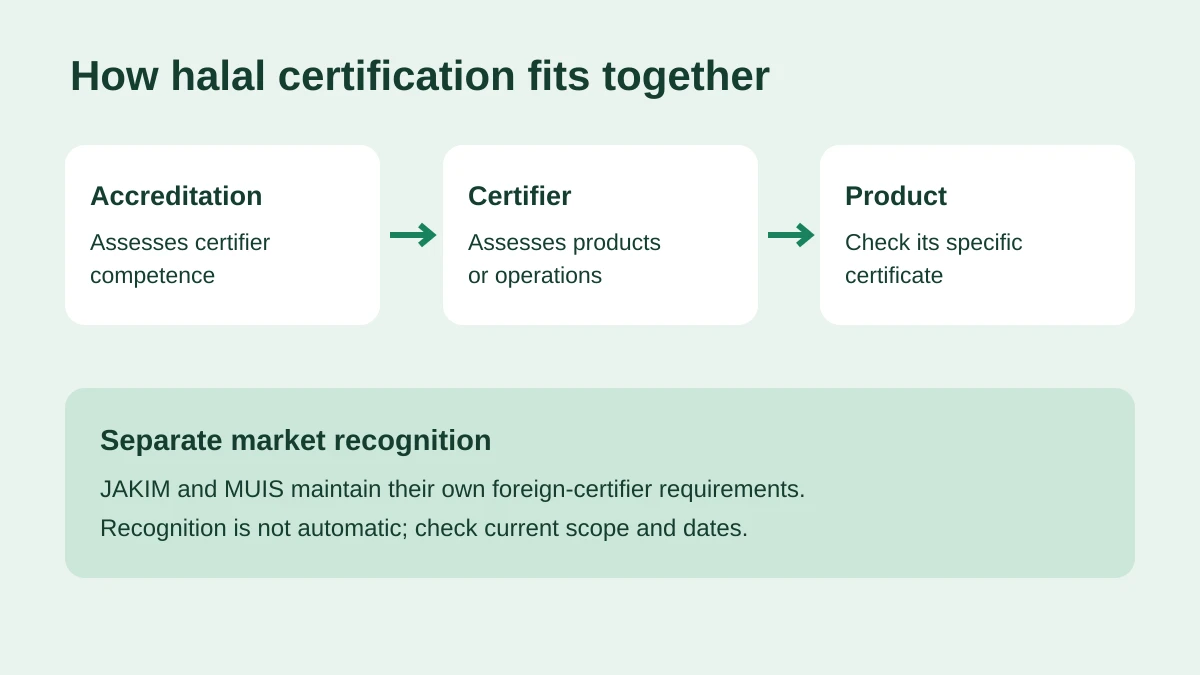
The Bangsamoro region has launched a framework for assessing halal certification bodies. That is a different step from certifying a packet of food, and it does not automatically place a certifier on Malaysia’s or Singapore’s recognised foreign-body lists.
The Bangsamoro government says the Bangsamoro Halal Accreditation and Certification Scheme and its guidelines were launched on 21 October 2026 by the Ministry of Trade, Investments and Tourism (MTIT). The framework sets out requirements and procedures for assessing certifiers’ competence and impartiality.
At a glance
| Question | Answer |
|---|---|
| What was launched? | A Bangsamoro scheme and guidelines for assessing halal certification bodies |
| Who launched it? | BARMM’s Ministry of Trade, Investments and Tourism |
| Is a product certified merely because the scheme exists? | No. Check the individual product and its certificate |
| Does it automatically establish JAKIM or Muis recognition? | No. Check each authority’s current list and scope |
| What remains unclear? | The launch report does not explain how the regional scheme connects to national accreditation |
Three different checks
| Step | What it addresses | What it does not establish on its own |
|---|---|---|
| Accreditation or assessment | Whether a certification body meets applicable competence and impartiality requirements | That every product is certified |
| Certification | Whether a named product or operation is covered by a certificate | That every country accepts that certificate |
| Market recognition | Whether a destination authority recognises a foreign certifier within a stated scope | That every product from that certifier is covered |
These steps can connect, but they are not interchangeable. The BARMM announcement describes the first of them. It does not publish a list of accredited bodies, fees or an implementation timetable, nor does it explain how regional and national accreditation will fit together.
Where the Philippine system fits
The Philippines also has a national halal framework. The new regional announcement does not say whether a certification body must hold both a regional and a national accreditation, or whether either process will recognise the other. Businesses should seek guidance from the responsible Philippine authorities rather than assume an answer from the launch alone.
A separate proposal to create a Bangsamoro Halal Development Authority is recorded as a bill by the Bangsamoro Parliament. The parliamentary record lists it at committee stage as of 5 October 2026. A proposal is not the same thing as an enacted authority; check the record for later action.
How Malaysia and Singapore recognise foreign certifiers
JAKIM’s foreign certification body page explains Malaysia’s recognition process and links to its current list. It also sets out separate requirements for imported meat and approved establishments. For a product intended for Malaysia, check the body, product category and any additional establishment requirements.
Muis’s foreign halal certification body guidance explains that Muis recognises overseas bodies because it does not itself certify food products manufactured overseas. Its recognition process assesses foreign bodies against Singapore’s requirements. Muis describes recognition as valid for three years with annual reporting; consult the live list rather than relying on an old list or logo.
A BARMM assessment and recognition in an importing market answer different questions. Do not assume that an authority has recognised a body simply because it operates in the Philippines or holds another approval.
How to check a Philippine-made product
- Find the certification body on the packaging, or ask the manufacturer for the certificate.
- Check the current official list for the market where the product will be sold. Search the certifier’s full name, not just a similar-looking logo.
- Check dates and the scope of recognition, including product category and country, where shown.
- Ask whether the individual product and production site are covered by the certificate. A listed certifier does not certify every product made by a manufacturer.
- If a mark or certificate cannot be verified, contact the certifier or relevant authority before relying on the claim.
What this means for shoppers and producers
For shoppers, the useful action is still to identify the certifier and verify the product. For producers, a regional scheme may matter to the body’s accreditation while an export destination may separately require recognition of that body. The official launch does not yet settle how all those processes interact.
This is an explanation of certification administration, not a verdict on a particular food or a ruling for a particular madhab. Explore our halal certification hub for related guidance.
Halal Certification Hub
Need the bigger picture, not just this one article?
Browse the full halal certification hub for step-by-step guidance on costs, certification bodies, logos, audits, labelling, and international trade requirements.
Visit the certification hubIngredients change. Be first to know.
Brands reformulate without warning. We track every E-code update and halal certification — one short weekly email.
Partner with HalalCodeCheck
Reach halal-conscious buyers and food businesses at the moment they decide
Our audience uses HalalCodeCheck to verify ingredients, compare certification bodies, and choose products with confidence. That means you can reach both high-intent shoppers and serious food-business decision-makers across the UK, US, Canada, Australia, and Europe.
- Featured product & brand placements
- Certification guide sponsorships & category features
- Search, tool, and directory visibility
Sponsored placements and partnerships by arrangement
Related Articles
 Halal Certification
Lotteria Singapore: How to Check Halal Certification
Check the current Muis certification status of Lotteria outlets in Singapore before visiting.
 Halal Certification
US Halal Label Rules: What FDA and USDA Actually Require
The US has no federal halal definition or certification. A halal label is a private claim that must be truthful. Here is what FDA and USDA rules mean for you.
 Halal Certification
Halal Sticker Rolls on Noon: Why a Sticker Is Not Certification
A generic halal sticker proves nothing about how a product was made. Check for a MoIAT-registered certifier and a genuine mark on the original packaging.