
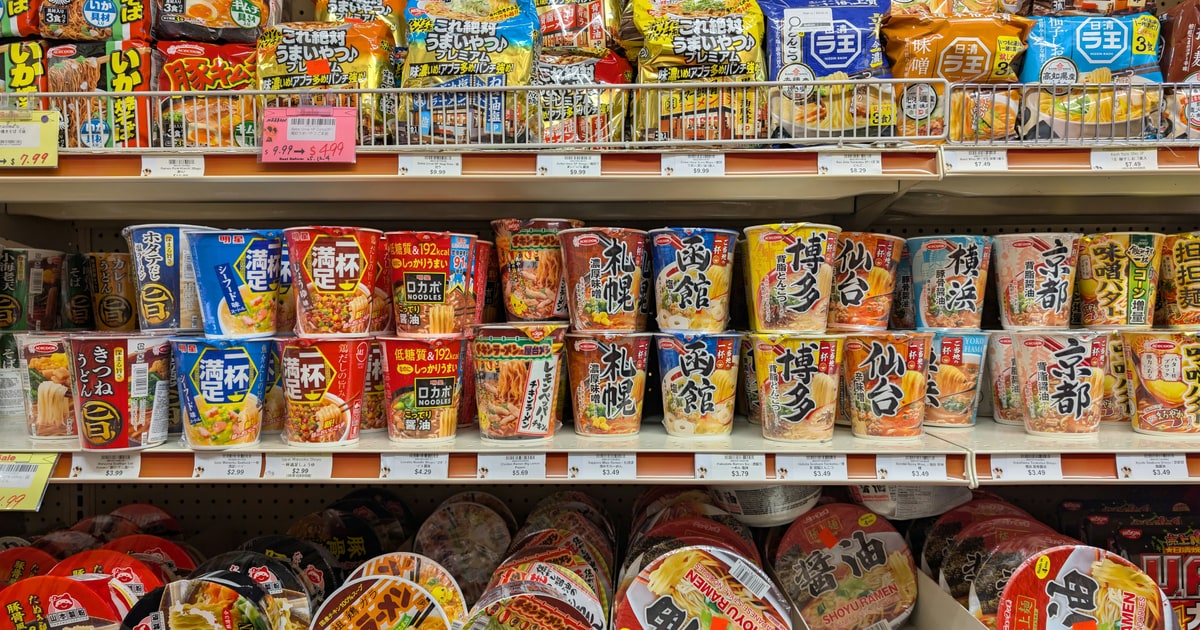
Instant noodles are a global staple — quick, cheap, filling, and beloved across student kitchens, office desks, and late-night snack sessions worldwide. For Muslim consumers in the UK, navigating instant noodles requires brand-by-brand attention: the noodles themselves are usually fine, but the flavour sachets introduce meat extracts, E-codes, and processing methods that vary significantly by brand and flavour.
What’s Actually in Instant Noodles?
Understanding the component structure of instant noodles makes the halal analysis clearer:
The noodle block: Made from wheat flour, palm oil, salt, and sometimes starch. Palm oil is plant-derived. The noodle block itself is almost always halal across all brands.
The flavour sachet (soup base): This is where halal concerns arise. It typically contains:
- Powdered flavourings (chicken, beef, pork, vegetable)
- Monosodium glutamate / E621 (MSG)
- Salt and sugar
- Hydrolysed vegetable protein (HVP)
- Dehydrated vegetables
- Sometimes powdered meat extracts or animal fats
Oil sachets (in some brands like Mi Goreng): Contain palm oil and sometimes animal-derived fats.
Vegetable sachets: Dehydrated vegetables — generally halal.
Indomie — Halal Certified
Verdict: Halal (MUI certified)
Indomie is produced by Indofood, an Indonesian food conglomerate, and carries certification from MUI (Majelis Ulama Indonesia) — Indonesia’s top Islamic authority and one of the world’s most rigorous halal certification bodies. For Muslim consumers, MUI certification is a reliable stamp of assurance.
The most popular Indomie products in the UK include:
Mi Goreng (fried noodle style): Contains flavour sachets with soy sauce, sweet soy sauce, chilli sauce, and an oil sachet. All certified halal. Ingredients are palm oil, soy-based sauces, and spice mixes.
Mi Goreng Rendang: Beef rendang flavour — beef extract from halal-slaughtered cattle. MUI certified.
Chicken Flavour: Chicken extract from halal sources. MUI certified.
Onion Chicken: Also MUI certified.
Indomie is widely available in UK Asian grocery stores, some Tesco and ASDA stores, and online. The MUI halal logo should be visible on the packaging. Always verify the packaging you purchase, as product formulations can occasionally change.
Pot Noodle — Mushbooh
Verdict: Mushbooh (not halal certified; meat extracts from unverified sources)
Pot Noodle is manufactured by Unilever and has been a UK staple since 1977. Despite its popularity, it presents significant halal ambiguity.
The noodles and MSG: The noodle block uses standard wheat/palm oil ingredients. E621 (monosodium glutamate, MSG) is present in nearly every Pot Noodle flavour. MSG is typically produced by bacterial fermentation of sugars (from sugar beet, sugarcane, or tapioca) and is halal.
The flavour sachets: This is the problem area. Pot Noodle flavours such as:
- Chicken & Mushroom: Contains chicken extract — source is not halal-certified
- Beef & Tomato: Contains beef flavouring — source and slaughter method not disclosed
- Original Curry: Contains hydrolysed vegetable protein and spices; no obvious meat, but not certified
- Sticky Rib: Contains pork flavouring — Haram
The “Sticky Rib” flavour makes pork content explicit. Other flavours use meat extracts from sources that have not been confirmed as halal-slaughtered.
Unilever does not publish halal certification for Pot Noodle. Consumer enquiries to Unilever have historically received responses confirming that Pot Noodle is not halal certified.
Practical guidance: Vegetarian Pot Noodle flavours (if available) present fewer concerns — but even these are not halal certified and may use shared production with pork-containing lines. Without certification, treat all Pot Noodle varieties as mushbooh.
Nissin — Varies by Market and Flavour
Verdict: Mushbooh for UK/US market products; halal certified variants exist for other markets
Nissin is a Japanese company, the inventor of instant noodles, and the maker of Cup Noodles and Top Ramen. In the Japanese home market, pork is a staple of ramen broth — tonkotsu (pork bone) ramen is culturally central. This heritage is reflected in Nissin’s product lines.
Nissin products in the UK/US:
- Top Ramen (Chicken): Contains chicken flavouring from non-halal-certified sources
- Cup Noodles (Chicken): Chicken extract; not certified halal
- Cup Noodles (Seafood): Seafood flavouring; generally permissible ingredients but not certified
- Nissin Demae Ramen (Tonkotsu/Pork): Contains pork — Haram
Nissin’s halal-certified products: Nissin produces dedicated halal-certified product lines for Southeast Asian markets (particularly in Malaysia and Indonesia, where Nissin has manufacturing facilities). These carry JAKIM or MUI certification. These certified variants are distinct from what is commonly sold in standard UK supermarkets. If purchasing Nissin products from Asian grocery stores, check the packaging carefully — the halal-certified Malaysian market versions may be available alongside non-certified imports.
Practical guidance: Standard UK-shelf Nissin products are not halal certified. Treat them as mushbooh unless the specific packaging shows a recognised halal certification logo.
Buldak (Samyang) — Some Halal Certified Variants
Verdict: Some flavours halal certified; check individual product
Samyang’s Buldak (Fire Noodles) took the world by storm with the viral spicy noodle challenge. The brand offers an expanding range of heat levels and flavours. For the full breakdown of the certified export version versus the near-identical uncertified domestic packet, see our dedicated guide: Is Buldak ramen halal?
Samyang produces halal-certified variants of several Buldak products, certified by Korea’s KHMA (Korea Halal Management Institute) or IFANCA. These certified products are identifiable by the halal logo on packaging and are sold through halal grocers and some mainstream UK retailers.
Certified halal Buldak variants (as of 2026):
- Buldak 2x Spicy Hot Chicken Ramen (halal-certified version)
- Buldak Carbonara (halal-certified version)
- Buldak Cheese (halal-certified version)
Non-certified variants may contain chicken or beef extract from non-halal sources, or flavourings that haven’t been certified.
The key is to look for the halal certification logo on the specific pack you are buying — the halal and non-halal versions are sometimes sold side by side in the same shops.
Other Brands Worth Noting
Maggi (Nestlé): Varies hugely by country of manufacture. Maggi Chicken Noodles manufactured in South Asian countries (Pakistan, Malaysia, Indonesia) are often halal certified. UK-manufactured Maggi products should be checked individually.
Mama (Thai): A popular Southeast Asian brand. Some variants are halal certified; the vegetarian and chicken lines from Thailand are generally from halal sources. Check for CICOT (Thailand’s halal certification body) or similar logos.
Ve Wong: A Taiwanese brand available in UK Asian grocery stores. Some flavours are vegetarian/halal; pork-containing flavours exist. Read labels carefully.
The E621 (MSG) Question
E621 (monosodium glutamate) appears in most instant noodles. Despite popular misconceptions, MSG is halal. It is produced by bacterial fermentation of plant-derived carbohydrates (corn starch, sugar beet molasses, sugarcane). The bacteria involved are not considered haram, and the fermentation process does not introduce any animal or prohibited substances. MSG is permitted in halal-certified foods by every major certification body.
How to Shop for Halal Instant Noodles
- Look for the certification logo — MUI (Indonesia), JAKIM (Malaysia), IFANCA (USA), KHMA (Korea) are all recognised
- Check the flavour sachet ingredients — “pork”, “lard”, “non-halal chicken extract” are explicit flags
- Favour Asian grocery stores — these carry a wider range of halal-certified brands including Indomie, halal Samyang, and certified Mama products
- Use HalalCodeCheck — scan the ingredient list to check E-codes and flagged additives
Summary
| Brand | Halal Status | Notes |
|---|---|---|
| Indomie | Halal | MUI certified; widely available in UK |
| Pot Noodle | Mushbooh | Not certified; meat extracts unverified; Sticky Rib flavour contains pork |
| Nissin (UK/US shelf) | Mushbooh | Not certified; some flavours pork-based |
| Nissin (SE Asia certified) | Halal | Check for JAKIM/MUI logo on specific pack |
| Buldak (Samyang) | Varies | Some flavours certified halal (check for logo) |
| Maggi (South Asia manufactured) | Often Halal | Verify certification on specific pack |
| Verdict | Most noodle blocks are halal; the flavour sachet determines the ruling |
Ingredients change. Be first to know.
Brands reformulate without warning. We track every E-code update and halal certification — one short weekly email.
Related Articles
 E-Code Guides
 Is Propylene Glycol (E1520) Halal? The Flavour Solvent Explained
Propylene glycol (E1520) is halal. It is a synthetic diol made from petroleum-derived propylene oxide, contains nothing animal-derived and does not intoxicate. The word 'glycol' is not 'alcohol' in the fiqh sense. Where it does matter: as the carrier in flavourings that may also contain ethanol.
 E-Code Guides
 Is Sodium Citrate (E331) Halal? The Short Answer (2026)
Sodium citrate (E331) is a fully synthetic acidity regulator made from citric acid and sodium hydroxide. No animal source, no alcohol — halal across all four Sunni madhabs.
 E-Code Guides
 Is Aspartame (E951) Halal? The Old Alcohol Myth Explained (2026)
Aspartame (E951/NutraSweet) is synthetic, made from amino acids. Alcohol is used in processing but doesn't appear in the finished sweetener — most scholars and certifiers now rule it halal.