
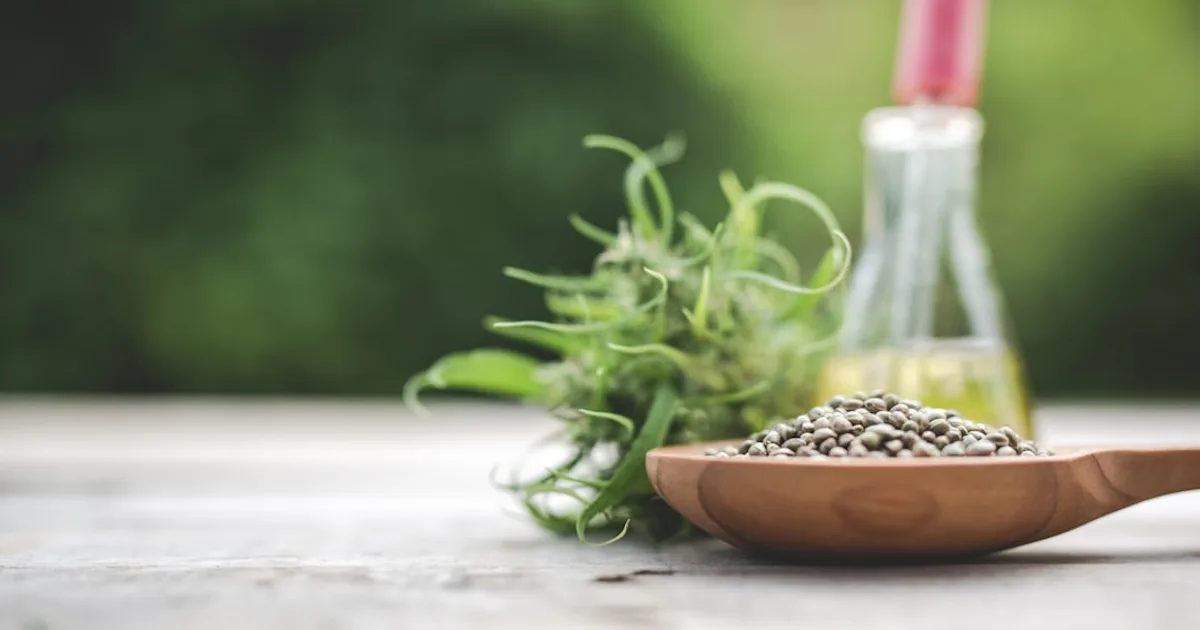
Hemp and marijuana are the same plant species. One of them is halal to eat. The difference comes down to a single number on a lab report: 0.3% THC.
That number explains why hemp seeds are sold openly on health-food shelves alongside chia and flaxseed — and why scholars from very different traditions, from South Africa to Saudi Arabia, have reached the same conclusion: hemp products are permissible. Industrial hemp (Cannabis sativa L.) is legally required to contain less than 0.2–0.3% THC, the psychoactive compound that makes marijuana intoxicating. Below that threshold, no quantity of hemp seed, oil, or protein can make you high — and in Islamic law, that changes everything.
Why the Cannabis Prohibition Doesn’t Cover Hemp Foods
The prohibition on cannabis rests on the hadith: “Every intoxicant is khamr, and every khamr is forbidden” (Sahih Muslim). Classical jurists prohibited cannabis (hashish) because consuming it intoxicates. The ruling attaches to the effect — intoxication — not to the plant’s botanical family.
Hemp seeds and the oil pressed from them contain effectively no THC. The seeds are not the part of the plant where cannabinoids concentrate; THC forms in the flowers and leaves. This is precisely the distinction contemporary muftis have drawn:
- Askimam (Mufti Ebrahim Desai) — Hanafi ruling: the Shariah prohibited cannabis for its psychoactive effect, but since hemp oil does not intoxicate, it is permissible to consume hemp seed oil and to apply it to the body. Selling it is also permissible where the law allows.
- Jamiatul Ulama KZN — a fatwa issued by Mufti Moosa Salie and confirmed by Mufti Ebrahim Desai: food-grade hemp oil is permissible for internal and external use without restriction. Medical-grade (higher-cannabinoid) hemp oil is a separate category — permitted only when prescribed by a competent Muslim medical professional for severe cases, on the principle “treat yourselves medically, but use nothing unlawful.”
- IslamQA (fatwa 259044) — the haram element in cannabis is THC specifically. Where the intoxicant percentage is negligible — “no trace of it can be found and it does not cause intoxication in the one who eats or drinks a large amount” — consuming the product is permissible. The ruling cites the Saudi Permanent Committee for Scholarly Research.
Three independent rulings, two very different schools of methodology, one conclusion: non-intoxicating hemp is not khamr.
Hemp Products, One by One
Not everything sold under the hemp label carries the same ruling. The status tracks the THC content and the intended use:
| Product | What it is | THC content | Halal status |
|---|---|---|---|
| Hemp seeds (hulled/whole) | Food — eaten like chia or flax | Effectively zero | Halal |
| Hemp seed oil | Pressed from seeds; cooking/dressing oil | Below 0.3% | Halal |
| Hemp protein powder | Ground seed by-product | Effectively zero | Halal |
| CBD oil / CBD drinks | Extract from leaves, stalks, flowers | Trace (must be below legal limit) | Permissible with conditions — verify THC lab report and carrier oil |
| Medical-grade hemp/cannabis oil | High-cannabinoid therapeutic extract | Varies — can be significant | Only under medical need, prescribed by a competent professional |
| Hemp flower (smoked/brewed) | Raw flower, where THC concentrates | Higher and variable | Avoid — intoxication risk and no reliable dose control |
| Marijuana / THC products | High-THC cannabis | High by design | Haram — intoxicant |
The pattern is consistent: the further you move from the seed toward the flower, the more THC enters the picture, and the more caution the fatwas apply.
CBD — Permissible, but Check Two Things
CBD (cannabidiol) is extracted from the parts of the plant where cannabinoids do concentrate, which is why it gets more scholarly scrutiny than hemp seed oil. The majority contemporary position — reflected in IslamQA’s ruling and in Islam Hashtag’s review of the fatwas — is that CBD is permissible when it is non-psychoactive: derived from compliant hemp, THC below the legal threshold, incapable of intoxicating even in large amounts.
Before buying a CBD product, verify:
- The THC lab report. Reputable CBD brands publish third-party certificates of analysis. THC must be below the legal limit (0.2% UK, 0.3% US). CBD extracted from high-THC marijuana rather than hemp does not meet the halal threshold.
- The carrier and format. CBD oil is diluted in a carrier — MCT (coconut) oil and hemp seed oil are halal; check anything unnamed. CBD gummies add a second question entirely: gelatine. A halal CBD extract in a pork-gelatine gummy is still haram.
Halal certifiers are already working in this space. Islamic Services of America (ISA) notes that certified halal CBD oils from industrial hemp exist, while stressing that hemp products need “very deep and careful reviews” — because THC, wherever it appears in meaningful amounts, is an intoxicant and not halal.
We’ve applied this framework before: Trip CBD drinks got a halal-in-formulation verdict on exactly these grounds — no alcohol, no animal derivatives, non-intoxicating CBD doses.
What About Hemp’s Health Halo?
Part of why this question keeps coming up is that hemp is genuinely good food, not a novelty. Hemp seeds are a complete plant protein with all nine essential amino acids, rich in omega-3 and omega-6 fatty acids, magnesium, and vitamin E — ISA’s review calls hemp “nutritionally dense” and a quality vegan protein source. For Muslim consumers looking at plant proteins, hemp protein powder is one of the cleanest options on the shelf: single ingredient, no gelatine capsules, no source-ambiguous emulsifiers.
That said, nutrition doesn’t change fiqh. Hemp foods are halal because they don’t intoxicate — the omega-3s are just a bonus.
How to Check a Hemp or CBD Product in 30 Seconds
- Find the plant part. “Hemp seed” or “hulled hemp” → halal, no further checks needed. “Whole-plant extract,” “full-spectrum,” or “flower” → keep reading.
- Find the THC number. Look for “THC below 0.2%” (UK/EU) or “below 0.3%” (US) on the label or the brand’s lab reports. No published number on a CBD product is a red flag.
- Check the delivery format. Capsules and gummies: look for gelatine and its source. Oils: check the carrier oil.
- Scan the rest of the ingredient list — flavourings, colours, and emulsifiers follow the normal rules regardless of the hemp question.
Summary
| Question | Answer |
|---|---|
| Are hemp seeds and hemp seed oil halal? | Yes — no intoxicating THC; ruled permissible by Hanafi and Saudi authorities alike |
| Is CBD halal? | Permissible with conditions — hemp-derived, THC below legal limit, non-intoxicating, halal carrier/format |
| Is hemp flower halal to smoke? | Avoid — THC concentrates in the flower and doses are uncontrolled |
| Is marijuana/THC halal? | No — it intoxicates, which makes it khamr |
| What should I check on a CBD label? | Third-party THC lab report, carrier oil, and gelatine in gummies/capsules |
Look up any additive from a hemp product label in the E-codes database.
To scan a full ingredient list for halal status in seconds, use the ingredient scanner.
For the drinks version of this question, see our Trip CBD brand verdict.
How we reached this verdict
We checked the following Tier-1 sources before publishing this verdict:
- Hanafi fatwa scholarship: Askimam (Mufti Ebrahim Desai) — hemp oil permissible to consume, apply, and sell because it does not intoxicate; Jamiatul Ulama KZN (Mufti Moosa Salie, confirmed by Mufti Ebrahim Desai) — food-grade hemp oil unconditionally permissible; medical-grade only under professional prescription for severe cases.
- Saudi/Salafi scholarship: IslamQA fatwa 259044 — CBD permissible where THC is negligible and non-intoxicating even in quantity, citing the Permanent Committee for Scholarly Research.
- Halal certification industry: Islamic Services of America — THC is an intoxicant and not halal; certified halal CBD oils from industrial hemp exist after rigorous review.
- Fatwa aggregation: Islam Hashtag’s review — cross-references the Islamic Fiqh Academy’s 1985 resolution on non-intoxicating trace amounts in medicine and the hemp-vs-marijuana THC distinction.
Madhab note
The four Sunni madhabs converge on the core rule applied in this guide:
- Intoxicants (khamr) — haram across all four madhabs, based on the hadith “every intoxicant is khamr, and every khamr is forbidden” (Sahih Muslim). Marijuana and any THC product used for its effect fall under this without dispute.
- Non-intoxicating derivatives — the Hanafi position (Askimam, Jamiatul Ulama KZN) and the Saudi Permanent Committee’s principle both permit products whose intoxicant trace is negligible and cannot intoxicate in any quantity. Hemp seeds and hemp seed oil qualify plainly; compliant CBD qualifies by the same reasoning.
- The cautious minority view — some scholars discourage all cannabis-plant derivatives as a precaution (sadd al-dhara’i), or restrict CBD to medical need with professional oversight, as the Jamiatul Ulama KZN fatwa does for medical-grade oil. If you follow this stricter position, hemp seeds and seed oil remain uncontroversial; it is CBD and whole-plant extracts you would avoid.
- Medical use — where a genuine therapeutic need exists, the fatwas allow more latitude under professional supervision, on the principle that Allah “has not placed your cure in what He has forbidden to you.”
If your madhab or scholar takes the stricter view on CBD, the seed-based products in this guide are unaffected. For binding rulings on borderline products, consult a competent scholar in your tradition.
Ingredients change. Be first to know.
Brands reformulate without warning. We track every E-code update and halal certification — one short weekly email.
Related Articles
 Ingredient Guides
 Halal Omega-3 Fish Oil: The Capsule Problem No One Warns You About (2026)
Fish oil is halal. The capsule enclosing it usually isn't. This guide explains the porcine gelatine softgel problem and lists safe UK halal omega-3 alternatives.
 Ingredient Guides
 Are Collagen Supplements Halal? Marine vs Bovine vs Porcine Explained (2026)
Collagen supplements default to porcine sources. Marine collagen is halal; bovine needs certification. Full UK brand guide with verdict on each type.
 Ingredient Guides
 Is The Ordinary Multi-Peptide Eye Serum Halal? INCI Checked (2026)
The Ordinary's Multi-Peptide Eye Serum is PETA-certified vegan, alcohol-free, and its peptides are synthetic — permissible to use, though not halal-certified.