
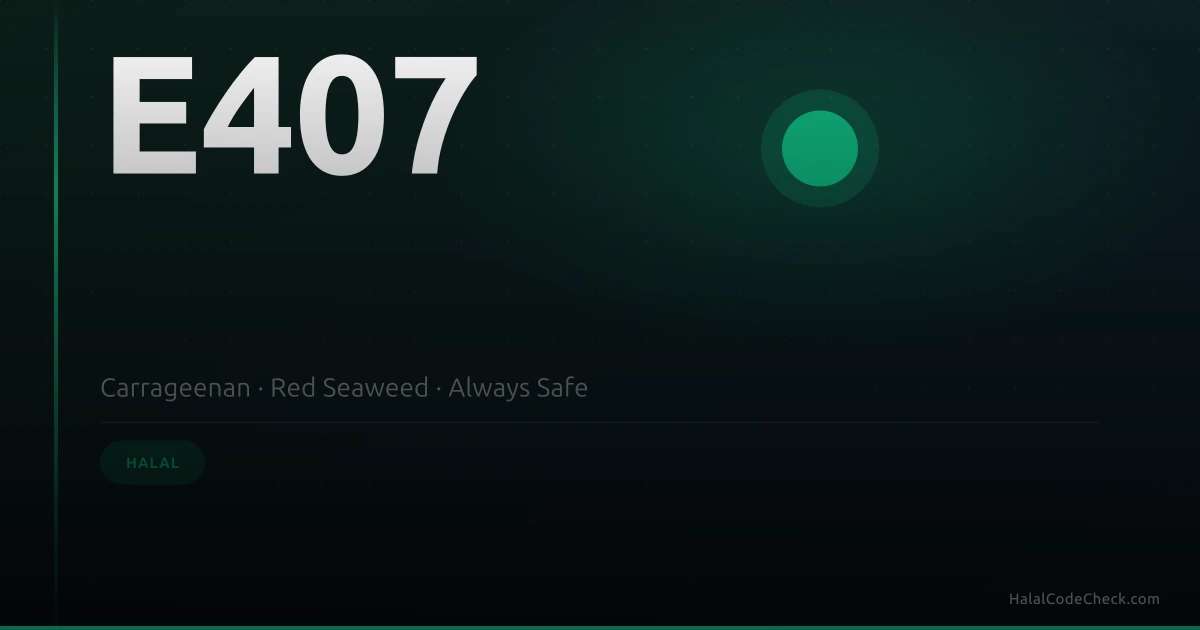
You see E407 or carrageenan on a dairy, meat, or confectionery label. Is it halal?
Yes — carrageenan is halal. It comes from red seaweed with no animal origin and no haram processing steps.
What Is Carrageenan (E407)?
Carrageenan is a natural polysaccharide (a type of carbohydrate) extracted from certain species of red seaweed, particularly Chondrus crispus (Irish moss) and Kappaphycus alvarezii.
In food, it functions as a:
- Thickener — increases viscosity of liquids
- Gelling agent — forms soft gels
- Stabiliser — prevents ingredient separation
It appears on labels as:
- E407
- Carrageenan
- Carrageen or Carragheen
- Irish moss extract
- Semi-refined carrageenan (E407a)
Is Carrageenan (E407) Halal?
Yes — carrageenan is halal.
| Criterion | Status |
|---|---|
| Source | Red seaweed — plant/algae origin |
| Processing | Water or alkaline extraction — no haram solvents |
| Animal origin | None |
| Scholar consensus | Halal — widely accepted |
| Certification body position | Permitted; found in halal-certified products |
Carrageenan has no animal origin and involves no haram processing. It is analogous to agar agar (E406) in this respect — both come from red seaweed and are unconditionally halal.
Where Is Carrageenan Used?
| Product category | Why carrageenan is used |
|---|---|
| Chocolate milk and flavoured milks | Prevents cocoa from settling |
| Infant formula | Thickener and stabiliser |
| Processed deli meats | Improves texture, retains moisture |
| Ice cream | Prevents ice crystal formation |
| Plant-based dairy alternatives | Thickens oat milk, almond milk, etc. |
| Dairy-free cheese | Provides melt and texture |
| Cream, sour cream | Stabilises texture |
| Pet food | Gelling agent in wet food |
| Confectionery jellies | Gelling agent (often in combination with other gums) |
In deli meat products, carrageenan is used to bind water to the meat — this is why it appears in processed ham, chicken slices, and similar products. The carrageenan itself is halal, but the presence of carrageenan in a processed meat product does not make the meat halal — you still need to verify the meat source.
Carrageenan vs Gelatin — Why This Comparison Matters
Muslim shoppers sometimes confuse carrageenan with gelatin because both can be used to create soft gels in food. They are completely different:
| Carrageenan (E407) | Gelatin (E441) | |
|---|---|---|
| Source | Red seaweed | Animal collagen (pork, beef, fish) |
| Halal status | ✅ Always halal | ⚠️ Source-dependent |
| Vegan | ✅ Yes | ❌ No |
If a product uses carrageenan as its gelling agent rather than gelatin, that is a positive indicator — the gelling function has no halal concern.
Any Health Debate?
There is an ongoing debate in nutritional science (not in Islamic jurisprudence) about whether carrageenan at high doses may cause digestive inflammation. This is a nutritional question, not a halal one. The halal status of carrageenan is not affected by this debate.
Summary
| E-code | E407 |
| Name | Carrageenan |
| Source | Red seaweed |
| Halal status | Halal |
| Vegan | Yes |
| Found in | Dairy, dairy alternatives, processed meat, confectionery |
Carrageenan is one of the few food additives where Muslim shoppers can stop reading and move on — it requires no further verification.
For the full E407 technical entry, see the E-codes database. To scan a full ingredient list including carrageenan and other additives, use Verify Ingredients.
How we reached this verdict
We checked the following Tier-1 sources before publishing this verdict:
- Halal certification bodies (HMC, HFA, JAKIM, MUI): Where the ingredient appears in certified products, the certifying body’s audit covers source verification; where it appears in uncertified products, manufacturer disclosure is required.
- Manufacturer statements: Public ingredient lists, vegetarian / vegan suitability labels, customer-service correspondence on source disclosure.
- Sunni fatwa scholarship across the four madhabs:
- Hanafi-leaning bodies: IslamQA Hanafi, Darul Iftaa Birmingham (Mufti Mohammed Haroon Hussain), AskImam.org (Mufti Ebrahim Desai), Daruliftaa.com (Mufti Taqi Usmani), Wifaqul Ulama, Darul Iftaa New York.
- Shafi’i / Maliki-leaning bodies: NU (Nahdlatul Ulama, Indonesia), Dar al-Ifta al-Misriyyah (Egypt), e-fatwa.com (UAE), al-Azhar.
- Hanbali / Saudi-Salafi-leaning bodies: Saudi Permanent Committee for Scholarly Research, IslamQA Saudi.
Madhab note
The four Sunni madhabs broadly converge on the rules applied in this guide:
- Pork-derived sources (pig fat, pig gelatine, pig-derived enzymes) — Haram across all four madhabs.
- Alcohol-based ingredients (intoxicants, residual fermentation alcohol that intoxicates) — Haram across all four madhabs.
- Source-ambiguous E-codes (E471, E476, E631, E627, E635, E920) — require source verification across all four schools; manufacturer plant-source disclosure (vegetarian-suitable label) is treated as sufficient under the Hanafi/Maliki/Shafi’i mainstream rule (Darul Ifta Birmingham, IslamQA case 245452); HMC-strict / Hanbali-leaning view requires formal independent certification.
- Istihāla (transformation) — Hanafi and Maliki accept istihāla strongly, so spirit vinegar (alcohol → vinegar) is halal. Most Shafi’i scholars permit spirit vinegar specifically. Some Hanbali scholars are more cautious on transformed haram products.
- Insect-derived dyes (E120 cochineal/carmine) — Hanafi, Shafi’i, and Hanbali generally treat as haram; some Maliki scholars permit small insects.
- Non-zabihah meat (Ahl al-Kitāb / People-of-the-Book slaughter) — Maliki and classical Shafi’i/Hanbali generally accept; Hanafi-Deobandi tradition more restrictive.
If your madhab differs on a specific ruling, the relevant section above flags the school-specific position. For binding rulings on borderline products, consult a competent scholar in your tradition.
Ingredients change. Be first to know.
Brands reformulate without warning. We track every E-code update and halal certification — one short weekly email.
Related Articles
 E-Codes & Additives
 Is L-Cysteine (E920) Halal? The Bread Additive With a Hidden Source
L-cysteine (E920) in bread can be derived from human hair, duck feathers, or synthetic production. Human hair source is haram. Synthetic E920 is halal. Here's how to tell.
 E-Codes & Additives
 Is Shellac (E904) Halal? The Insect-Derived Glazing Agent
Shellac (E904) is a resin secreted by lac insects used to coat confectionery and apples. Most scholars consider it haram. Here's what to look for on labels.
 E-Codes & Additives
 Is E415 (Xanthan Gum) Halal? Yes - Here's Why
E415 (Xanthan Gum) is halal in the vast majority of commercial products. Learn what it is, where it comes from, and the one edge case worth knowing about.