
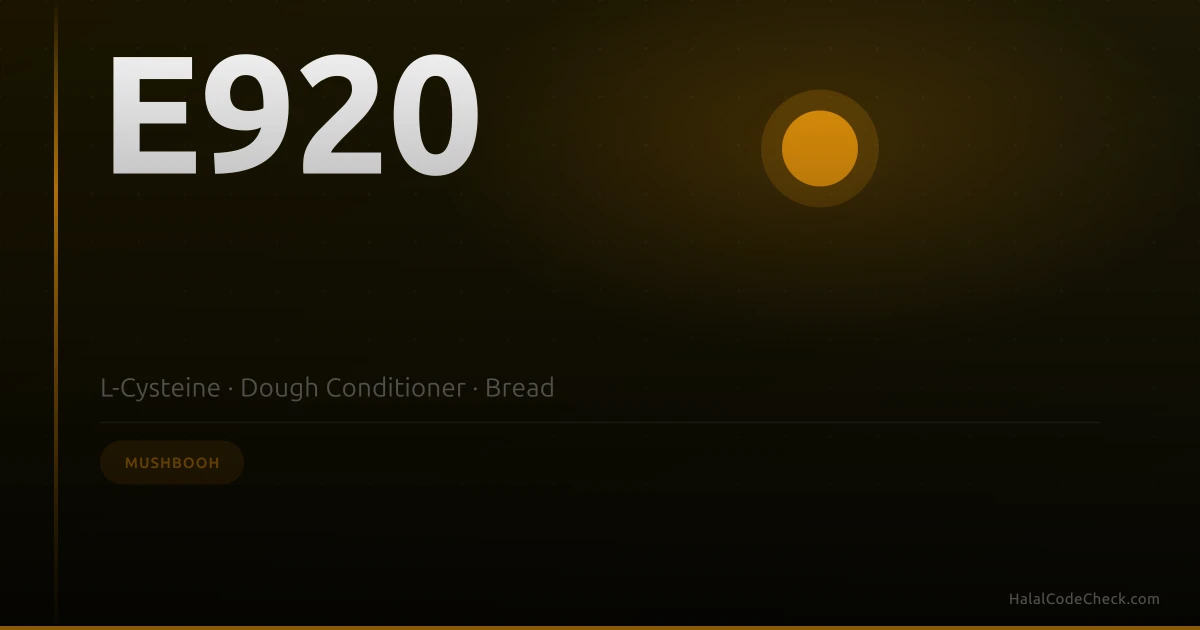
You see E920 on a bread label. It’s listed as a dough conditioner. Is it halal?
It depends on the source — and the source is almost never disclosed on the label.
L-cysteine (E920) is an amino acid used in commercial bread baking to improve dough flexibility and reduce mixing time. It sounds innocuous — but where it comes from can make it haram.
What Is L-Cysteine (E920)?
L-cysteine is a naturally occurring amino acid found in proteins. In bread manufacturing, it is used as a dough conditioner (also called a reducing agent or flour treatment agent). It:
- Relaxes the gluten network in dough
- Reduces mixing time
- Improves dough extensibility (stretch)
- Helps produce softer, more uniform bread at scale
It appears on UK/EU labels as:
- E920
- L-cysteine hydrochloride
- Flour treatment agent: E920
Sources of L-Cysteine — and Why It Matters
| Source | Halal status | How common |
|---|---|---|
| Human hair (hydrolysis) | Haram — najas (filth) | Historically common, especially from China; declining |
| Duck or poultry feathers | Haram by majority ruling (non-zabiha animal product) | Common |
| Pig bristles/hoofs | Haram | Less common |
| Synthetic production | Halal | Increasingly common |
| Fermentation (bacterial) | Halal | Growing |
The cheapest historical source of L-cysteine was human hair collected from hair salons and barbershops, predominantly in China. Hair is dissolved in hydrochloric acid and L-cysteine is extracted. This source is considered najas (impure) and haram under Islamic law.
Duck or chicken feathers (feather hydrolysate) are now a more common source. Most scholars consider this haram because the feathers come from birds not slaughtered according to Islamic requirements.
Synthetic L-cysteine (produced via chemical synthesis or fermentation) raises no halal concerns. Major food companies have increasingly shifted toward synthetic or fermentation-derived L-cysteine in response to religious and ethical concerns.
Which Bread Products Use E920?
E920 is most commonly found in:
- Commercial soft bread — sliced white, burger buns, rolls
- Flatbreads — pitta, wraps, tortillas
- Pastry dough
- Pizza bases
- Fast food buns (McDonald’s, Burger King, etc.)
Artisan, sourdough, and bread made with only flour, water, salt, and yeast will not contain E920.
How to Check Your Bread
1. Look for E920 or L-cysteine in the ingredients
If it is present, the source is not identifiable from the label alone.
2. Look for halal certification
A halal certification mark (HMC, HFA, JAKIM) means the certifying body has confirmed the E920 source is halal — typically synthetic or fermentation-derived. This is the most reliable check.
3. Contact the manufacturer
Ask specifically: “What is the source of the L-cysteine (E920) used in this product? Is it animal-derived, human hair, or synthetic?”
Many major UK bread brands have documented their E920 sources for customer queries. Warburtons, for example, has confirmed synthetic L-cysteine sources in their certified halal products.
4. Choose E920-free bread
Artisan bread, sourdough, and many organic bread products do not use E920. A shorter ingredient list is a practical workaround.
Summary
| E920 source | Halal status |
|---|---|
| Human hair | Haram |
| Duck/poultry feathers | Haram (majority ruling) |
| Pig-derived | Haram |
| Synthetic | Halal |
| Fermentation (bacterial) | Halal |
| Unspecified “E920” | Mushbooh — verify before consuming |
E920 in uncertified commercial bread is mushbooh. The safest options are either halal-certified bread (source verified) or bread made without E920 (artisan, sourdough, or short-ingredient-list varieties).
Search E920 in the E-codes database for the full technical entry, or use Verify Ingredients to check all additives in a bread label at once.
How we reached this verdict
We checked the following Tier-1 sources before publishing this verdict:
- Halal certification bodies (HMC, HFA, JAKIM, MUI): Where the ingredient appears in certified products, the certifying body’s audit covers source verification; where it appears in uncertified products, manufacturer disclosure is required.
- Manufacturer statements: Public ingredient lists, vegetarian / vegan suitability labels, customer-service correspondence on source disclosure.
- Sunni fatwa scholarship across the four madhabs:
- Hanafi-leaning bodies: IslamQA Hanafi, Darul Iftaa Birmingham (Mufti Mohammed Haroon Hussain), AskImam.org (Mufti Ebrahim Desai), Daruliftaa.com (Mufti Taqi Usmani), Wifaqul Ulama, Darul Iftaa New York.
- Shafi’i / Maliki-leaning bodies: NU (Nahdlatul Ulama, Indonesia), Dar al-Ifta al-Misriyyah (Egypt), e-fatwa.com (UAE), al-Azhar.
- Hanbali / Saudi-Salafi-leaning bodies: Saudi Permanent Committee for Scholarly Research, IslamQA Saudi.
Madhab note
The four Sunni madhabs broadly converge on the rules applied in this guide:
- Pork-derived sources (pig fat, pig gelatine, pig-derived enzymes) — Haram across all four madhabs.
- Alcohol-based ingredients (intoxicants, residual fermentation alcohol that intoxicates) — Haram across all four madhabs.
- Source-ambiguous E-codes (E471, E476, E631, E627, E635, E920) — require source verification across all four schools; manufacturer plant-source disclosure (vegetarian-suitable label) is treated as sufficient under the Hanafi/Maliki/Shafi’i mainstream rule (Darul Ifta Birmingham, IslamQA case 245452); HMC-strict / Hanbali-leaning view requires formal independent certification.
- Istihāla (transformation) — Hanafi and Maliki accept istihāla strongly, so spirit vinegar (alcohol → vinegar) is halal. Most Shafi’i scholars permit spirit vinegar specifically. Some Hanbali scholars are more cautious on transformed haram products.
- Insect-derived dyes (E120 cochineal/carmine) — Hanafi, Shafi’i, and Hanbali generally treat as haram; some Maliki scholars permit small insects.
- Non-zabihah meat (Ahl al-Kitāb / People-of-the-Book slaughter) — Maliki and classical Shafi’i/Hanbali generally accept; Hanafi-Deobandi tradition more restrictive.
If your madhab differs on a specific ruling, the relevant section above flags the school-specific position. For binding rulings on borderline products, consult a competent scholar in your tradition.
Ingredients change. Be first to know.
Brands reformulate without warning. We track every E-code update and halal certification — one short weekly email.
Related Articles
 E-Codes & Additives
 Is Shellac (E904) Halal? The Insect-Derived Glazing Agent
Shellac (E904) is a resin secreted by lac insects used to coat confectionery and apples. Most scholars consider it haram. Here's what to look for on labels.
 E-Codes & Additives
 Is Carrageenan (E407) Halal? The Seaweed Thickener Explained
Carrageenan (E407) is derived from red seaweed and is halal — no animal ingredients, no haram processing. Learn where it is used and why it is safe for Muslim shoppers.
 E-Codes & Additives
 Is E415 (Xanthan Gum) Halal? Yes - Here's Why
E415 (Xanthan Gum) is halal in the vast majority of commercial products. Learn what it is, where it comes from, and the one edge case worth knowing about.