
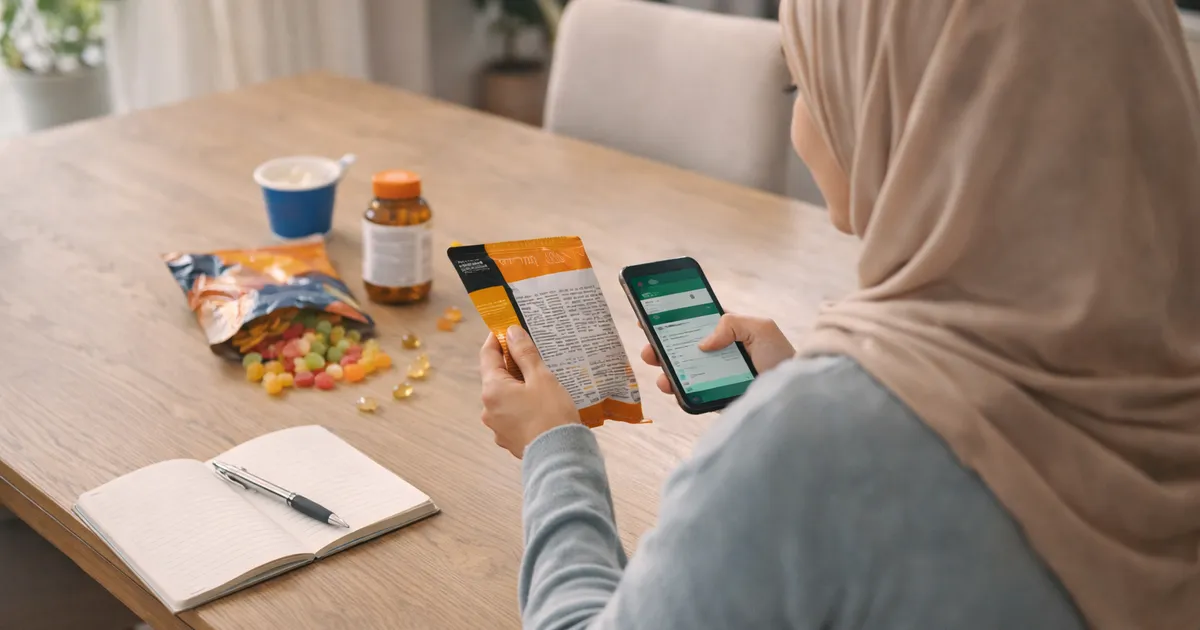
These are the halal food questions Muslim shoppers search for most - and the answers are often buried under vague advice or conflicting opinions.
Here are clear, practical answers you can actually use at the store, at home, or when someone asks you “is this halal?“
1) Are all E-codes haram?
No. E-codes are just identification numbers for food additives. Many are completely halal - E300 is vitamin C, E330 is citric acid. Others like E120 (from beetles) are haram, and some like E471 depend entirely on their source.
The code itself doesn’t tell you the halal status. The source does.
Quick reference: E-Codes Halal Guide | Full E-codes database (370+ codes)
2) Is E471 halal?
It depends on the fat source. E471 (mono and diglycerides) can be made from plant oils (halal), beef fat (halal if zabiha), or pork fat (haram). Two products can both list E471 - one halal, one not.
How to check: E471 details and lookup | Full E471 guide
3) Is gelatin halal?
Usually not. In Western countries, 60-80% of gelatin comes from pork. Beef gelatin is only halal if the animal was slaughtered according to Islamic guidelines. Fish gelatin is always halal but uncommon.
If a label just says “gelatin” with no qualifier, assume pork.
Deep dive: Gelatin complete guide
4) Does “vegetarian” mean halal?
Not always. “Vegetarian” means no meat - but halal also covers additive sources, alcohol-based processing, and cross-contamination. A vegetarian product can still contain E471 from animal fat or flavors extracted with alcohol.
It’s a useful signal, but it’s not a halal certification.
Full breakdown: Why vegetarian doesn’t always mean halal
5) Is “natural flavor” halal?
Sometimes yes, sometimes unclear. “Natural flavor” is a regulatory category, not a halal verdict. It can mean plant extracts (halal), animal-derived flavoring (possibly not halal), or alcohol-based extracts. Without more detail from the manufacturer, you can’t know for certain from the label alone.
Rule of thumb: If the product has halal certification, the natural flavors have been verified. If not, contact the manufacturer.
6) I accidentally ate something haram. What should I do?
Most scholars distinguish between genuine mistakes and deliberate choices. If you ate something non-halal without knowing, you haven’t sinned intentionally. Seek guidance from a scholar you trust, make dua, and focus on building better verification habits going forward.
The fact that you’re asking this question shows you care - that matters.
7) Can I trust one halal certification logo everywhere?
Certification quality varies. Not all halal certifiers audit to the same standards, and recognition differs by region. IFANCA, HFA, HMC, and MUI are among the more widely recognized bodies, but it’s worth learning which certifiers are credible in your country.
Practical tip: Pick 2-3 certifiers you trust and look for those consistently.
8) Do I need to avoid all processed foods?
No. You need a reliable verification method, not total avoidance. Many processed foods are perfectly halal. The issue isn’t processing itself - it’s specific additives that can be source-dependent.
A quick ingredient scan takes seconds and tells you exactly what’s safe and what’s not.
9) What’s the fastest way to check halal status in-store?
Three options, from fastest to most thorough:
- Look for halal certification on the package (5 seconds)
- Scan the ingredient label with HalalCodeCheck (15 seconds)
- Search specific codes in the E-codes database (30 seconds each)
For a complete in-store workflow, see our 5-minute label reading guide.
10) Is MSG (E621) halal?
Usually, yes. Most MSG is produced through bacterial fermentation and is halal. However, the culture media used in fermentation can occasionally be animal-derived. If the product is halal-certified, the MSG source has been verified.
Quick lookup: E621 details
11) Are cheese and yogurt always halal if there’s no meat?
No. Cheese can contain animal rennet (from calf stomachs). Yogurt can contain gelatin as a thickener. Both may use emulsifiers or flavor systems with unclear sources. “No meat” doesn’t mean “no animal-derived ingredients.”
Safe approach: Check for “vegetarian rennet” on cheese. Check yogurt ingredients for gelatin or E441. Browse dairy products for a full E-code breakdown of this category.
12) How do I stop overthinking every label?
Build a system, not a habit of anxiety. Here’s what works:
- Certified first - if it has a trusted halal logo, move on
- Verify unclear additives once - use HalalCodeCheck or the E-codes database
- Keep a safe list - products you’ve verified don’t need re-checking
- Re-check when formulas change - manufacturers update recipes, so revisit occasionally
After a few weeks, you’ll have a reliable list and most shopping decisions become automatic.
For a quick-reference of the most commonly missed categories, see 10 Foods You Thought Were Halal (But Usually Are Not).
A Practical Weekly Routine
If you want less stress and fewer mistakes, try this:
- Once a week: Spend 10 minutes checking any new products you bought
- Save trusted brands: Add verified products to your safe list
- Teach family members: Share a simple 3-step check (halal logo → scan ingredients → ask if unsure)
- Bookmark the E-codes database: Quick reference whenever you need it
This turns halal shopping from constant uncertainty into a repeatable routine that gets easier every week.
What To Do Next
Most halal food confusion isn’t because people don’t care - it’s because labels are inconsistent and life is busy.
You don’t need perfect memory. You need a practical method you can keep using:
- Scan your next grocery haul - check everything at once after you get home
- Share this guide - chances are someone in your family or community is asking the same questions
- Bookmark the E-codes database - your quick-reference for any additive, anytime
Related Articles
 Ingredients
 15 Haram Ingredients Hiding in Everyday Groceries (Most Shoppers Miss These)
From gelatin to L-cysteine, these 15 ingredients are in products most Muslim shoppers consider safe. Learn exactly where they hide and how to spot them fast.
 Ingredients
 Is Agar Agar Halal? Yes - The Seaweed Gelling Agent That's Always Safe
Agar agar (E406) is 100% halal - plant-derived from red seaweed with no animal processing. Learn where it's used, how it compares to gelatin, and how to spot it on labels.
 How-To Guides
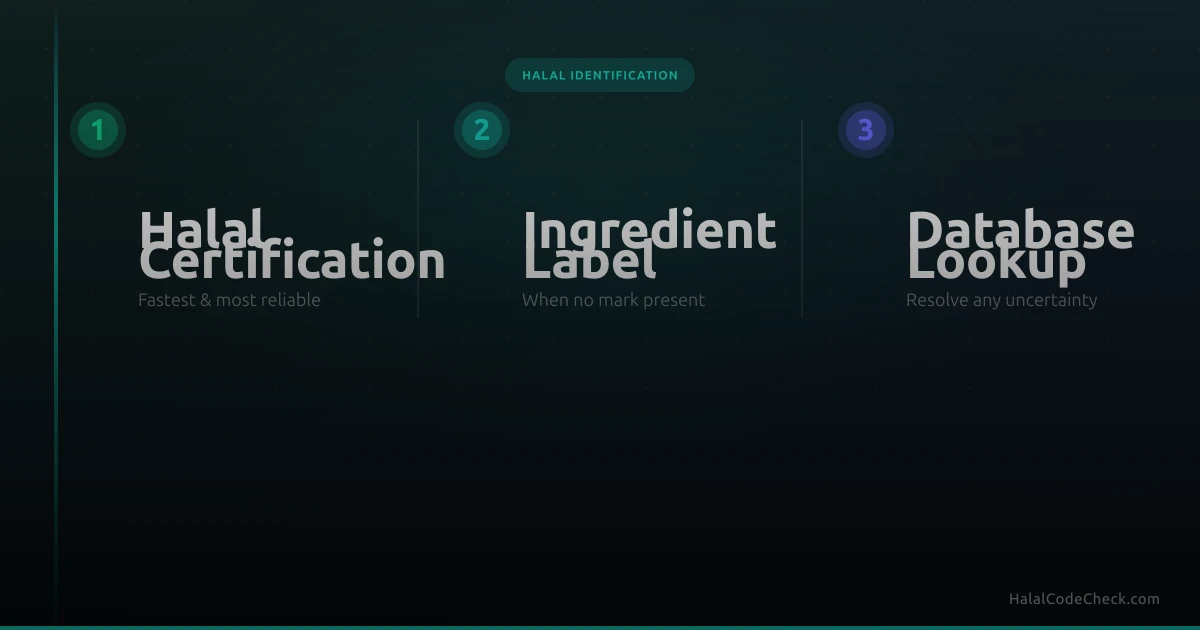
 How to Identify Halal Products: A Practical 3-Step System
Learn how to identify halal products quickly and confidently - certification marks, ingredient label reading, E-codes to watch, and tools that do the checking for you.
Ready to verify E-codes instantly?
Stop guessing about food ingredients. Use HalalCodeCheck to scan products and get instant halal verification.