
You’re standing in the aisle. You have ten seconds before your kid loses patience. Is this product halal?
Most guides on this topic tell you to “look for a halal logo” and leave it there. But logos are missing from most products, especially in Western supermarkets. This guide gives you a complete system that works whether the logo is there or not.
The 3-method system
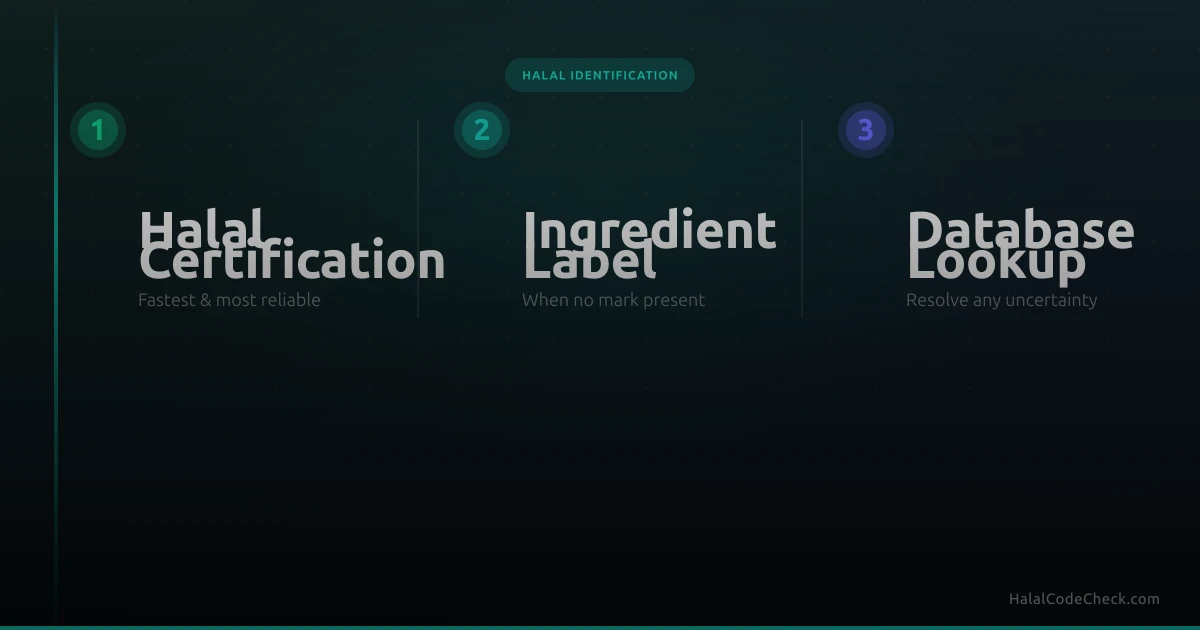
Every halal check follows the same order of reliability:
- Halal certification mark — fastest, most reliable
- Ingredient label reading — works when there’s no certification
- Database or tool lookup — resolves uncertainty on specific additives
Use them in this order. If method 1 gives you an answer, stop. Move to method 2 only if needed.
Method 1: Find the halal certification mark
A halal certification mark means an accredited body has audited the product and confirmed its ingredients and manufacturing process meet Islamic dietary requirements.
What to look for:
The mark will usually say “Halal” in Arabic (حلال) or English, often with the certifying body’s initials. Recognised bodies include:
- HMC (Halal Monitoring Committee) — widely respected in the UK, strict slaughter standards
- HFA (Halal Food Authority) — one of the oldest UK certifiers
- IFANCA — major US and international certifier
- JAKIM — Malaysia’s government halal authority, common on imported products
- MUI — Indonesia’s national certifier
Where to look: Back of pack near the ingredients list, or on the front near the product name.
One important caveat: A halal mark only covers what it was issued for. If a product has a halal mark for its “original” recipe but the variant you’re holding has different ingredients, the mark may not apply. Always check you have the right variant.
If you find a recognised halal mark: You’re done. Put it in the trolley.
Method 2: Read the ingredient label
When there’s no certification, you need to read the label. This takes under a minute once you know what to scan for.
Step 1 — Scan for obvious haram ingredients first
These words on a label are immediate stops regardless of anything else:
- Pork / pig / lard / bacon / ham / gelatin (without “fish” or “beef halal” qualifier)
- Alcohol / wine / beer / ethanol in significant quantities
- Carmine / cochineal / E120 — derived from insects
If you see any of these, put the product back unless it carries a halal certification that specifically addresses that ingredient.
Step 2 — Check the E-codes
E-codes are the European numbering system for food additives. They’re not inherently suspicious — most are completely halal. But a small number are derived from animal sources or have sourcing questions.
E-codes that need checking:
| E-code | Name | Issue |
|---|---|---|
| E120 | Cochineal / Carmine | Insect-derived — haram |
| E441 | Gelatin | Usually pork — haram unless certified |
| E471 | Mono & Diglycerides | May be animal-derived — mushbooh |
| E472 | Esters of Mono & Diglycerides | Same source concern as E471 |
| E422 | Glycerol | May be animal-derived — mushbooh |
| E542 | Bone Phosphate | Animal bone-derived — haram |
The full picture: see our E-Codes Halal Guide or browse the complete E-codes database.
Step 3 — Handle Mushbooh ingredients
Mushbooh means “doubtful” — the ingredient can be halal or haram depending on its source. The label won’t tell you which.
Your options when you find a mushbooh ingredient:
- Does the product have halal certification? If yes, the source is already verified — proceed.
- Does the label specify the source? “Soya lecithin” or “sunflower mono and diglycerides” = halal. “From animal fat” or no qualifier = uncertain.
- Can you contact the manufacturer? A simple email usually gets a clear answer within a few days.
- Is there a similar product without the ingredient? Often the easiest path.
Method 3: Use a database or scanning tool
When you’re not sure about a specific ingredient or E-code, look it up rather than guessing.
E-codes database — search any E-code number and get its halal status, source details, and what to verify. 370+ codes covered.
Scan the ingredient list — photograph or type the ingredient list and get a full breakdown of every additive — halal, haram, or mushbooh — in one result. Fastest option in the aisle.
Common mistakes that catch people out
”It says vegetarian, so it must be halal.”
Vegetarian and halal are not the same. A product can be vegetarian (no meat) and still contain:
- Alcohol-based flavorings
- E120 (cochineal — an insect, not an animal in the vegetarian definition)
- Rennet from non-halal slaughter in cheese
Full breakdown: Why Vegetarian Doesn’t Always Mean Halal
”It’s imported from a Muslim-majority country.”
Country of origin does not equal halal certification. Many products exported from Muslim-majority countries are made for international markets and may use different ingredient sourcing for the export version. Always check the label you’re holding, not assumptions about the brand’s country.
”It’s in a health food shop so it must be fine.”
Health food and organic products often use the same additives as mainstream products. E441 (gelatin) appears in some organic gummy vitamins. E120 appears in some natural food colourings. The channel doesn’t change the ingredient.
”Gelatin is listed but no source — it’s probably beef.”
In Western markets, unlabelled gelatin is statistically likely to be pork-derived. The gelatin guide covers this in detail, but the short answer: if it just says “gelatin” on a Western product with no halal mark, assume pork unless the manufacturer confirms otherwise.
How long does this actually take?
With practice, a full label check takes 20–30 seconds:
- 5 seconds: scan for a halal mark
- 10 seconds: scan the ingredient list for obvious haram ingredients
- 10 seconds: check any E-codes using the scanner if needed
The first few times take longer. After a month of shopping with this system, you’ll know the products you buy regularly and only need to check new items.
Quick FAQ
What is the fastest way to check if a product is halal?
Look for a recognised halal certification mark first. If there isn’t one, scan the ingredient list — you’ll get a result for every additive in the product within seconds.
What ingredients make a product haram?
Pork and pork derivatives (lard, gelatin, collagen), alcohol in measurable quantities, blood, insects (E120/cochineal), and any ingredient from an animal not slaughtered according to Islamic requirements.
Can I trust “suitable for vegetarians” as a halal indicator?
It helps — it rules out pork gelatin and meat fats. But it doesn’t confirm the product is halal. Some haram ingredients (E120, certain alcohol-based flavourings) are vegetarian but not halal.
Are all E-numbers safe?
Most are. The majority of E-codes are plant-derived or synthetic and fully halal. A specific subset has animal sourcing concerns. See the full E-codes status list — the problematic ones are a small minority.
How do I verify an ingredient I’m unsure about?
Search it in the E-codes database, or look up the manufacturer’s customer service contact and ask directly about the specific ingredient’s source. Most brands will confirm in writing.
Your system in three steps
- Check for a halal certification mark — if present from a recognised body, done
- Scan for haram ingredients — obvious stops first, then E-codes
- Resolve Mushbooh codes — check certification, label wording, or contact the brand
Once you’ve verified a product once, you won’t need to check it again. Build a mental (or physical) list of your regular products. The checking gets faster every week.
Start now: Scan any ingredient list →
Related Articles
 E-Codes & Additives
 Is E110 (Sunset Yellow) Halal? The Complete Guide
E110 (Sunset Yellow FCF) is Mushbooh — halal as dry powder, but depends on the solvent if liquid. Learn what countries require warnings, where it hides, and how to check fast.
 How-To Guides
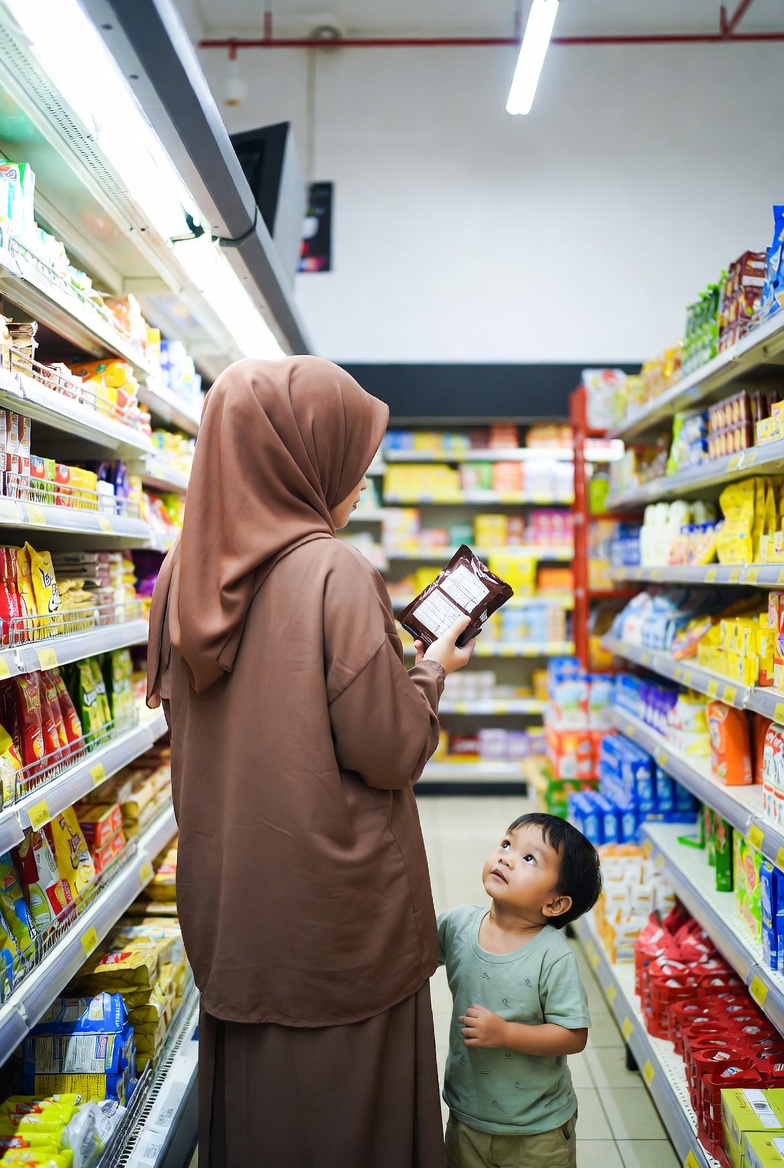
 Reading Food Labels: A Muslim Parent's 5-Minute Halal Crash Course
A practical, parent-friendly system to check ingredient labels quickly without stress. Learn what to scan first and what to verify later.
 Ingredients
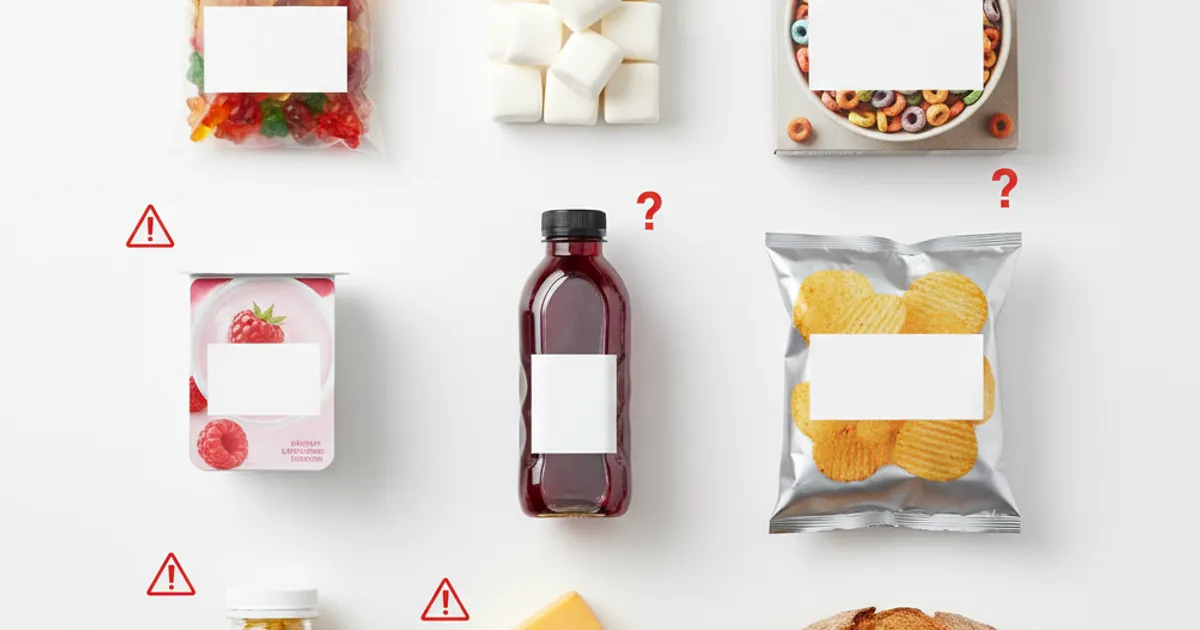
 10 Foods You Thought Were Halal (But Usually Are Not)
A practical list of commonly misunderstood foods that can contain non-halal ingredients, plus safer alternatives for Muslim shoppers.
Ready to verify E-codes instantly?
Stop guessing about food ingredients. Use HalalCodeCheck to scan products and get instant halal verification.