
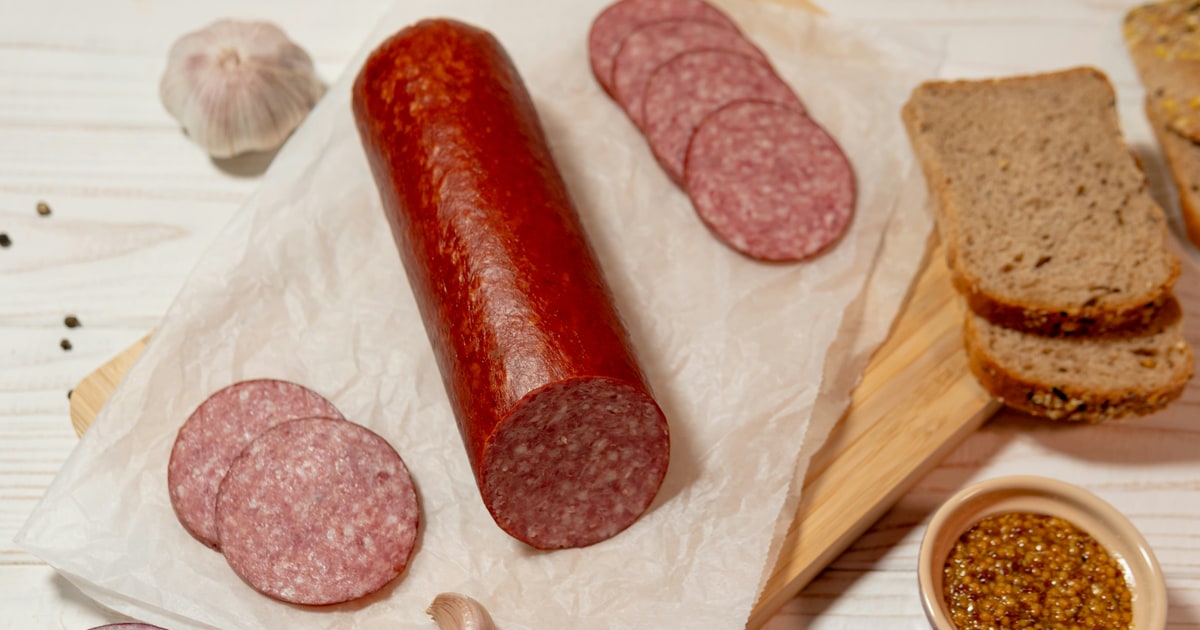
Traditional salami is a pork product — haram without qualification. Salami originated in Italy and Central Europe as a cured, fermented sausage made primarily from pork. The vast majority of salami sold in UK supermarkets, delis, and restaurants continues to use pork as the primary ingredient. Beef and turkey versions exist, but the burden is on the consumer to verify both the meat source and the slaughter method.
The History and Ingredients of Salami
Salami is produced by mixing minced meat with fat, salt, and spices, then fermenting and air-drying the mixture. The fermentation process lowers the pH, which preserves the meat without refrigeration. In traditional European recipes, the meat is pork, and pork fat is used for the characteristic marbling visible in each slice.
There is no processing step that transforms the pork into something permissible. Fermentation and drying change the texture and flavour but do not constitute the kind of complete chemical transformation (istihalah) that could render pork halal under any of the four Sunni madhabs.
UK Supermarket Salami: What You Will Find
Walking the deli aisle of any major UK supermarket — Tesco, Sainsbury’s, Asda, Waitrose, M&S — the default product is pork salami. Varieties include:
- Milano salami — pork, finely ground
- Napoli/Napolitana salami — pork, coarsely ground, spicy
- Chorizo — technically a different product, also pork, commonly shelved with salami
- Hungarian salami — pork with paprika
- Genoa salami — pork with garlic and pepper
All of these are haram. The label will list pork as the primary ingredient.
Beef and Turkey Salami: The Certification Requirement
Beef salami and turkey salami are genuine alternatives to pork salami in terms of taste and texture. Several manufacturers produce these specifically for Muslim consumers and for the kosher market. However, the meat itself being beef or turkey does not automatically make the product halal:
- Slaughter method — beef and turkey must be slaughtered according to Islamic rites (zabiha) by a Muslim who invokes the name of Allah. Conventional UK beef slaughter does not meet this standard.
- Casing — salami is traditionally cased in animal intestines, which may be pork intestines even in a “beef salami” product. Halal-certified products use either beef-derived casings or collagen/plant-based casings.
- Additives — flavourings and processing aids may have animal-derived components. In certified products, the entire supply chain is audited.
Certification is the only reliable verification. A label reading “beef salami” without a halal certification logo is Mushbooh.
Certification Bodies to Look For
| Body | Country | What It Covers |
|---|---|---|
| HMC (Halal Monitoring Committee) | UK | Strict certification; widely trusted in UK Muslim communities |
| HFA (Halal Food Authority) | UK | Major UK certification body; different threshold from HMC |
| JAKIM | Malaysia | Government-backed; high trust across global Muslim communities |
| MUI | Indonesia | Widely recognised; common on Asian imported products |
| IFANCA | USA | American Islamic Food and Nutrition Council |
The absence of any of these logos on a salami product means the halal status of the meat, casing, and additives has not been independently verified.
Halal Salami Brands Available in the UK
Tahira
Tahira produces beef and chicken deli meats including salami-style products. Available in UK halal supermarkets and some mainstream stores in areas with significant Muslim populations.
Deli Counter Risks
Many UK halal supermarkets also operate deli counters. Even where the product behind the counter is halal-certified, ask:
- Is the slicing equipment dedicated to halal products, or shared with non-halal meats?
- Has the counter staff been trained in halal cross-contamination protocols?
Cross-contamination from a shared slicer that has cut pork is a real concern. Dedicated halal delicatessens typically use segregated equipment.
E-Codes in Salami
Salami typically contains:
- E250 (sodium nitrite) — a curing agent; mineral-derived, halal in isolation. Present in both pork and halal salami.
- E252 (potassium nitrate) — another curing salt; mineral-derived, halal.
- E316 (sodium erythorbate) — an antioxidant used to maintain colour; synthetically produced from plant-derived erythorbic acid, halal.
- Natural flavourings — in pork salami, these may be pork-derived. In certified halal products, flavourings must meet certification standards.
The E-codes in salami are not themselves the primary concern — the pork content is. But they illustrate why full ingredient transparency and certification matter.
Practical Guidance
When buying salami-style products:
- Reject any product listing pork in the ingredients. This is non-negotiable.
- Look for a recognised halal certification logo on the front or back of pack.
- Verify the casing material if it is not stated — contact the manufacturer.
- At a deli counter, ask for the full ingredient list and whether the equipment is segregated.
- For pizza and sandwiches made at home or ordered out, confirm the salami used is certified halal.
Summary
| Factor | Detail |
|---|---|
| Traditional (pork) salami | Haram |
| Beef salami (uncertified) | Mushbooh — slaughter unverified |
| Beef salami (HMC/HFA certified) | Halal |
| Turkey salami (certified) | Halal |
| Mainstream UK supermarket salami | Pork — Haram |
| Halal UK brands | Tahira |
| Certification to look for | HMC, HFA, JAKIM, MUI |
Look up any E-code from a salami label in the E-codes database. Use the ingredient scanner to check a full deli product ingredient list in seconds.
How we reached this verdict
- UK halal certification bodies (HMC, HFA): Confirmed that conventional salami is pork-based and that beef/turkey alternatives require independent certification of slaughter and full supply chain.
- Sunni fiqh consensus: Pork is haram without exception across all four madhabs. Istihalah (transformation) arguments do not apply to cured pork products.
- Manufacturer labelling: UK supermarket salami ingredient lists reviewed.
Madhab note
All four Sunni madhabs are in complete agreement that pork is haram. For the beef/turkey variants, the madhabs converge on requiring halal slaughter — they differ only in whether Ahl al-Kitab (People of the Book) slaughter is acceptable, with classical Maliki and some Shafi’i positions permitting it more broadly. For certainty, certification from an established UK body removes this ambiguity.
Ingredients change. Be first to know.
Brands reformulate without warning. We track every E-code update and halal certification — one short weekly email.
Related Articles
 Ingredient Guides
 Is Pepperoni Halal? Pork, Beef & What to Buy Instead (2026)
Standard pepperoni is made from pork and is haram. Halal beef pepperoni exists but must carry certification. Full UK and US brand guide and pizza chain breakdown.
 Ingredient Guides
 Is Pepperami Halal? Unilever UK Ingredients Checked (2026)
Pepperami contains pork salametti — it is haram. Made by Unilever. No halal version is available in the UK. Full ingredient analysis and halal snack alternatives.
 Ingredient Guides
 Is Cat Food Halal? What Muslim Cat Owners Need to Know
Cats don't have to eat halal — but buying cat food containing pork or carrion is where scholars differ. The full ruling, plus what's actually in the tin.