
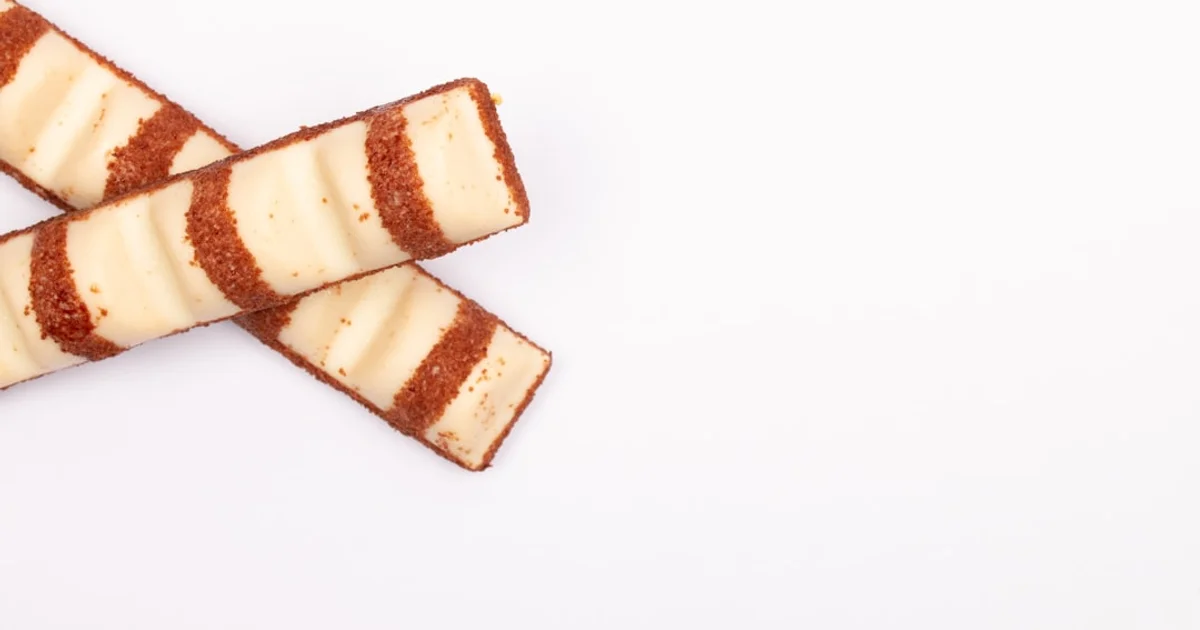
Roshen Konafetto is halal when the pack carries the Halal mark. The export packs sold in the US and Malaysia do, and the ingredient list backs it up: wafer, sugar, vegetable fat, milk powder, soya lecithin, flavourings. No gelatine. No E471. No E476.
Packs without the mark — stock imported straight from European production — are not confirmed. Treat those the way the Roshen brand page treats every unlabelled Roshen product: check the back label before buying. The one ingredient worth knowing about is the vanilla flavour’s 0.02% vanilla extract, covered below.
Which Konafetto Packs Carry the Mark
Roshen is a Ukrainian confectioner that does not certify its brand as halal. What it does instead is put a “Halal” or “Halal & Kosher” mark on a specific set of products it exports to diaspora markets — the 80% dark chocolate, Crabs caramel, Bim Bom hard candy, Bonny Fruit jellies, and Konafetto. Walmart lists all three Konafetto flavours with “Kosher, Halal” in the product name, which is how the US pack reads, and Malaysian retailers list the cocoa rolls as halal-labelled.
The mark is not on every Konafetto pack in the world. Roshen sells the same wafers across Europe and the CIS, and packs from those markets often carry no halal mark at all — the vanilla pack we read was one of them. Same recipe, different label. The label is the only assurance you have, because there is no certificate behind it. So the rule is simple: mark on the pack, buy; no mark, check the ingredient list on the back — which is what the next section gives you.
What Is Actually in Konafetto
We read the cocoa and vanilla ingredient panels from pack photographs. The cocoa pack photo shows the Halal mark. The vanilla pack scan we read does not show one — the “Kosher, Halal” for vanilla comes from the US retailer listing. The hazelnut panel we could not read ourselves; its US listing carries the same mark, and the recipe is a nut-cream variant of the same wafer.
| Flavour | Wafer | Filling | Emulsifier | Gelatine | Concern |
|---|---|---|---|---|---|
| Cocoa | Wheat flour, sugar, starch, coconut oil | Sugar, vegetable fat, fat-reduced cocoa 9.8%, caramel colour, anthocyanin, vanillin | Soya lecithin | None | None found — Halal mark seen on pack |
| Vanilla | Wheat flour, sugar, starch, coconut oil | Sugar, palm/sunflower oil, whey and whole milk powder, beta-carotene, vanillin, vanilla extract 0.02% | Soya lecithin | None | Trace vanilla extract — see note below; mark reported by retailer, not seen on the pack scan |
| Hazelnut | Same wafer | Hazelnut cream (pack not read by us) | Soya lecithin (per listing) | None listed | Confirm the mark on your pack |
The things that usually sink a wafer bar are absent. There is no gelatine — this is not a marshmallow or jelly product, so there is no reason for it to be there, and it is not. There is no E471 (mono- and diglycerides) and no E476 (PGPR), the two emulsifiers whose source Roshen does not disclose elsewhere in its range. The only emulsifier is soya lecithin, which is plant-derived on its face. The colours are caramel (E150d, synthetic), anthocyanin (plant) and beta-carotene (plant or synthetic). The dairy is milk powder and whey, which are halal.
The one thing worth knowing about the vanilla flavour: the pack lists “vanilla extract 0.02% (in the filling)”. Commercial vanilla extract is often alcohol-carried. At 0.02% of the filling it is a flavouring trace, not an ingredient you could taste or measure, and it sits well inside what mainstream Hanafi scholarship treats as a permissible non-intoxicating trace (see the madhab note). If your own rule is zero alcohol-carried flavourings of any kind, the cocoa flavour has no such line and is the one to pick.
Reading the Label
Roshen is a major Eastern European confectionery brand with no brand-wide halal certification. A growing set of export products — the 80% dark chocolate, Crabs Caramel, Bim Bom, Konafetto wafer rolls, Bonny Fruit pectin jellies and Peppinez sour candy — carry a 'Halal' or 'Halal & Kosher' mark on the pack. Others do not: the Double Peanuts bar contains E476 with no halal label, and the gummy range uses gelatine. Unlabeled Roshen products should be treated as status unknown.
Full Roshen brand guide →Roshen’s labelling has a pattern, and Konafetto fits it. The mark goes on products with simple, plant- or dairy-based formulations: hard candy, plain chocolate, pectin jellies, and wafers. It stays off products that lean on undisclosed-source emulsifiers — the Double Peanuts bar with its E476 — and off anything gelatine-set, like the Yummi Gummi Twists we checked earlier and told you to avoid. When Roshen leaves the mark off, there is usually an ingredient reason. When it puts the mark on, the ingredient list usually explains why it could.
Konafetto is the second kind. Wafer, sugar, fat, milk, lecithin, flavouring. Nothing that would make a “Halal” mark a lie.
That said, be precise about what the mark is. No certifying body appears on the pack — not HMC, not HFA, not JAKIM, not MUI. This is a manufacturer’s claim, and we treat it as label-level assurance, not certification. For a product this simple, a clean label plus a clean ingredient list is a sound basis. It is not the same thing as an audited certificate, and we do not call any Roshen product “certified”.
Halal Alternatives
If you would rather have a wafer with a certificate behind it than a label:
- Roshen’s own labelled range — Bim Bom, Crabs, Bonny Fruit and the 80% dark chocolate share the same label-level status as Konafetto, if it is Roshen you want
- Ülker wafer bars — a Turkish brand we rate Halal, with a halal programme covering its range
- Any wafer carrying an HMC, HFA, JAKIM or MUI logo on the pack — the logo is the difference between a claim and a certificate
As an Amazon Associate, HalalCodeCheck earns from qualifying purchases.
Summary
| Question | Answer |
|---|---|
| Is Roshen Konafetto halal? | Yes — “Kosher, Halal” on the pack, clean ingredient list |
| Does it contain gelatine? | No, in any flavour |
| Any source-ambiguous emulsifier (E471/E476)? | No — soya lecithin only |
| Is it halal if the pack has no mark? | Not confirmed — check the back label; US and Malaysian export packs carry the mark |
| Is it certified? | No — a manufacturer label claim, no certifying body named |
| Which flavour if you avoid all alcohol-carried flavourings? | Cocoa — the vanilla flavour lists 0.02% vanilla extract |
Look up soya lecithin, E150d and every other additive in the E-codes database.
To scan a full ingredient list for halal status in seconds, use the ingredient scanner.
How we reached this verdict
We checked the following Tier-1 sources before publishing this verdict:
- Halal certification bodies: No HMC, HFA, JAKIM, MUI or SANHA listing exists for Roshen Konafetto or for Roshen as a brand. The “Halal” on the pack is a manufacturer mark, not a certificate.
- Manufacturer statements: Roshen’s product pages list Konafetto in cocoa, vanilla and hazelnut. Roshen names no certifying body for any product.
- Pack photographs: Konafetto Cocoa 140 g (EAN 4823077633034) — Halal mark visible in the pack photo on Open Food Facts, ingredients read from the pack. Konafetto Vanilla 140 g (EAN 4823077631863) — ingredients read from the pack: no gelatine, milk-based filling, soya lecithin, vanilla extract 0.02%; no Halal mark recorded on that scan. Walmart US lists all three flavours as “Kosher, Halal” and Malaysian retailers list the cocoa rolls as halal-labelled — retailer text, treated as label reported for vanilla and hazelnut.
- Sunni fatwa scholarship across the four madhabs:
- Hanafi-leaning bodies: IslamQA Hanafi, Darul Iftaa Birmingham, AskImam.org, Daruliftaa.com (Mufti Taqi Usmani), Wifaqul Ulama, Darul Iftaa New York.
- Shafi’i / Maliki-leaning bodies: NU (Nahdlatul Ulama, Indonesia), Dar al-Ifta al-Misriyyah (Egypt), e-fatwa.com (UAE), al-Azhar.
- Hanbali / Saudi-Salafi-leaning bodies: Saudi Permanent Committee for Scholarly Research, IslamQA Saudi.
Madhab note
The four Sunni madhabs broadly converge on the rules applied in this guide:
- Milk powder and whey — halal across all four madhabs; dairy from a permissible animal needs no slaughter question.
- Soya lecithin (E322) — plant-derived, halal across all four madhabs; unlike E471 and E476 its source is stated by its name.
- Caramel colour E150d, anthocyanin, beta-carotene — synthetic or plant colourings, halal across all four madhabs. E150d is not the insect-derived carmine (E120).
- Trace alcohol-carried flavouring (vanilla extract 0.02%) — the Hanafi mainstream (Darul Iftaa Birmingham, Mufti Taqi Usmani) permits non-intoxicating trace quantities of a flavour carrier that is not itself grape or date wine, on the principle that the amount cannot intoxicate; many Shafi’i and Maliki bodies reach the same result. Some Hanbali and Saudi-Salafi scholars, and some strict Hanafi positions, advise avoiding any product where alcohol is used as a carrier. The cocoa flavour lists no such extract.
- Manufacturer label vs certification — all four schools accept a trustworthy manufacturer’s declaration for a simple product with no haram ingredient in view; HMC-strict and Hanbali-leaning views prefer independent certification where it is available.
If your madhab differs on a specific ruling, the relevant section above flags the school-specific position. For binding rulings on borderline products, consult a competent scholar in your tradition.
Ingredients change. Be first to know.
Brands reformulate without warning. We track every E-code update and halal certification — one short weekly email.
Related Articles
 Shopping Guides
 Halal Shopping at Coles: Aisle-by-Aisle Australia Guide (2026)
Coles stocks halal-certified meat from accredited abattoirs but own-brand packaged goods require E-code checking — here's what to look for in each aisle.
 Shopping Guides
 Halal Shopping at Carrefour: France, UAE & Turkey Guide (2026)
Carrefour's halal status varies by country — UAE stores stock certified halal products throughout, while French stores require label-by-label checking.
 Shopping Guides
 Halal Food in Malaysia: Beyond JAKIM — Full Supermarket & Brand Guide
JAKIM certification is Malaysia's gold standard but not every product on shelf is JAKIM-certified — here's how to shop confidently in Mydin, Giant, and Aeon.