
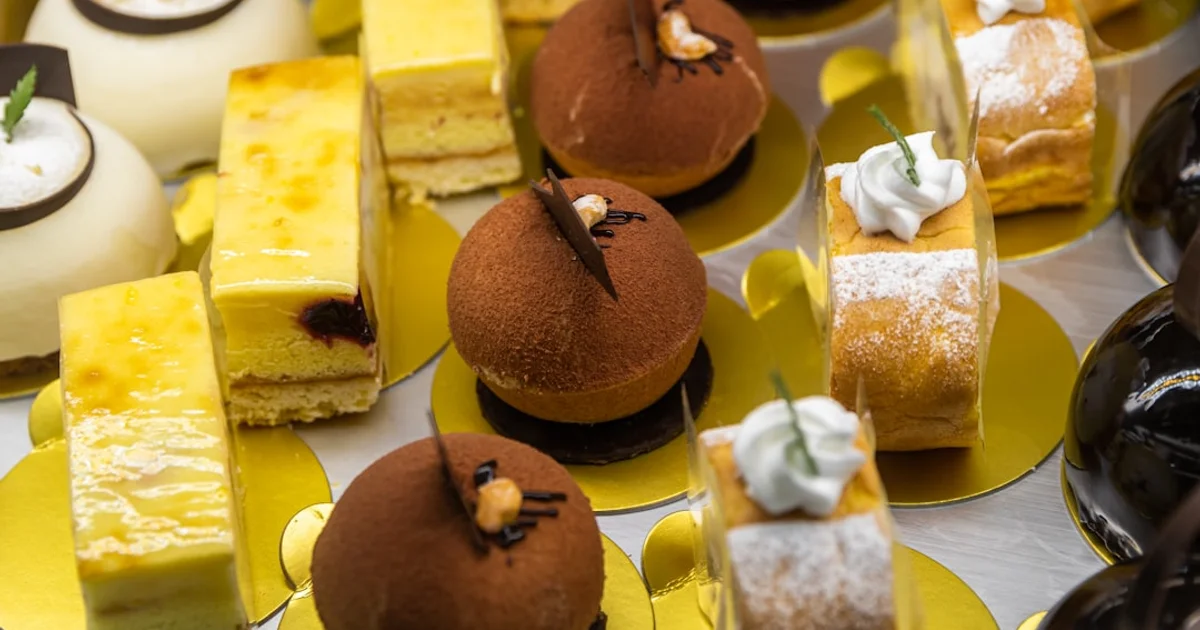
You’ve picked up a pack of Puk’s — the individually wrapped mini cakes Kuchenmeister sells for a coffee-break snack. The ingredient list looks reassuringly plain: sugar, flour, eggs, vegetable fats. Then you hit the emulsifier line, and it stops being simple.
The direct verdict: Puk’s is Mushbooh — no gelatine, no animal fat by name, but three ingredients (E471, E322, E422) have no stated source, and Puk’s isn’t confirmed on Kuchenmeister’s own halal-certified product list.
What’s Actually in Puk’s
The full ingredient list for the original variant: sugar, wheat flour, eggs, vegetable fats (palm, coconut), glucose-fructose syrup, fully hardened palm fat, low-fat cocoa powder, rapeseed oil, humectant (glycerin), skimmed milk powder, raising agents (diphosphates, sodium carbonates), natural flavouring, salt, emulsifiers (mono- and diglycerides of fatty acids, sorbitan tristearate, sodium stearoyl-2-lactylate, lecithins), acidity regulator (sodium acetates).
No pork, no lard, no gelatine, no explicit animal fat — the fats named are palm, coconut, and rapeseed, all plant sources. That’s a genuinely clean starting point compared to many bakery products.
The Three Ingredients That Matter
E471 (mono- and diglycerides of fatty acids) — the standard emulsifier ambiguity. Can be plant-derived (halal) or animal-derived, including from pork fat (haram). Kuchenmeister does not state which for Puk’s.
E322 (lecithin) — most commonly soy-derived in European bakery products, which would be halal, but the source isn’t printed on this specific label.
E422 (glycerin) — used as a humectant to keep the cake moist. Glycerin can come from plant oils (halal), animal fat (Mushbooh/Haram depending on source), or petrochemical synthesis (halal). Undisclosed here.
Two other emulsifiers, E481 (sodium stearoyl-2-lactylate) and E492 (sorbitan tristearate), are typically synthetic or plant-based and carry lower concern, though their sourcing isn’t stated either.
Kuchenmeister’s Halal Range — And Why It Doesn’t Automatically Cover Puk’s
This is the part worth understanding beyond just this one product. Kuchenmeister genuinely holds halal certification — confirmed through Gulfood’s exhibitor halal-certification listings and independent halal-product directories — for at least its Flammkuchen base and a Zitronenkuchen (lemon cake) line. That’s real, auditable certification, not a marketing claim.
But halal certification is granted product by product, not brand-wide. A company can be legitimately certified for some SKUs while others from the same factory have never gone through the same audit. No source found confirms Puk’s is on Kuchenmeister’s certified list — which means the E471/E322/E422 sourcing question stays open for this specific product, even though the company clearly has the infrastructure to resolve it for products it chooses to certify.
How to Check Any Kuchenmeister Product
- Look for a halal certification logo on the specific pack — don’t assume brand-wide coverage
- Check the emulsifier line for E471, E322, E422 — these are the recurring undisclosed-source ingredients in German bakery products generally
- Compare against confirmed-certified Kuchenmeister lines (Flammkuchen base, Zitronenkuchen) if you need a product you know is covered
- When uncertain, treat as Mushbooh rather than assuming either verdict without a logo or manufacturer confirmation
Summary
| Question | Answer |
|---|---|
| Does Puk’s contain gelatine? | No |
| Does it contain named animal fat? | No — fats are palm, coconut, rapeseed |
| What’s undisclosed? | E471, E322, E422 sourcing |
| Is Puk’s on Kuchenmeister’s halal-certified list? | Not confirmed |
| Verdict | Mushbooh |
Look up E471, E322, E422 and every other additive in the E-codes database.
To scan a full ingredient list for halal status in seconds, use the ingredient scanner.
How we reached this verdict
We checked the following Tier-1 sources before publishing this verdict:
- Halal certification bodies: Gulfood exhibitor halal-certification listings and third-party halal-product directories confirm Kuchenmeister holds certification for select products; none of those sources list Puk’s specifically.
- Manufacturer statements: Kuchenmeister’s official product pages (kuchenmeister.de) and cross-referenced retailer/ingredient-database listings (Open Food Facts, World of Sweets) for the ingredient panel.
- Sunni fatwa scholarship across the four madhabs:
- Hanafi-leaning bodies: IslamQA Hanafi, Darul Iftaa Birmingham, AskImam.org, Daruliftaa.com (Mufti Taqi Usmani), Wifaqul Ulama, Darul Iftaa New York.
- Shafi’i / Maliki-leaning bodies: NU (Nahdlatul Ulama, Indonesia), Dar al-Ifta al-Misriyyah (Egypt), e-fatwa.com (UAE), al-Azhar.
- Hanbali / Saudi-Salafi-leaning bodies: Saudi Permanent Committee for Scholarly Research, IslamQA Saudi.
Madhab note
The four Sunni madhabs broadly converge on the rules applied in this guide:
- Source-ambiguous E-codes (E471, E322, E422, E476, E631, E627, E635, E920) — manufacturer plant-source disclosure (vegetarian-suitable label) is treated as sufficient under the Hanafi/Maliki/Shafi’i mainstream rule (Darul Ifta Birmingham, IslamQA case 245452); HMC-strict / Hanbali-leaning view requires formal independent certification. Puk’s provides neither, which is why it sits at Mushbooh.
- Product-specific vs brand-wide certification — all four madhabs’ certifying-body practice treats each formulation as requiring its own audit; a certified sibling product does not extend certification to an uncertified one.
- Pork-derived sources — Haram across all four madhabs, though none were identified by name in this product’s ingredient list.
If your madhab differs on a specific ruling, the relevant section above flags the school-specific position. For binding rulings on borderline products, consult a competent scholar in your tradition.
Ingredients change. Be first to know.
Brands reformulate without warning. We track every E-code update and halal certification — one short weekly email.
Related Articles
 Shopping Guides
 Halal Bakery & Cakes in the UAE: Brand-by-Brand Guide (2026)
Bahlsen is HQC-certified for UAE-stocked lines, Mr Kipling is Haram (carmine), and McVitie's Jaffa Cakes stay Mushbooh — even Dubai's own Modern Bakery has no public halal certificate. Full brand audit.
 Shopping Guides
 Best Halal Pita Bread to Buy Online — E471-Free Picks
Commercial pita bread often contains E471 (mono and diglycerides) which can be pork-derived. Here are the best halal, E471-free pita breads available online.
 Shopping Guides
 Halal Bakery and Bread in the Philippines: Gardenia Is Certified, But Not by JAKIM
Gardenia Philippines holds product-level IDCP certification with identity numbers you can check. The JAKIM certificate people cite belongs to a different company in Malaysia. And one Filipino maker uses vegetable shortening in its bread and lard in its piaya.