
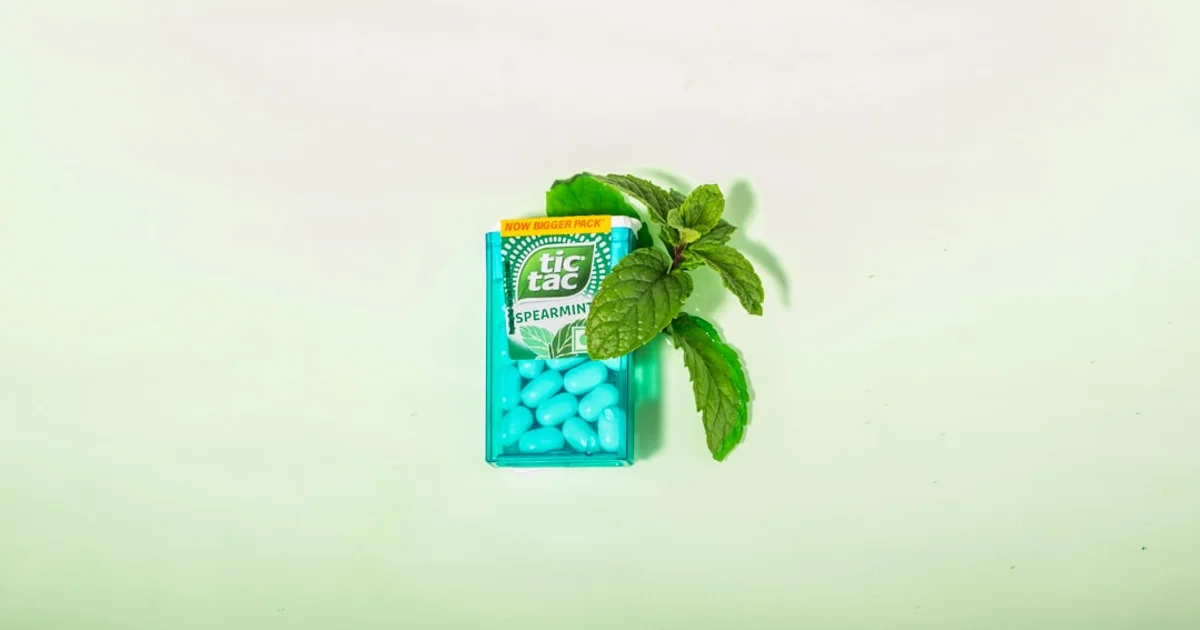
Chewing gum doesn’t look like it should raise halal questions — until you notice the ingredient list has one line item, “Kaumasse” (gum base), that doesn’t actually tell you what’s in it.
The direct verdict: no confirmed haram ingredients in Fresh & Free Active Spearmint. The glazing agent is plant-derived carnauba wax, not shellac or beeswax, and no gelatine appears anywhere on the list.
Who Makes Fresh & Free
Fresh & Free is Aldi’s own-brand sugar-free chewing gum line, sold at both Aldi Nord and Aldi Süd stores across Germany and Belgium. It’s manufactured under contract by Gumlink A/S, a Danish confectionery company based in Vejle — Gumlink makes gum for a range of retail and branded customers, not just Aldi.
Full Ingredient List (Active Spearmint, 36g)
Sorbitol, gum base (Kaumasse), xylitol, calcium carbonate, flavourings, titanium dioxide, dicalcium phosphate, aspartame, maltitol syrup, sodium bicarbonate, acesulfame K, sunflower lecithin, carnauba wax.
The Glazing Agent Question — Resolved Clean
This is the one ingredient in chewing gum that most reliably separates a clean product from a questionable one. Fresh & Free uses carnauba wax (E903) — extracted from the leaves of the Brazilian wax palm, entirely plant-derived. That’s the halal-safe option. The two glazing agents to actually watch for on other gum brands are shellac (E904), a resin secreted by the lac insect, and beeswax (E901), both of which some scholars treat with more caution. Neither appears here.
The Gum Base Itself — An Industry-Wide Ambiguity
“Kaumasse” (gum base) is listed as a single compound ingredient with no sub-breakdown — this is standard practice under EU food labelling rules, which permit gum base to be declared as one line without itemising every polymer and softener inside it. No glycerin, gelatine, or other animal-derived softening agent is separately disclosed anywhere in Fresh & Free’s ingredient list, which is a genuinely good sign — but it also means the gum base’s full composition can’t be independently confirmed as 100% synthetic or plant-based from the label alone. This is a limitation of gum labelling generally, not something specific to Fresh & Free doing anything unusual.
What Else Is on the List
The remaining ingredients are all standard, uncontroversial sweeteners and stabilisers: sorbitol (E420), xylitol (E967), maltitol syrup (E965), calcium carbonate (E170), titanium dioxide (E171), aspartame (E951), sodium bicarbonate (E500), acesulfame K (E950), and sunflower lecithin (a plant-based emulsifier, functionally the same as soy lecithin E322). None of these raise a halal concern.
Summary
| Question | Answer |
|---|---|
| Does it contain gelatine? | No |
| Glazing agent | Carnauba wax (E903) — plant-derived |
| Any shellac or beeswax? | No |
| Is the gum base fully disclosed? | No — standard industry practice, not specific to this product |
| Is it halal-certified? | No |
| Overall read | No confirmed haram ingredients found |
Look up any E-code from the ingredient list in the E-codes database.
To scan a full ingredient list for halal status in seconds, use the ingredient scanner.
Buying the rest of the shop at the same time? Our full Aldi UK halal shopping guide covers every aisle, confectionery included.
How we reached this verdict
We checked the following Tier-1 sources before publishing this verdict:
- Manufacturer statements: the product’s ingredient panel via CodeCheck.info and Open Food Facts, cross-checked for consistency.
- Halal certification bodies (HMC, HFA, JAKIM, MUI): no certified-establishment listing exists for this product.
- Sunni fatwa scholarship across the four madhabs:
- Hanafi-leaning bodies: IslamQA Hanafi, Darul Iftaa Birmingham, AskImam.org, Daruliftaa.com (Mufti Taqi Usmani), Wifaqul Ulama, Darul Iftaa New York.
- Shafi’i / Maliki-leaning bodies: NU (Nahdlatul Ulama, Indonesia), Dar al-Ifta al-Misriyyah (Egypt), e-fatwa.com (UAE), al-Azhar.
- Hanbali / Saudi-Salafi-leaning bodies: Saudi Permanent Committee for Scholarly Research, IslamQA Saudi.
Madhab note
The four Sunni madhabs broadly converge on the rules applied in this guide:
- Plant-derived glazing agents (carnauba wax, E903) — Halal across all four madhabs.
- Insect-derived glazing agents (shellac, E904) — Hanafi, Shafi’i, and Hanbali scholars generally treat as a lesser concern than mammalian haram sources when used as a thin surface coating; some Maliki scholars are more permissive of insect derivatives generally. Not present in this product.
- Undisclosed compound ingredients (gum base) — where no specific haram component is separately listed, most scholars across the four madhabs do not require the same level of source verification as for a named ambiguous ingredient like E471; the absence of a red flag is treated as meaningful, though formal certification remains the more cautious standard.
If your madhab differs on a specific ruling, the relevant section above flags the school-specific position. For binding rulings on borderline products, consult a competent scholar in your tradition.
Ingredients change. Be first to know.
Brands reformulate without warning. We track every E-code update and halal certification — one short weekly email.
Related Articles
 Shopping Guides
 Is Chupa Chups Halal? Cola Lollipop and All Lines Checked (2026)
Chupa Chups Cola lollipops contain no gelatin or E120 — but carry no halal certification. Gummies and soft chews contain gelatin and are Haram. Full breakdown by product line.
 Shopping Guides
 Is Kik Imly Candy Halal? The Tamarind Sweet Checked (2026)
Kik Imly is a Pakistani tamarind candy popular in the UK diaspora. The tamarind base is halal, but artificial colours E110, E122, and E129 are present without halal certification. Verdict: Mushbooh.
 Shopping Guides
 Are Mentos Halal? Every Variety Checked (Rainbow, Mint, Fruit)
Chewy Mentos rolls contain undisclosed gelatine — Mushbooh in UK/EU. Hard mints are gelatine-free but uncertified. Malaysian JAKIM-certified Mentos is halal.