
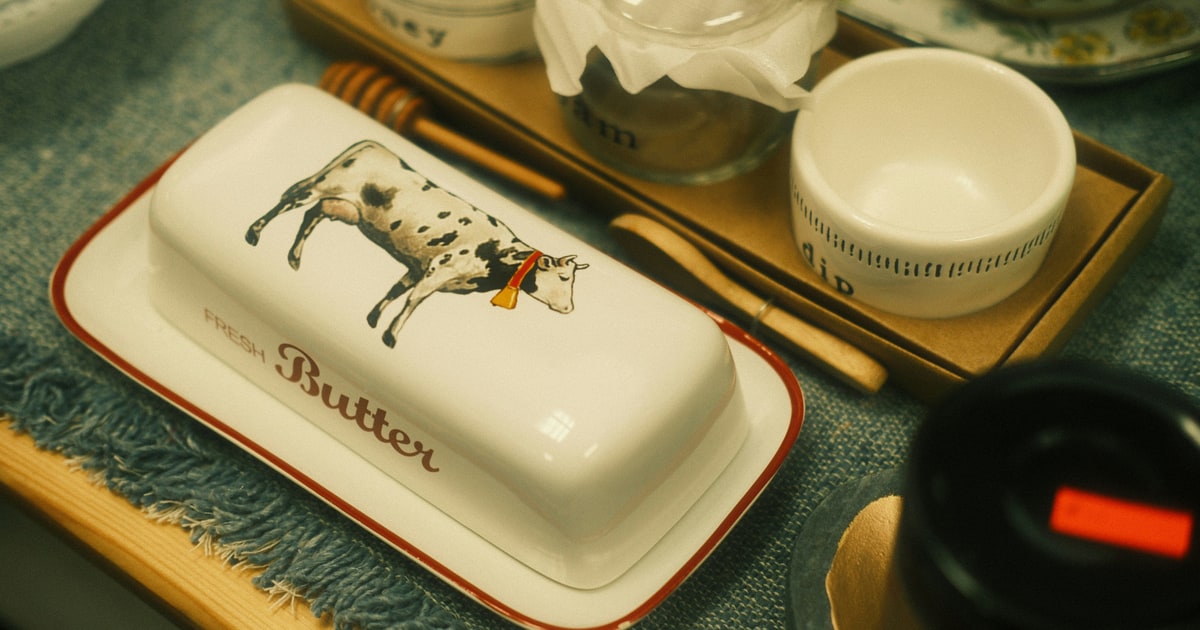
Butter is one of the simplest dairy products to navigate from a halal perspective. Pure butter requires no rennet, no enzymes, and no complex additives — it is made by churning cream until the fat separates. That simplicity makes most block butter halal by default.
The question gets slightly more involved when you move to spreadable butters, flavoured butters, and butter blends. Here is a full breakdown.
Why Pure Butter Is Halal
Butter is produced entirely through a physical process — churning cream. There is no fermentation, no animal-derived enzymes, and no coagulation. A typical block butter ingredients list looks like:
Pasteurised cream, salt
Both ingredients are halal. Cream is simply the fat portion of cow’s milk. Salt is a mineral. There is nothing controversial in that combination.
This is why mainstream block butters from all the major UK brands are halal without requiring certification.
Kerrygold Butter
Kerrygold is made in Ireland from the milk of grass-fed cows. The ingredients in Kerrygold Pure Irish Butter are: pasteurised cream, salt. Nothing else.
- No rennet
- No E-codes
- No animal additives beyond milk fat
Verdict: Halal.
Kerrygold also produces a spreadable version with added rapeseed oil, and a lighter version. Both remain halal — the rapeseed oil is plant-derived. Kerrygold does not carry a halal certification mark, but it does not need one for the core ingredients.
Lurpak Butter
Lurpak is a Danish butter brand sold across the UK. The classic Lurpak Slightly Salted block contains: cream, water, salt, starter culture. The starter culture is a bacterial culture used during churning for flavour development — it is a dairy fermentation culture and is halal.
Lurpak Spreadable adds rapeseed oil and water to make it soft straight from the fridge — both additions are halal.
Verdict: Halal.
Lurpak does not carry halal certification but none of its standard ingredients present a halal concern.
Anchor Butter
Anchor is a New Zealand dairy brand owned by Fonterra. The block butter contains: cream, salt. The spreadable version adds rapeseed oil.
Verdict: Halal.
What About Spreadable Butters with E471?
This is where butter gets more complicated. Some cheaper spreadable butter blends and budget supermarket own-brand spreads contain E471 (mono and diglycerides of fatty acids) as an emulsifier.
E471 can be derived from plant or animal fats. The packaging does not distinguish between sources. This creates a Mushbooh (questionable) situation.
The test to apply:
- “Suitable for vegetarians” label present? — The E471 is plant-sourced. Halal.
- “Suitable for vegans” label present? — Even cleaner. Halal.
- No vegetarian label, contains E471? — Source unconfirmed. Mushbooh.
For a full explanation of E471 and how to interpret it, read Is E471 Halal?.
Supermarket Own-Brand Butter
Most supermarket block butters (Tesco, Sainsbury’s, ASDA, Morrisons) contain only cream and salt — halal. The spreadable own-brand options vary. Check for vegetarian marks and scan the E-code list.
If the only ingredients are cream, water, salt, and perhaps rapeseed oil, you are looking at a halal product regardless of brand.
Flavoured Butters
Garlic butter, herb butter, and other flavoured variants warrant a quick ingredients scan. Concerns to look for:
- Wine or alcohol in garlic butter — some contain white wine; this makes it haram
- E471 — check source as above
- Natural flavourings — usually halal but source is worth confirming on alcohol-containing flavour preparations
Ghee: The Halal-Certified Dairy Fat
If you prefer a certified option or cook primarily with cooking fat, ghee (clarified butter) from halal-certified producers is widely available. Many South Asian grocery brands carry HFA or HMC certification on their ghee range. Ghee undergoes more processing than butter, but the halal status is typically easier to verify because the market caters to Muslim consumers.
Butter vs Margarine: An Important Distinction
Butter is not the same as margarine. Margarine is a manufactured fat blend that often contains E471 and other emulsifiers. The halal considerations for margarine are more complex — treat it like a spreadable product and apply the E471 source check.
Summary Table
| Factor | Detail |
|---|---|
| Main concern | E471 in spreadable butters (source ambiguity) |
| Pure block butter | Halal — cream and salt only; no rennet or enzymes |
| Kerrygold block | Halal — cream and salt |
| Lurpak block | Halal — cream, water, salt, starter culture |
| Anchor block | Halal — cream and salt |
| Spreadable with E471 + vegetarian mark | Halal — plant-sourced E471 confirmed |
| Spreadable with E471, no vegetarian mark | Mushbooh — source unconfirmed |
| Verdict | Block butter: halal. Spreadable: check for E471 and vegetarian label. |
Check any butter label quickly with the Verify Ingredients tool, or look up individual E-codes in the E-codes database.
Ingredients change. Be first to know.
Brands reformulate without warning. We track every E-code update and halal certification — one short weekly email.
Related Articles
 Ingredient Guides
 Are Starter Cultures & Microbial Rennet Halal?
Starter cultures and microbial rennet are generally halal — the bacteria themselves are pure. The real concern is the growth medium they're propagated on. Here's how to check.
 Ingredient Guides
 Is Cream Halal? Double, Single & Soured Cream (2026)
Pure double and single cream is halal — just milk fat. Soured cream may contain E471 or E412. Most UK supermarket cream is halal. Here's how to check any variety.
 Ingredient Guides
 Is The Ordinary Multi-Peptide Eye Serum Halal? INCI Checked (2026)
The Ordinary's Multi-Peptide Eye Serum is PETA-certified vegan, alcohol-free, and its peptides are synthetic — permissible to use, though not halal-certified.