
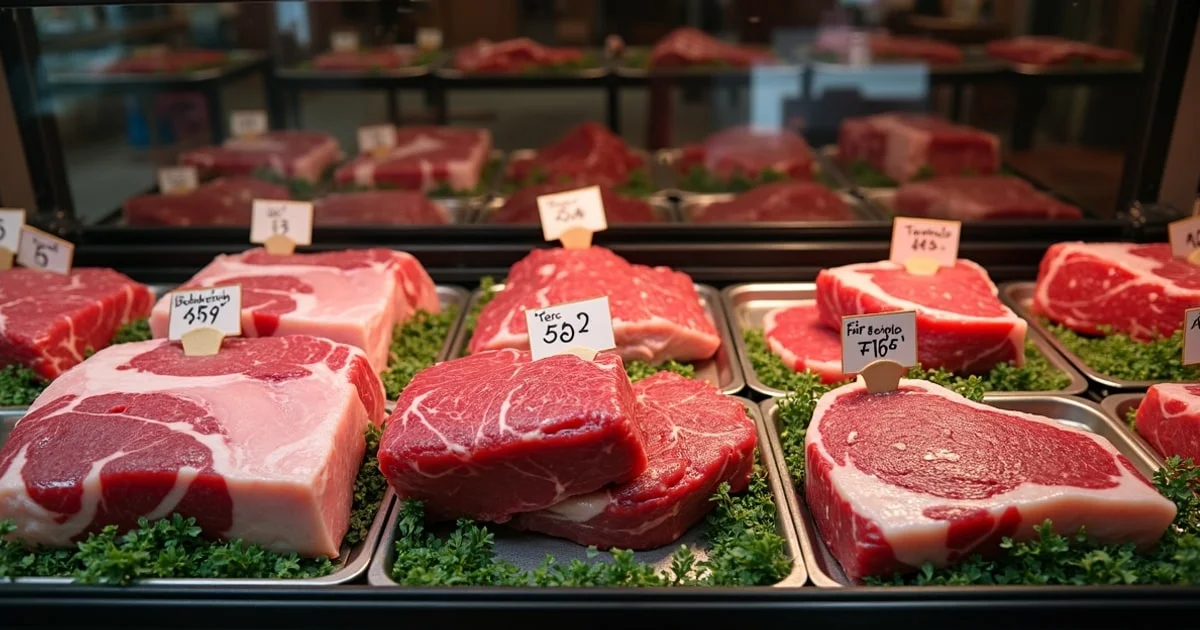
Both can be genuinely halal. They are not certified to the same standard. A certified halal butcher — one on HMC’s outlet registry — sells unstunned, hand-slaughtered meat under continuous monitoring. A supermarket halal range carries real certification too, almost always HFA, but the meat is pre-stunned and machine slaughter is common for poultry. The strictest UK standard is simply not on supermarket shelves, and the most convenient certified meat is not at most butchers.
So the honest comparison isn’t “butcher good, supermarket bad” — it’s five separate questions: who certifies it, how it was slaughtered, how fresh it is, what it costs, and how easily you can verify any of it. Here is each one, plainly.
| Certified halal butcher | Supermarket halal range | |
|---|---|---|
| Typical certifier | HMC (verify on outlet registry) | HFA or similar (logo on pack) |
| Stunning | Not permitted under HMC | Pre-stunned (own-label lines) |
| Monitoring | Continuous on-site (HMC) | Periodic certifier inspection |
| Traceability | Ask the certifier and supplying abattoir | Establishment number printed on pack |
| Cuts | To order, whole-carcass range | Pre-packed standard cuts |
| Verification effort | You must ask — or check the registry | Logo and code visible at the shelf |
Certification: who actually stands behind the meat?
This is the dimension people assume favours the butcher automatically. It doesn’t — it favours the certified butcher.
The certified butcher. HMC (Halal Monitoring Committee) certifies not just slaughterhouses but retail outlets, and publishes the list on its own registry. An HMC-certified counter means the supply chain is monitored from slaughter to display — the strongest paper trail available in UK halal retail. Only a handful of slaughterhouses feed that chain: 6 of the 202 establishments in our meat code database hold HMC certification.
The uncertified butcher. Plenty of independent shops display “halal” with no named body behind it. In our own city research we record these honestly: some name HMC and appear on its registry; others state halal but name no certifier anywhere — a business claim, not an audit. The word above the door is not evidence. Two questions settle it at the counter: who certifies you? and which slaughterhouse supplies you? A certified shop answers both without hesitation.
The supermarket. Own-label halal ranges at the major chains carry genuine certification — typically HFA (Halal Food Authority), the UK’s largest certifier. That is a real, auditable standard. What it isn’t is HMC: supermarket own-label halal meat is pre-stunned, and HMC does not accept stunning, which is why no supermarket shelf carries the HMC mark on own-label chicken. Beware the soft phrasing too — “suitable for a halal diet” without any certifier logo is a claim, not a certification.
Where the two bodies differ, and why it matters, is covered fully in our HMC vs HFA comparison.
Stunning: the real dividing line
Strip away the branding and this is the substantive difference between the two shopping routes.
HMC-certified meat (the butcher route) is unstunned and hand slaughtered, with an individual tasmiyah per animal and post-slaughter inspection.
HFA-certified meat (the supermarket route) permits pre-stunning on the condition the stun is recoverable — the animal must still be alive when the cut is made. If the animal dies from the stun before slaughter it is carrion (mayta), which is categorically haram; the certifier’s job is verifying the stun parameters stay non-lethal. For poultry, machine slaughter with batch or electronic tasmiyah is also common under HFA — the mechanics and the scholarly debate are set out in our machine-slaughtered chicken analysis.
Neither route disputes what halal slaughter requires — a live animal, the tasmiyah, the cut severing the throat vessels, full drainage (the full requirements here). The dispute is whether stunning and batch tasmiyah are compatible with those requirements.
Madhab note
The stunning and machine-slaughter disagreement is largely an ikhtilaf within the Hanafi school rather than between schools. HMC’s rejection of stunning and batch tasmiyah is grounded in a strict Hanafi reading; the mainstream UK Darul Uloom position accepts machine slaughter with conditions, on the same Hanafi methodology. The Maliki and Shafi’i schools take somewhat more flexible positions on the tasmiyah question. Both positions are held by respected scholars — the point of this comparison is not to rule between them, but to make sure you know which standard the meat in your basket actually meets.
Freshness and cuts: the butcher’s home ground
Here the butcher wins on substance, not sentiment. A counter cuts to order — thickness you ask for, the fat trimmed the way you want, mince made in front of you. Whole-carcass shops sell the cuts supermarkets rarely stock: shanks, trotters-free offal ranges, bone-in shoulder, whole birds at sizes the multiples don’t carry. And you can see the meat before it’s wrapped.
Supermarket halal meat is pre-packed in modified-atmosphere trays — consistent, date-coded, longer-lasting in the fridge. That’s a genuine advantage for once-a-week shoppers; it’s not the same product experience as a counter. Neither format is “fresher” by definition — a busy butcher turns stock daily, a quiet one doesn’t, and a supermarket’s cold chain is professionally managed throughout.
Price: no honest blanket answer
We are not going to invent a price table — halal meat prices vary by city, cut, and week. What holds generally:
- Butchers in competitive areas — districts with several halal shops within walking distance — are frequently strong per-kilogram on chicken and lamb, because whole-carcass buying and local competition keep margins tight.
- Supermarkets win on promotions — multibuys and price-locked lines that an independent can’t match, plus one-trip convenience.
- Unstunned HMC meat can carry a premium over stunned supermarket halal — you are paying for the slower slaughter process and the monitoring chain.
The only comparison that means anything is the per-kilogram price on the specific cut you actually buy — pack sizes and bone-in versus boneless differences bury the real number otherwise.
Traceability: the supermarket’s quiet advantage
One thing the pre-packed format does better: the evidence is printed on the pack. Every supermarket pack carries a certification logo you can check and an establishment number you can trace. The line “Slaughtered in: GB XXXX” identifies the exact abattoir — type the digits into our meat code lookup and you’ll see whether that site is HMC certified, handles pork, or is unverified. Our establishment number guide walks through real examples.
At a butcher, traceability runs through people rather than print: the certifier’s outlet registry, and the shop’s answer to “which slaughterhouse supplies you?” For an HMC shop that chain is verifiable end to end. For an uncertified shop, it stops at the counter.
For processed and marinated products from either source, the ingredients panel is a separate check — marinades and coatings carry their own additives, which the ingredient scanner or E-codes database can verify in seconds.
So which should you choose?
Split by the standard you follow, not by loyalty to a shop type:
- You follow HMC / unstunned-only: a certified butcher is effectively your only walk-in option. Verify the shop on HMC’s outlet registry rather than taking the sign’s word for it.
- You accept HFA-standard certification: supermarket halal ranges are a legitimate, certified choice — check for the logo on every pack, since halal and conventional lines sit in the same aisle. Our supermarket halal meat comparison covers which chains stock what.
- You’re optimising for cuts and quality: the butcher’s counter, certified where possible.
- You’re optimising for convenience: the supermarket range — with the ten-second logo-and-code check before it goes in the trolley.
Find a checked halal butcher near you
We maintain city listings where every entry records the certifier and the evidence behind it — including which shops are HMC-registered and which merely state halal:
- London — halal butchers in London: nine HMC-certified counters across the capital, Southall to East Ham.
- Wolverhampton — halal butchers in Wolverhampton: an HMC-certified shop in Whitmore Reans plus HMB-listed poultry suppliers — and one shop that names no certifier, recorded as exactly that.
- Birmingham — the city’s butcher scene is covered in our Birmingham halal directory.
- Manchester — start from the Manchester halal directory.
- Milton Keynes — vetted listings in the Milton Keynes halal directory.
How we reached this verdict
We checked the following Tier-1 sources before publishing this comparison:
- HMC — certified outlet registry and published slaughter standard at halalhmc.org (checked July 2026); HMC does not permit stunning and certifies retail outlets as well as slaughterhouses.
- HFA — published certification standard permitting recoverable pre-stunning and conditional machine slaughter; HFA logos appear on major supermarket halal ranges.
- Tesco religious-slaughter policy (October 2025) — confirms own-label halal meat is certified and pre-stunned, with branded stunned and unstunned lines stocked alongside.
- FSA Approved Establishments register — cross-referenced with the HMC supplier list in our meat code database: 6 HMC-certified slaughterhouses of 202 establishments tracked (England and Wales).
- Scholarly positions on stunning and machine slaughter — HMC’s published position, mainstream UK Darul Uloom acceptance with conditions, and JAKIM’s MS 1500:2019 electronic-tasmiyah standard, as detailed in our machine-slaughter analysis.
Community halal-status sites are not cited here. They do not audit supply chains and we do not treat them as authoritative.
Summary
| Question | Answer |
|---|---|
| Which is stricter? | An HMC-certified butcher — unstunned, hand slaughtered, continuously monitored |
| Is supermarket halal meat certified? | Yes, typically HFA — genuine certification, but pre-stunned |
| Is every halal butcher certified? | No — ask for the certifier and check the registry; “halal” on the sign is not evidence |
| Which is cheaper? | Neither consistently — compare per-kg on the cut you buy |
| Which is easier to verify? | The supermarket pack: logo plus a traceable establishment number |
Whichever route you take, the verification habit is the same: a named certifier, and a traceable chain behind it. Check any pack’s slaughterhouse in seconds with the meat code lookup, and scan any ingredients list with the HalalCodeCheck scanner.
Ingredients change. Be first to know.
Brands reformulate without warning. We track every E-code update and halal certification — one short weekly email.
Related Articles
 Shopping Guides
 Best Halal Meal Kits UK 2026 — Which Are Actually Certified
Most UK halal meal kit brands don't name a certifying body. We checked six directly — one names HMC, one admits its kitchen isn't certified, the rest are unverified claims.
 Shopping Guides
 Halal Shopping at Ocado: The Halal Aisle, Butcher Brands & Online Label Checks (2026)
Ocado runs a dedicated halal aisle with fresh halal chicken from brands including HFA-certified Shazans — and every product page shows the full ingredient list.
 Shopping Guides
 Machine-Slaughtered Chicken: Halal or Haram? The Evidence
Machine-slaughtered chicken is a contested issue — accepted by many Western Muslim scholars and some certification bodies but rejected by HMC and stricter Hanafi positions.