
If you receive food through a US government assistance programme, you may have seen the letters (H) next to a product name on the USDA Foods Available List. That small marker indicates the food has been independently certified as halal — required by the USDA as a condition of the procurement contract. It is the closest thing the US federal government has to an official halal designation, and it is rarer than most people realise.
The agency documents most readers still recognise as USDA FNS materials now sit under the renamed Food and Nutrition Administration (FNA) as of June 1, 2026. In this article, we refer to the historical programme documents as they are titled in the source material, while using the current agency context where relevant.
At a Glance
What the (H) means
A TEFAP contract required private halal certification for that item. It is not a standalone government halal standard.
What matters most
The underlying Islamic certifier, not just the presence of the government-side marker.
Current practical reality
Halal-certified TEFAP options remain very limited, especially for meat and protein.
| Topic | Summary |
|---|---|
| What the (H) means | A TEFAP contract required private halal certification for that item; it is not a standalone government halal standard |
| What matters most | The underlying Islamic certifier, not just the presence of the government-side marker |
| Current practical reality | Halal-certified TEFAP options remain very limited, especially for meat and protein |
What Is the USDA’s (H) Halal Label?
The (H) designation appears on the TEFAP Foods Available List — the catalogue of commodity foods distributed through The Emergency Food Assistance Program, a federal nutrition programme that supplies food to food banks, pantries, soup kitchens, and shelters across the United States.
TEFAP operates under USDA’s Food and Nutrition Service (FNS). The Foods Available List specifies which commodity foods are available for distribution in a given fiscal year and flags products that meet dietary or religious requirements. Items marked (K) carry kosher certification; items marked (H) carry halal certification.
The current list is the FY2025 TEFAP Foods Available List (Revised August 2024). The USDA FNS publishes guidance on halal and kosher accommodation at fns.usda.gov/tefap/halal.
The One Currently (H)-Certified TEFAP Food
Of over 80 commodity items on the FY2025 TEFAP Foods Available List, exactly one carries the (H) halal certification mark:
| Item | Certifications |
|---|---|
| Tomato Sauce, Low Sodium, Canned (24 × 15.5 oz) | (K)(H) — Kosher and Halal |
This item carries both (K) and (H), meaning it has been certified under both kosher and halal standards. That overlap is not coincidental: kosher and halal certification share several requirements (no pork, no blood, oversight of production), and for a plant-based product like canned tomato sauce, the two sets of requirements are relatively straightforward for a single supplier to satisfy simultaneously.
The absence of (H) on other items does not necessarily mean they are haram. Fresh produce, dried pulses, grains, eggs, and plain canned fish on the TEFAP list are generally considered halal without formal certification — more on that below.
How the USDA (H) Label Works: Private Certification Required
The USDA does not operate its own halal certification programme. There is no federal halal standard equivalent to the USDA Organic standard, and no USDA inspector verifying halal compliance.
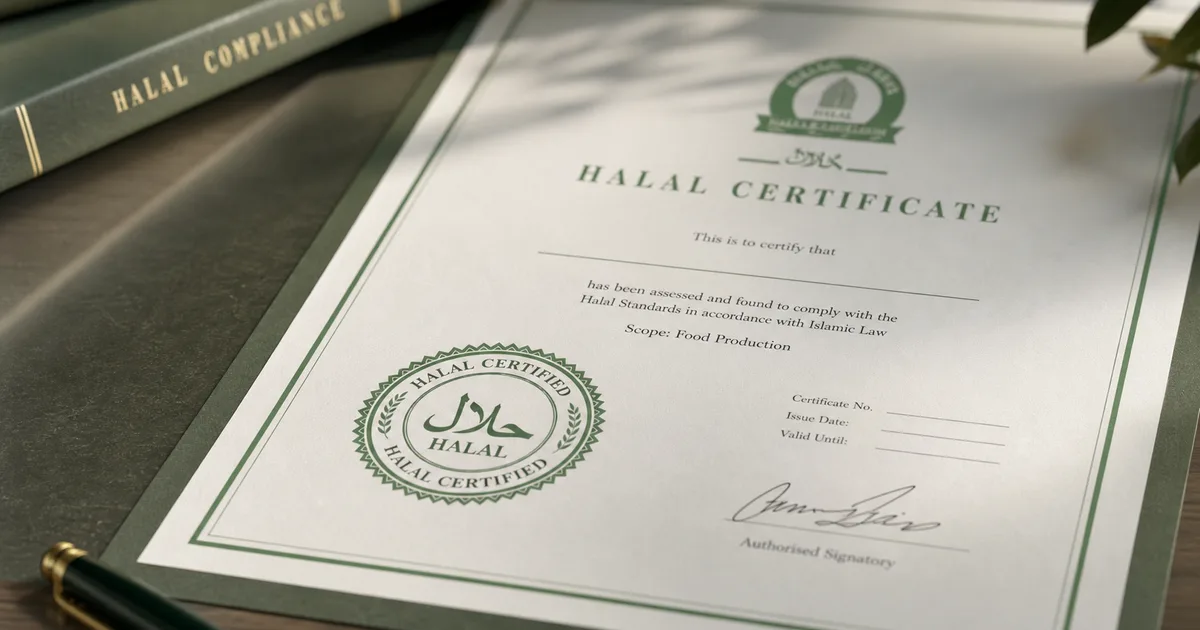
Instead, when the USDA marks a TEFAP item as (H), it means the procurement contract requires the supplier to obtain independent halal certification from a recognised Islamic certifying body. The certifier audits the product, production facility, ingredients, and supply chain — the USDA then reflects that requirement in the product specification.
This is an important distinction: the (H) on the TEFAP list is the government’s way of saying “a recognised Islamic certifier has certified this” — it is not a government-invented halal standard. The rigour behind the label depends entirely on the private Islamic certifier involved.
USDA (H) vs. Private Islamic Halal Certification: How They Compare
| Scheme | Who audits | Meat covered |
|---|---|---|
| USDA (H) — TEFAP | Private Islamic certifier (contract requirement) | No meat currently carries (H) |
| IFANCA | IFANCA Islamic scholars and auditors | Yes — meat and poultry |
| ISNA Halal | ISNA Canada certification committee | Yes |
| HMC | HMC representatives on-site continuously | Yes — hand slaughter, no pre-stunning |
| HFA | HFA auditors; controlled stunning permitted | Yes — stunning permitted |
| JAKIM | Malaysian government body | Yes |
| MUI | Indonesian Ulema Council | Yes |
The USDA (H) label operates only within the TEFAP commodity system. You will never see it on a retail supermarket product. For everyday shopping, the relevant certifications are IFANCA, ISNA, HMC, HFA, JAKIM, and MUI.
Why So Few TEFAP Foods Are (H) Certified
Only one item on the FY2025 list carries (H). There are structural reasons for this.
Commodity scale is the primary obstacle. USDA buys food in enormous quantities — millions of pounds at a time — under competitive bid contracts. Finding a halal-certified supplier capable of meeting commodity-scale volumes, at commodity prices, is genuinely difficult. Most certified halal production facilities serve retail or export markets at much smaller volumes.
Meat certification is especially complex. Halal meat certification requires oversight of slaughter — the animal must be alive at slaughter, the slaughterman must be Muslim, and the correct recitation must be made. Integrating this into a commodity beef or chicken procurement at USDA’s scale involves auditing slaughter facilities, continuous on-site monitoring, and preventing cross-contamination. No TEFAP meat currently carries (H).
Cost of certification increases bid prices. Halal certification adds compliance costs for the supplier. In a competitive commodity procurement, this can price certified suppliers out of winning contracts.
ICNA Relief is actively working to change this. The Islamic Circle of North America’s relief arm (icnarelief.org/halal-tefap) has a formal partnership with USDA FNS to expand halal-certified options in TEFAP. Their goals include identifying halal-certifiable commodity items, educating distributors on halal requirements, and expanding halal protein availability. ICNA Relief currently operates TEFAP halal food distribution in 27 states — making them the primary on-the-ground infrastructure for halal food assistance in the US.
”May Be Acceptable Without Certification”: The Other Category
The USDA explicitly acknowledges that not all halal-permissible foods require formal certification. The FNS guidance notes that certain commodity items — fresh produce, plain dried legumes, grains, eggs, and some fish products — “may be acceptable without certification” for halal-observant recipients.
This reflects a sound Islamic principle: foods that are naturally halal do not require certification. A bag of lentils, a crate of apples, or a carton of eggs does not become halal through a certifier’s audit — they are halal by nature. Certification is most necessary for processed products where ingredients, additives, and production processes could introduce non-halal elements.
The USDA guidance explicitly defers to community knowledge on this point: “It is important to work with leaders in your community to identify what non-certified items will be acceptable.” That is the correct approach — local scholars and community leaders understand the madhab-level nuances that a government procurement document cannot resolve.
If you want to check any E-codes or additives in processed foods — whether TEFAP-distributed or purchased at a supermarket — use the E-codes database or run a quick ingredient scan.
How to Advocate for More (H) Foods
If you work with a food bank, halal community organisation, or state agency and want to expand halal options in TEFAP:
- Contact your state distributing agency. TEFAP operates through state agencies that select from the national Foods Available List. State agencies can express demand for (H)-certified items to USDA FNS, which influences procurement priorities.
- Support ICNA Relief’s TEFAP programme. ICNA Relief (icnarelief.org) is the most active advocacy and distribution body for halal food assistance in the US. They accept volunteers, donations, and partnerships with food banks.
- Engage directly with USDA FNS. The FNS Supplemental Food Programs Division is the relevant contact point. The USDA publishes FAQs on kosher and halal accommodation at fns.usda.gov/tefap/supporting-kosher-and-halal-communities-faqs.
- Work with local halal certifiers. If you know a food supplier capable of meeting commodity volumes, connecting them with IFANCA, ISNA Halal, or the Islamic Services of America (ISA) for certification is the upstream step that makes a future (H) designation possible.
The expansion of halal options in government food programmes is a practical matter of logistics and procurement policy — solvable with sustained advocacy and supplier-side capacity.
How we reached this verdict
We checked the following Tier-1 sources before publishing this article:
- USDA Food and Nutrition Service (FNS): TEFAP Halal Factsheet FNS-969 (August 2023), TEFAP FY2025 Foods Available List (Revised August 2024), guidance at fns.usda.gov/tefap/halal, and supporting FAQs at fns.usda.gov/tefap/supporting-kosher-and-halal-communities-faqs.
- ICNA Relief halal TEFAP programme: icnarelief.org/halal-tefap/ — documentation of the ICNA Relief / USDA FNS partnership and 27-state distribution footprint.
- Halal certification bodies (HMC, HFA, JAKIM, MUI, IFANCA, ISA): Scope and auditing standards drawn from each body’s published certification criteria and IFANCA’s listing of USDA-context certifications.
- Sunni fatwa scholarship on naturally halal foods: IslamQA, Darul Iftaa Birmingham, and Wifaqul Ulama confirm the mainstream position that naturally halal single-ingredient foods (produce, pulses, grains, eggs) do not require a certifier’s mark.
No madhab-divergent ruling is engaged in this article — the question is certification process and policy, not a fiqh dispute between the schools.
Common Questions
Is the USDA itself certifying halal food?
No. The government-side marker reflects a procurement requirement for private Islamic certification. The halal audit itself is not carried out by a USDA religious standard programme.
Does the absence of (H) automatically mean a TEFAP item is not halal?
No. Many naturally halal foods do not require formal certification. Fresh produce, grains, pulses, eggs, and similar single-ingredient foods may still be acceptable without a certifier’s mark.
Will I ever see the USDA (H) marker on ordinary supermarket food?
No. The (H) label discussed here is specific to the TEFAP commodity system, not to normal retail packaging.
Next Steps
If you work with a food bank or community distribution programme, the practical next move is to separate three questions:
- Which TEFAP items are naturally halal without formal certification?
- Which processed items need recognised third-party halal certification?
- Which local agencies, distributors, and community partners can help expand the certified list over time?
If you want the broader consumer-certification context, compare the main halal bodies in Halal Certification Logos Explained and UK halal certification bodies. If you need to check additives in processed foods, use the E-codes database or run a quick ingredient scan.
Halal Certification Hub
Need the bigger picture, not just this one article?
Browse the full halal certification hub for step-by-step guidance on costs, certification bodies, logos, audits, labelling, and international trade requirements.
Visit the certification hubIngredients change. Be first to know.
Brands reformulate without warning. We track every E-code update and halal certification — one short weekly email.
Partner with HalalCodeCheck
Reach halal-conscious buyers and food businesses at the moment they decide
Our audience uses HalalCodeCheck to verify ingredients, compare certification bodies, and choose products with confidence. That means you can reach both high-intent shoppers and serious food-business decision-makers across the UK, US, Canada, Australia, and Europe.
- Featured product & brand placements
- Certification guide sponsorships & category features
- Search, tool, and directory visibility
Sponsored placements and partnerships by arrangement
Related Articles
 Halal Certification
 Halal Certification in Australia: AFIC, ICCV, HCA and the Approved Bodies List (2026)
How halal certification works in Australia — the major certifiers (AFIC, ICCV, HCA), the government's export-only approval program, and how to verify any halal claim.
 Halal Certification
 UK Halal Certification Bodies: HMC, HFA, HFCE and Other Logos Explained (2026)
Compare UK halal certification bodies and logos. HMC, HFA, HFCE, Halal Trust, MCB, and international certifiers explained — what they do, how standards differ, and how to verify claims.
 Halal Certification
 HMC vs HFA: Which UK Halal Certification Should You Trust? (2026)
HMC and HFA are the UK's main halal certifiers. This guide explains their key differences on stunning, slaughter method, and which restaurants and brands each certifies.