
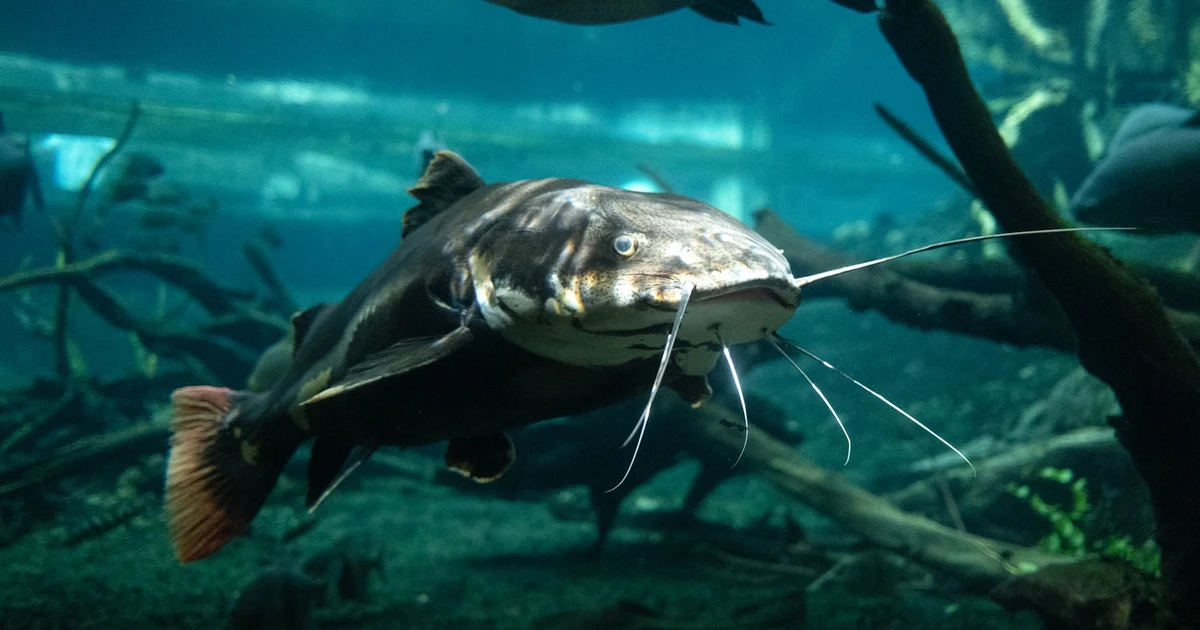
Catfish is halal. All four Sunni madhabs — Hanafi, Maliki, Shafi’i, and Hanbali — classify fish as permissible, and catfish is a fish. A small minority of scholars in certain South Asian communities raise a concern about scaleless fish, but this is not the dominant ruling in any school.
Quick Verdict
| Question | Answer |
|---|---|
| Is catfish halal? | ✅ Yes — halal across all four madhabs in their mainstream positions |
| Does it need zabiha slaughter? | ❌ No — fish do not require slaughter in any madhab |
| Farm-raised vs wild-caught? | No halal difference |
| Any community concerns? | ⚠️ A minority Hanafi view flags scaleless fish as Mushbooh — not the dominant ruling |
| USDA TEFAP status? | Permitted with an asterisk noting a small segment of communities who avoid it |
What Is Catfish?
Catfish (family Ictaluridae in North America) are freshwater fish found across rivers, lakes, and aquaculture operations. The three most common commercial species are channel catfish (Ictalurus punctatus), blue catfish (Ictalurus furcatus), and flathead catfish (Pylodictis olivaris).
What makes catfish distinctive — and the source of all the fiqh discussion — is their appearance. They have whisker-like barbels around the mouth, a smooth or lightly textured skin, and no prominent visible scales. Scientifically, catfish do possess small embedded scales in some species, but to the naked eye they appear scaleless. This is the sole basis for any halal debate.
Catfish is widely farmed across the United States (particularly Mississippi, Alabama, and Arkansas), and is a staple protein in many American households. It is a common item in USDA food assistance programmes.
Why Some Muslims Question Catfish
The question arises for two reasons.
The scale debate. Some Hanafi scholars — particularly those in the South Asian scholarly tradition — have historically applied extra caution to fish without visible prominent scales. This derives from a minority opinion within Hanafi fiqh that differentiates between types of water creatures based on appearance. However, even within the Hanafi school, the dominant position is that all samak (fish) are halal, regardless of whether scales are visible to the eye.
The USDA asterisk. The USDA’s TEFAP Halal Factsheet (FNS-969, August 2023), which governs halal food distribution in federal emergency food assistance programmes, includes catfish with a note: “Please work with experts in your community, as there is a small sector of halal-observant communities who will not consume catfish.” This is not a ruling that catfish is haram — it is a logistical instruction for food banks dealing with diverse Muslim communities. The USDA factsheet lists catfish as a permitted halal protein (WBSCM item codes 110390 for farm-raised and 111800 for wild-caught). The asterisk acknowledges community variation, not a fiqh objection.
Community unfamiliarity. In communities where catfish is uncommon — such as parts of South Asia, the Arab world, and West Africa — some scholars have been cautious simply because they encountered the fish in an unfamiliar form. Once a scholar examines the fish and classifies it within the samak category, the mainstream ruling applies.
What the Four Madhabs Say
| Madhab | Position on Catfish |
|---|---|
| Hanafi | ✅ Halal (mainstream) — major Deobandi institutions (Darul Iftaa Birmingham, AskImam.org, Daruliftaa.com) confirm. A minority view flags scaleless fish as Mushbooh, but this is not the dominant ruling. |
| Maliki | ✅ Halal — all sea and freshwater fish permitted; rare exceptions are frogs and crocodiles. |
| Shafi’i | ✅ Halal — all seafood is permissible without qualification. |
| Hanbali | ✅ Halal — fish are halal. |
The convergence across all four schools is notable. Even the Hanafi mainstream — the school most associated with caution on this question — holds catfish to be halal. The minority Hanafi view is a scholarly position held by some, not a fatwa from any major institution.
Farm-Raised vs Wild-Caught Catfish: Does It Matter for Halal?
No. For fish, the method of capture or farming has no bearing on halal status.
Unlike land animals, fish do not require zabiha slaughter under any of the four madhabs. Fish die naturally when removed from water, and Islamic jurisprudence across all schools treats this as sufficient. There is no requirement for a Muslim to slaughter the fish, no need to say bismillah at the point of catch, and no distinction between farm-raised and wild-caught.
This means:
- Farm-raised catfish (USDA WBSCM 110390) — halal
- Wild-caught catfish (USDA WBSCM 111800) — halal
- Catfish from a non-Muslim fisherman or an industrial processing plant — halal
- Frozen catfish fillets without any certification — halal
The only things that could affect the halal status of a processed catfish product are cross-contamination in processing (shared equipment with pork products) or haram additives in marinades, coatings, or seasonings. Always check the ingredient list on processed or pre-seasoned catfish products for additives that may carry their own halal concern. You can scan the ingredient label to check any E-codes or additives instantly.
Catfish in USDA Food Programs
The USDA’s TEFAP (The Emergency Food Assistance Program) Halal Factsheet (FNS-969, August 2023) includes catfish on its approved halal protein list. Two specific product codes appear:
- WBSCM 110390 — Farm-raised catfish
- WBSCM 111800 — Wild-caught catfish
Both carry an asterisk directing food bank staff to consult community religious leaders if there is uncertainty among recipients. This reflects the USDA’s awareness that Muslim communities in the United States are diverse in their scholarly traditions — some following South Asian Hanafi traditions that may be more cautious, others following Maliki or Shafi’i schools where the answer is clear-cut halal.
The presence of catfish on the USDA halal-approved list, even with the community-consultation note, confirms that there is no mainstream objection to catfish in halal jurisprudence.
Summary
Catfish is halal. The ruling is consistent across all four Sunni madhabs in their mainstream positions. No major halal certification body (HMC, HFA, JAKIM, MUI, IFANCA) has issued a ruling that catfish is haram. The USDA includes catfish on its halal food programme list.
The only nuance worth knowing is that a small number of scholars — primarily within certain South Asian Hanafi communities — may treat scaleless fish with caution. If you follow a scholar or institution in that tradition and they have issued specific guidance, defer to them. If you have not received specific guidance to the contrary, the mainstream ruling in all four schools is that catfish is halal.
For processed catfish products with marinades, coatings, or seasoning mixes, always check the additives. The fish itself is not the concern — it is the other ingredients in the packet that may require verification. Use the E-codes database to check any unfamiliar additives quickly.
How we reached this verdict
We checked the following Tier-1 sources before publishing this verdict:
- USDA FNS TEFAP Halal Factsheet (FNS-969, August 2023): Official US government halal food guidance for emergency food assistance programmes. Lists catfish (WBSCM 110390 and 111800) as halal-approved proteins with a community-consultation note.
- Halal certification bodies (HMC, HFA, JAKIM, MUI, IFANCA): None of these bodies have issued a ruling classifying catfish as haram. Where catfish appears in certified products, certification covers all ingredients and processing conditions.
- Sunni fatwa scholarship across the four madhabs:
- Hanafi-leaning bodies: Darul Iftaa Birmingham (catfish classified as samak, therefore halal), AskImam.org / Mufti Ebrahim Desai (catfish is a fish and is halal), Daruliftaa.com / Mufti Taqi Usmani (fish are halal; catfish falls within this category), Wifaqul Ulama, Darul Iftaa New York.
- Shafi’i / Maliki-leaning bodies: NU (Nahdlatul Ulama, Indonesia — all seafood permissible), Dar al-Ifta al-Misriyyah / al-Azhar (Egypt — seafood broadly halal), e-fatwa.com (UAE).
- Hanbali / Saudi-Salafi-leaning bodies: Saudi Permanent Committee for Scholarly Research (fish are halal; no catfish-specific objection), IslamQA Saudi.
- Classical jurisprudence on samak: The Quran (5:96) and hadith literature establish the permissibility of water creatures broadly. The four madhabs interpret samak to include all true fish species, with only the Hanafi school applying any additional consideration — and even within Hanafi fiqh, the mainstream classical position permits all fish.
Madhab note
The primary divergence on catfish runs within the Hanafi school rather than between madhabs. A minority Hanafi scholarly opinion — particularly from scholars influenced by certain South Asian traditions — holds that fish without prominent visible scales are Mushbooh or should be avoided as a precaution. This view is based on an interpretation that links the permissibility of water creatures to physical fish-like characteristics including scales.
The mainstream Hanafi position — upheld by Darul Iftaa Birmingham, AskImam.org, and Daruliftaa.com — is that catfish is a fish (samak), and all fish are halal. The presence or absence of visible scales does not alter the species classification.
For the Maliki, Shafi’i, and Hanbali schools, there is no debate at all: catfish is straightforwardly halal. These three schools permit all seafood and freshwater fish without qualification regarding scales.
If you follow a scholar or institution that advises caution on catfish specifically, respect that guidance. The mainstream ruling across all four schools, however, is that catfish is halal.
Ingredients change. Be first to know.
Brands reformulate without warning. We track every E-code update and halal certification — one short weekly email.
Related Articles
 Ingredients
 E120 in Fruit Yogurt: Is Your Child's Strawberry Yogurt Halal?
E120 (cochineal) is made from crushed insects and is Haram. It appears in many fruit yogurts sold in UK supermarkets. Here's how to spot it and find safe alternatives.
 Ingredients
 Are Energy Drinks Halal? E120, Alcohol, and What to Check
Some flavoured energy drinks contain E120 (crushed insects) for colour. Others raise questions around trace alcohol and E621. Here's what to check on the label.
 Ingredients
 Are Natural Flavours Halal? What the Label Really Means
Natural flavours can be halal or haram — 'natural' doesn't mean plant-based. Learn how to spot animal-derived flavourings, alcohol carriers, and when to ask the manufacturer.