
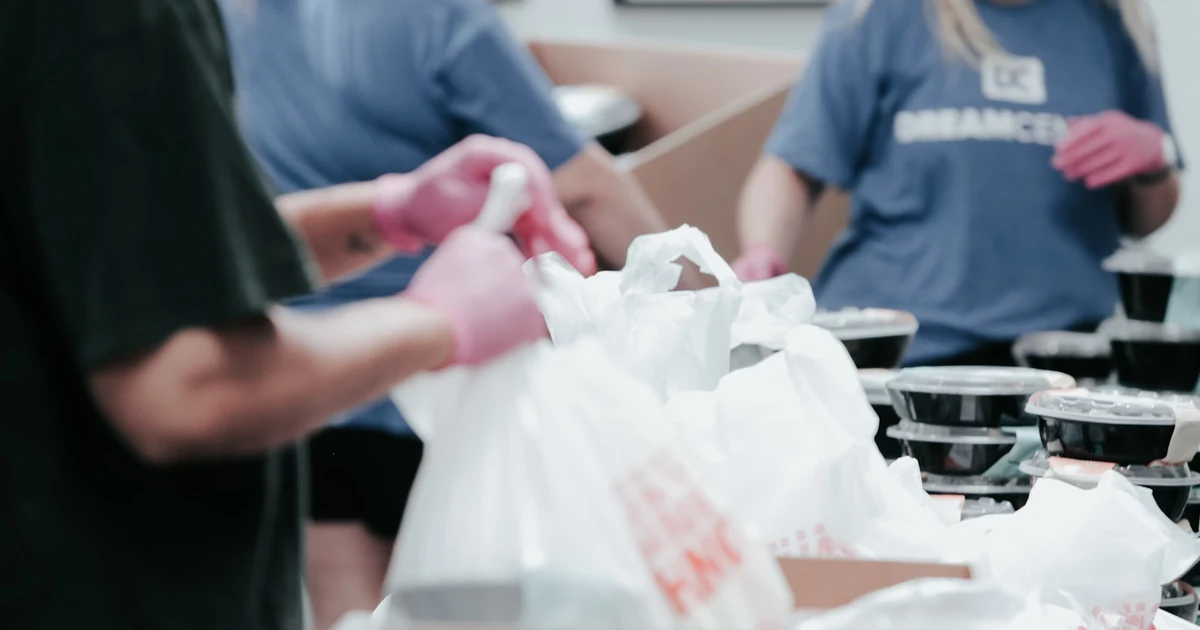
Muslim families who rely on TEFAP food assistance deserve a straight answer: which items on the USDA list are actually halal? The USDA has published clear guidance — but it is buried in agency factsheets. This guide brings it all together, using the official USDA FNS TEFAP Halal Factsheet (FNS 969, August 2023) and the TEFAP Foods Available List FY2025.
What Is TEFAP?
The Emergency Food Assistance Programme (TEFAP) is a federal programme administered by the US Department of Agriculture’s Food and Nutrition Service (FNS). It supplies food commodities to state agencies, which distribute them through local food banks and food pantries to low-income households. TEFAP operates across all 50 states and serves millions of Americans each year. The programme offers a wide range of commodities — canned goods, frozen proteins, fresh produce, grains, and dairy — though the specific items available at any distribution site depend on what the state has ordered from the USDA foods catalogue.
How USDA Defines Halal in TEFAP
The USDA FNS factsheet defines halal food as food that is permissible under Islamic law. The factsheet notes that halal diets typically do not permit:
- Pork products
- Alcohol and products containing alcohol
- Products containing ingredients that use non-halal animal-derived components
The USDA gives cheese as a direct example: rennet, which is used to produce cheese, is derived from an animal and is therefore not acceptable to halal-observant communities unless certified halal.
Under the TEFAP system, items marked with (H) on the Foods Available List have undergone formal halal certification — the product has been processed in a facility maintaining halal certification integrity. Items without the (H) mark may still be acceptable based on their nature: fresh produce, certain types of fish, and shell eggs may be acceptable without certification. The USDA guidance is explicit that community leaders and imams should be consulted to identify which non-certified items are acceptable to local halal-observant households.
The Only Halal-Certified TEFAP Food
As of the TEFAP Foods Available List FY2025 (Revised August 2024), there is one item on the USDA foods catalogue that carries formal halal certification — the (H) mark:
| Item | WBSCM Code | Pack Size |
|---|---|---|
| Tomato Sauce, Low Sodium, Canned (K)(H) | 110610 | 24 × 15.5 oz can |
This item is also kosher certified (K). That it is the only formally halal-certified commodity in the entire TEFAP catalogue reflects the difficulty of obtaining halal certification at USDA commodity scale — not a lack of halal-acceptable items. The list below shows everything that the USDA itself identifies as acceptable without formal certification.
Foods Acceptable Without Halal Certification
The USDA factsheet identifies a substantial range of TEFAP commodities that “may be acceptable without halal certification” based on their nature. These are grouped below by category using the official FY2025 Foods Available List.
Fruits
| Item | WBSCM Code |
|---|---|
| Applesauce Unsweetened Canned (K) | 100207 |
| Apple Slices Unsweetened Frozen (IQF) | 110470 |
| Apples, Braeburn Fresh | 100523 |
| Apples, Empire Fresh | 100517 |
| Apples, Fuji Fresh | 100522 |
| Apples, Gala Fresh | 100521 |
| Apples, Granny Smith Fresh | 110543 |
| Apples, Red Delicious Fresh | 100514 |
| Apples Fresh | 110561 |
| Blueberries Highbush Unsweetened Frozen | 110623 |
| Oranges Fresh | 100283 |
| Peaches Freestone Slices Frozen | 100238 |
| Pears, Bartlett Fresh | 111424 |
| Pears, Bosc Fresh | 111423 |
| Pears, D’Anjou Fresh | 111422 |
| Pears Extra Light Syrup Canned (K) | 100223 |
| Pears Fresh | 110560 |
| Strawberries Whole Unsweetened Frozen | 111680 |
Vegetables
| Item | WBSCM Code |
|---|---|
| Beans Green Low Sodium Canned (K) | 100306 |
| Beans Green No Salt Added Frozen | 111054 |
| Carrots Diced No Salt Added Frozen | 111052 |
| Corn Whole Kernel No Salt Added Canned (K) | 100311 |
| Mixed Produce Box Fresh | 111427 |
| Peas Green No Salt Added Frozen | 110763 |
| Potatoes Round Fresh | 101019 |
| Potatoes Russet Fresh | 101017 |
| Sweet Potatoes Fresh | 111058 |
Legumes
| Item | WBSCM Code |
|---|---|
| Beans Garbanzo Canned (K) | 111060 |
| Beans Lima Baby Dry | 100378 |
| Beans Black-eyed Pea Dry | 100374 |
| Beans Pinto Dry | 100382 |
| Beans Great Northern Dry | 100380 |
| Lentils Dry | 100388 |
| Beans Kidney Light Red Dry | 100385 |
| Peas Green Split Dry | 111055 |
Protein
| Item | WBSCM Code | Notes |
|---|---|---|
| Almonds Natural Whole Shelled | 100907 | |
| Atlantic Haddock Fillet Frozen | 111292 | |
| Atlantic Ocean Perch Fillet Frozen | 111293 | |
| Atlantic Pollock Fillet Frozen | 111291 | |
| Catfish Fillets Farm-Raised Frozen | 110390 | See catfish note below |
| Catfish Fillets Wild-Caught Frozen | 111800 | See catfish note below |
| Eggs Fresh | 100936 | |
| Peanut Butter Smooth (K) | 111170 | |
| Salmon Pink Canned (K) | 110580 | |
| Walnuts Pieces | 100908 |
Grains
| Item | WBSCM Code |
|---|---|
| Bakery Mix Lowfat (K) | 110902 |
| Cornmeal Yellow | 100471 |
| Flour All Purpose Enriched Bleached | 100400 |
| Flour White Whole Wheat | 110857 |
| Grits Corn White | 111082 |
| Grits Corn Yellow | 111072 |
| Oats Rolled Quick Cooking | 111074 |
| Macaroni Enriched | 110511 |
| Macaroni Whole Grain | 101023 |
| Rotini Whole Grain | 110777 |
| Spaghetti Enriched | 110450 |
| Spaghetti Whole Grain | 101035 |
| Rice Medium Grain | 100487 / 100488 |
| Rice Long Grain | 100491 / 100492 |
Dairy
| Item | WBSCM Code |
|---|---|
| Yogurt High-Protein Blueberry Chilled (K) | 110400 |
| Yogurt High-Protein Strawberry Chilled (K) | 110401 |
| Yogurt High-Protein Vanilla Chilled (K) | 111750 / 110402 |
These yogurts are kosher certified but not halal certified. Because they are dairy products with no meat-derived ingredients and no alcohol, they fall within the USDA’s “acceptable without certification” guidance. Consult your local imam if you have concerns about specific brands.
Oils
| Item | WBSCM Code |
|---|---|
| Vegetable Oil | 100441 |
Foods to Avoid at a TEFAP Distribution
The following TEFAP commodities are either explicitly haram or are not halal certified. Do not accept these items unless you have verified the specific batch carries halal certification.
| Item | WBSCM Code | Reason |
|---|---|---|
| Pork Canned / Pouch | 100139 | Pork — haram |
| Pork Ham Frozen | 100182 | Pork — haram |
| Pork Chops Boneless Frozen | 110380 | Pork — haram |
| Beef Canned / Pouch | 100127 | Not halal certified |
| Beef Fine Ground 85/15 Lean | 100159 / 110260 | Not halal certified |
| Beef Stew Canned / Pouch | 100526 | Not halal certified |
| Chicken Boneless Breast Frozen | 111820 | Not halal certified |
| Chicken Canned | 110940 | Not halal certified |
| Chicken Drumsticks Frozen | 111579 | Not halal certified |
| Chicken Pouch | 110477 | Not halal certified |
| Chicken Split Breast Frozen | 111577 | Not halal certified |
| Chicken Whole Frozen | 100880 | Not halal certified |
| Cheese American Reduced Fat | 100035 | Animal rennet; not halal certified |
| Cheese Cheddar | 110843 / 110841 | Animal rennet; not halal certified |
The beef and chicken items on this list are standard USDA commodity meats — there is no TEFAP beef or chicken commodity that is halal certified as of FY2025. If your food bank participates in a halal TEFAP programme (see ICNA Relief below), they will source halal-certified alternatives directly.
The cheeses are particularly worth flagging: American and cheddar cheese in the TEFAP catalogue use animal rennet, which is not acceptable under halal dietary law. This matches the example given in the USDA factsheet itself.
The Catfish Question
The USDA notes on both catfish items — Catfish Fillets Farm-Raised Frozen (110390) and Catfish Fillets Wild-Caught Frozen (111800) — that communities should “work with experts in your community, as there is a small sector of halal-observant communities who will not consume catfish.”
This is an accurate acknowledgement of a real scholarly divergence. The mainstream Sunni position — across all four madhabs — is that all fish are halal without slaughter requirements. However, among some Hanafi scholars, there is a minority opinion that only scaled fish are halal, which would exclude catfish. This view is not the dominant Hanafi position globally, but it does have scholarly support, particularly in some South Asian Hanafi communities.
The mainstream ruling is that catfish is halal. If you follow a scholar or community that restricts fish to scaled species, then catfish — along with pollock and perch — should be avoided. For all other families, the TEFAP catfish items are acceptable.
If you are uncertain, the other fish items on the TEFAP list — Atlantic Haddock (111292), Atlantic Ocean Perch (111293), Atlantic Pollock (111291), and Salmon Pink Canned (110580) — are unambiguously halal across all four madhabs and carry no community disagreement.
How to Access TEFAP as a Muslim Family
TEFAP distributions are open to qualifying low-income households. To find a distribution in your area:
- Contact your local food bank — search via Feeding America at feedingamerica.org using your postcode. Food banks can tell you which TEFAP commodities are available and when distributions take place.
- Ask about substitutions — many food banks allow you to decline specific items such as pork. You are entitled to make dietary selections at most distributions.
- Contact state agencies — your state’s TEFAP agency (administered via the Department of Agriculture or equivalent) can advise on halal-specific availability in your area.
- Ask specifically about ICNA Relief — if you are in a state where ICNA Relief operates, they offer a dedicated halal TEFAP programme (see below).
When collecting food, examine each item against the lists above. If the food bank offers beef, chicken, or cheese items and you are unsure, ask to see the product label and check for a halal certification logo from a recognised body such as IFANCA, ISNA, or another certifier. If there is no certification mark, the item is not halal certified under TEFAP.
You can also use the HalalCodeCheck ingredient scanner to check any packaged item’s ingredient list for halal-status concerns, or look up specific additives in the E-codes database.
ICNA Relief: Halal TEFAP in 27 States
ICNA Relief (Islamic Circle of North America Relief USA) operates a dedicated Halal TEFAP programme, making it the primary avenue for Muslim families to access fully halal-certified emergency food assistance through the TEFAP system.
ICNA Relief’s Halal TEFAP programme is currently active in 27 states, including:
- Arizona
- California
- Texas
- New York
- Michigan
- And additional states across the country
Through this programme, ICNA Relief works with USDA-approved suppliers to source halal-certified commodity equivalents — including halal-certified meat and poultry — that are not available in the standard TEFAP catalogue. The distribution model mirrors the TEFAP framework but is designed specifically for halal-observant households.
To find an ICNA Relief halal food bank near you, visit icnarelief.org/halal-tefap.
A note on food storage: USDA guidance recommends that food banks using halal-certified TEFAP items store them on separate pallets from non-halal commodities and, where possible, use separate refrigerated units. Where separate storage is not available, partitions and clear labels should be used. If you are receiving food from a halal-designated distribution, ask the staff how halal items are stored and separated.
How we reached this verdict
We drew on the following Tier-1 sources for this guide:
- USDA FNS TEFAP Halal Factsheet (FNS 969, August 2023) — the primary federal guidance document setting out which TEFAP commodities are halal certified, which are acceptable without certification, and the general halal dietary framework applied to the programme.
- TEFAP Foods Available List FY2025 (Revised August 2024) — the official USDA commodity catalogue identifying the single (H) halal-certified item and all other available commodities.
- ICNA Relief Halal TEFAP programme (icnarelief.org/halal-tefap) — operational information on the 27-state network providing halal-certified emergency food assistance.
- Halal certification bodies (HMC, HFA, JAKIM, MUI): Where products carry formal halal certification from any of these bodies, or where the (H) mark appears on the USDA Foods Available List, the product is treated as certified halal. Products with only the (K) kosher mark are not treated as halal certified, though they may be acceptable to some households when no animal-derived additives are present.
- Sunni fatwa scholarship across the four madhabs:
- Hanafi-leaning bodies: Darul Iftaa Birmingham, AskImam.org, Daruliftaa.com, Wifaqul Ulama, Darul Iftaa New York — on fish permissibility, catfish scholarly divergence, and rennet.
- Shafi’i / Maliki-leaning bodies: NU (Nahdlatul Ulama, Indonesia), Dar al-Ifta al-Misriyyah (Egypt), e-fatwa.com (UAE) — on the mainstream ruling that all fish are halal.
- Hanbali / Saudi-Salafi-leaning bodies: Saudi Permanent Committee for Scholarly Research, IslamQA Saudi — on meat slaughter requirements and the non-certification of standard USDA commodity beef and chicken.
Madhab note
The four Sunni madhabs broadly converge on the rulings applied in this guide, with one notable point of divergence:
- All fish are halal — This is the majority and mainstream ruling across all four madhabs, held by Shafi’i, Maliki, Hanbali, and the dominant Hanafi position globally. No slaughter requirements apply to fish. TEFAP fish commodities (haddock, pollock, perch, salmon, catfish) are halal under this mainstream position.
- Catfish — the minority Hanafi view: A minority position among some Hanafi scholars restricts halal fish to scaled species only, which would exclude catfish. This view has some scholarly backing but is not the dominant Hanafi opinion. If your scholar or community follows this position, substitute the unambiguous fish items (haddock, pollock, perch, salmon) instead.
- Non-certified beef and chicken are not halal — All four madhabs require that cattle and poultry be slaughtered in accordance with zabihah requirements. TEFAP beef and chicken commodities carry no halal certification and must be avoided. The debate over People-of-the-Book slaughter (Maliki and classical Shafi’i/Hanbali generally accepting; Hanafi-Deobandi more restrictive) is moot here because TEFAP meats are standard US commodity meats with no zabihah slaughter of any kind.
- Rennet in cheese — The USDA’s own factsheet identifies animal rennet as a reason cheese is not acceptable to halal-observant communities. This reflects mainstream scholarly opinion: animal rennet from a non-halal-slaughtered animal is not permissible. Some scholars apply istihāla (transformation doctrine) to argue that rennet is so transformed from its origin that it becomes permissible; the Hanafi and cautious Hanbali position does not accept this for rennet. We follow the conservative ruling here, which aligns with the USDA’s own guidance.
If your madhab differs on a specific ruling, consult a competent scholar in your tradition.
Ingredients change. Be first to know.
Brands reformulate without warning. We track every E-code update and halal certification — one short weekly email.
Related Articles
 Shopping Guides
 Halal Shopping at Coles: Aisle-by-Aisle Australia Guide (2026)
Coles stocks halal-certified meat from accredited abattoirs but own-brand packaged goods require E-code checking — here's what to look for in each aisle.
 Shopping Guides
 Halal Shopping at Carrefour: France, UAE & Turkey Guide (2026)
Carrefour's halal status varies by country — UAE stores stock certified halal products throughout, while French stores require label-by-label checking.
 Shopping Guides
 Halal Food in Malaysia: Beyond JAKIM — Full Supermarket & Brand Guide
JAKIM certification is Malaysia's gold standard but not every product on shelf is JAKIM-certified — here's how to shop confidently in Mydin, Giant, and Aeon.