
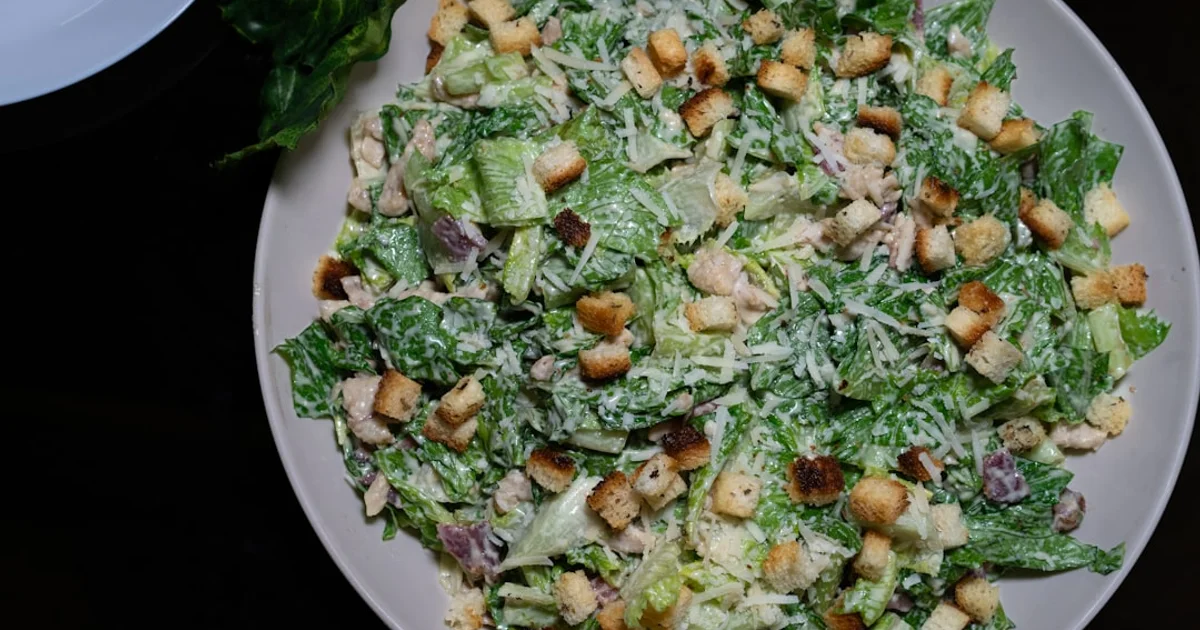
You’re checking Sainsbury’s Caesar Dressing before pouring it over a salad. Caesar dressing has a reputation for hidden halal concerns — usually anchovy or Worcestershire sauce. This one’s concern is different, and less obvious.
The direct verdict: Mushbooh. No anchovy, no Worcestershire sauce, no alcohol — but the Parmigiano Reggiano PDO cheese is legally required to use animal rennet.
Full Ingredient List (Standard 150ml)
Rapeseed oil, water, white wine vinegar, Parmigiano Reggiano Cheese PDO (5%) (cows’ milk), pasteurised egg, sugar, cornflour, salt, garlic purée, spirit vinegar, black pepper, treacle, onion purée, tamarind extract, clove powder, lemon oil.
Allergens declared: eggs, milk. No E-codes appear anywhere in this formulation — a genuinely additive-free ingredient list, which is unusual and worth noting on its own.
What’s Actually Clean
This dressing skips the two ingredients that most commonly trip up Caesar dressings: there’s no anchovy and no Worcestershire sauce (which itself typically contains anchovy). The vinegars — white wine and spirit — are used purely as acidulants; while wine vinegar begins as an alcoholic product, the fermentation to vinegar is a recognised transformation (istihāla) that the majority of scholars across madhabs accept as removing the alcohol concern.
The pasteurised egg gives this dressing its mayonnaise-style base — standard, no halal issue.
The Parmesan Is the Actual Concern
Parmigiano Reggiano PDO is not a generic “parmesan-style” ingredient — PDO (Protected Designation of Origin) is an EU legal status that locks in the exact traditional production method, and that method requires animal rennet, specifically from a calf’s stomach. Cheese carrying the genuine Parmigiano Reggiano PDO name cannot legally substitute microbial or vegetarian rennet and keep the designation. This is different from many supermarket “parmesan-style” hard cheeses, which do sometimes use non-animal rennet and can be labelled vegetarian-suitable — this dressing specifically uses the certified PDO product, which forecloses that option.
Whether that rennet came from a zabiha-slaughtered calf is unknown and unstated — as is standard for virtually all commercial PDO parmesan supply chains, which aren’t built around halal traceability.
How This Compares to Other Sainsbury’s Caesar Dressings
Sainsbury’s sells more than one Caesar dressing SKU — the “Be Good to Yourself” lower-fat version uses a different, yoghurt-based formulation. That’s a separate ingredient list from the standard 150ml dressing covered here, and shouldn’t be assumed to carry the same verdict without checking its own label.
Halal Alternatives
- Caesar dressings made with generic “parmesan-style” cheese (not PDO) — check the label for a vegetarian-suitable claim, which would indicate non-animal rennet
- Vegan Caesar dressings — skip the cheese question entirely, though check other ingredients independently
- Homemade Caesar dressing using a confirmed microbial-rennet hard cheese
This dressing is the worked example of why own-brand needs a label check beyond the obvious aisles — our full Sainsbury’s halal shopping guide applies the same checks across the whole store.
As an Amazon Associate, HalalCodeCheck earns from qualifying purchases.
Summary
| Question | Answer |
|---|---|
| Does it contain anchovy or Worcestershire sauce? | No |
| Does it contain alcohol? | No — vinegar only, not wine itself |
| What’s the concern? | Parmigiano Reggiano PDO — legally requires animal rennet |
| Is it halal-certified? | No |
| Verdict | Mushbooh |
Look up rennet and other ingredients in the E-codes database.
To scan a full ingredient list for halal status in seconds, use the ingredient scanner.
How we reached this verdict
We checked the following Tier-1 sources before publishing this verdict:
- Manufacturer statements: the product’s ingredient panel via Open Food Facts and retailer listings, confirming the Parmigiano Reggiano PDO designation and full formulation.
- EU PDO regulation: Parmigiano Reggiano’s Protected Designation of Origin specification, which mandates traditional animal-rennet coagulation as a condition of using the name.
- Halal certification bodies (HMC, HFA, JAKIM, MUI): no certified-establishment listing exists for this product.
- Sunni fatwa scholarship across the four madhabs:
- Hanafi-leaning bodies: IslamQA Hanafi, Darul Iftaa Birmingham, AskImam.org, Daruliftaa.com (Mufti Taqi Usmani), Wifaqul Ulama, Darul Iftaa New York.
- Shafi’i / Maliki-leaning bodies: NU (Nahdlatul Ulama, Indonesia), Dar al-Ifta al-Misriyyah (Egypt), e-fatwa.com (UAE), al-Azhar.
- Hanbali / Saudi-Salafi-leaning bodies: Saudi Permanent Committee for Scholarly Research, IslamQA Saudi.
Madhab note
The four Sunni madhabs broadly converge on the rules applied in this guide:
- Rennet from a non-zabiha-slaughtered animal — Hanafi and Maliki scholars generally accept it under istihāla (transformation) reasoning; some Shafi’i and Hanbali scholars are more cautious and recommend avoidance. This is the deciding ambiguity for this product.
- Istihāla (transformation) — spirit vinegar — Hanafi and Maliki accept istihāla strongly; spirit vinegar (alcohol → vinegar) is halal. Most Shafi’i scholars permit spirit vinegar specifically; some Hanbali scholars are more cautious. This resolves the wine-vinegar and spirit-vinegar ingredients here.
- Anchovy/fish-based ingredients — not present in this formulation, but where they appear elsewhere, fish require no zabiha slaughter across all four madhabs and are halal.
If your madhab differs on a specific ruling, the relevant section above flags the school-specific position. For binding rulings on borderline products, consult a competent scholar in your tradition.
Ingredients change. Be first to know.
Brands reformulate without warning. We track every E-code update and halal certification — one short weekly email.
Related Articles
 Shopping Guides
 The Complete Guide to Halal Pasta Sauces: Jar, Pesto, Fresh and Ready Meal (2026)
Plain tomato sauces are almost always fine. The problems: wine in bolognese, animal rennet in pesto parmesan, and anchovy in puttanesca. Dolmio, Sacla, Napolina, Lloyd Grossman — all checked.
 Shopping Guides
 Best Halal Salad Dressings USA 2026 — Verified Picks
We checked six major US salad dressing brands directly. Not one carries a real halal certification — one Muslim-owned condiment brand does, and it isn't a bottled ranch.
 Shopping Guides
 Is Michael Angelo's Eggplant Parmesan Halal? Cheese and Rennet Checked (2026)
No pork, gelatine, or wine in Michael Angelo's Eggplant Parmesan — but the mozzarella, Romano and Parmesan cheeses list 'enzymes' without naming the rennet source. Mushbooh explained.