
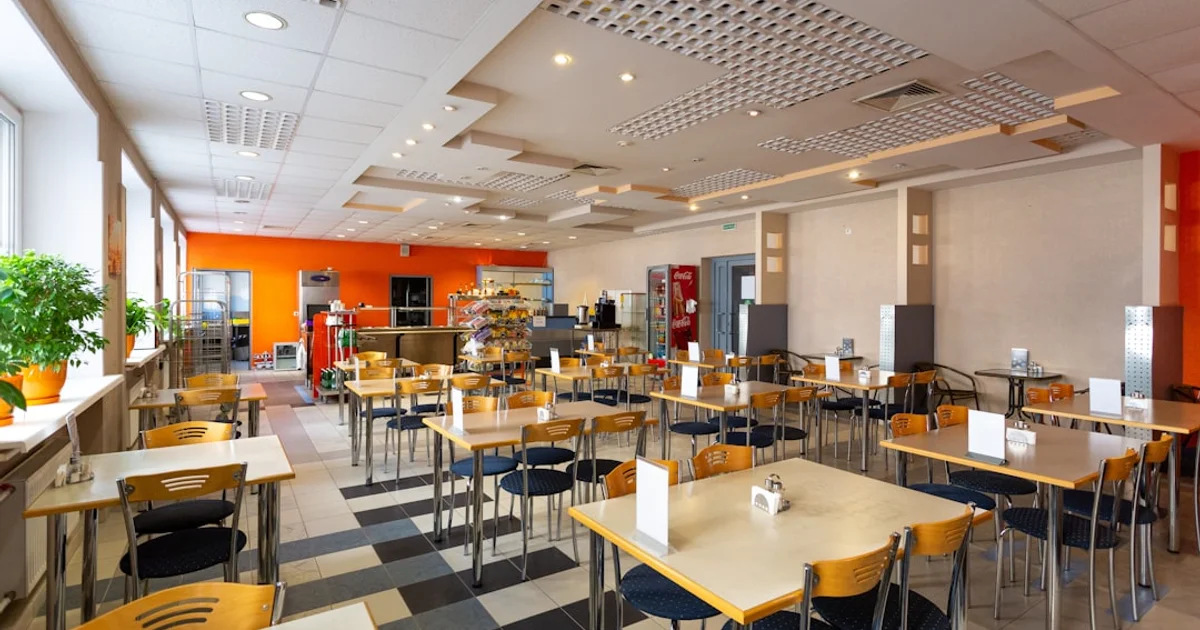
Koufu isn’t one restaurant with one halal answer — it’s a Singapore-listed operator running more than 180 food courts, coffee shops, and casual eateries under 12 separate brands. Some of those outlets are entirely halal. Most aren’t. Getting this right means knowing which brand you’re standing in, not just which company owns the building.
Fork & Spoon, Koufu’s dedicated halal food hall concept, is the exception that’s fully certified — every stall inside operates under a MUIS “No Pork, No Lard” policy. Standard Koufu-branded food courts, Cookhouse by Koufu, Gourmet Paradise, and the group’s coffee shop brands (Happy Hawkers, 1983 – A Taste of Nanyang) are mixed premises: individual stalls can be MUIS-certified, but the food court as a whole serves pork and non-halal dishes side by side.
Koufu’s Brand Portfolio — and Which Ones Are Halal-Focused
| Brand | Format | Halal status |
|---|---|---|
| Fork & Spoon | Halal food hall | Fully halal — MUIS-certified, “No Pork, No Lard” throughout |
| Koufu (flagship) | Food court | Mixed — check each stall individually |
| Cookhouse by Koufu | Food court | Mixed — check each stall individually |
| Gourmet Paradise | Food court | Mixed — check each stall individually |
| Rasapura Masters | Food court (Marina Bay Sands) | Mixed — check each stall individually |
| Happy Hawkers | Coffee shop | Mixed — check each stall individually |
| 1983 – A Taste of Nanyang | Coffee shop / quick service | Mixed — check each stall individually |
| Elemen | Full-service restaurant (vegetarian) | No meat served; not MUIS halal-certified as a policy — verify current status directly |
Why “Mixed” Food Courts Are the Real Risk
The concern for Muslim diners at a standard Koufu food court isn’t just whether a specific stall’s food is halal-sourced — it’s shared premises. Utensils, cooking surfaces, and in some cases fryers can be shared or positioned close to stalls preparing pork. MUIS certification for an individual stall accounts for this within that stall’s boundary, which is why the certificate has to be checked stall-by-stall rather than assumed for the food court as a whole.
This is a common pattern across Singapore’s food court industry, not unique to Koufu — but Koufu’s scale (180+ outlets) makes it one of the operators Muslim diners in Singapore encounter most often, which is exactly why the brand-level distinction matters.
How to Check a Koufu Stall in 30 Seconds
- Look for the MUIS certificate — a green-and-white logo displayed at the individual stall, not the food court entrance.
- Check the MUIS directory at muis.gov.sg before you go, if you’re planning a specific visit — search by outlet name or location.
- Default to Fork & Spoon if you want certainty without checking individual stalls — every vendor inside is halal by the food hall’s operating policy.
- Don’t assume based on cuisine type — a Malay or Indian-Muslim-cuisine stall inside a standard Koufu food court still needs its own certificate; cuisine type is not the same as certification.
Summary
| Question | Answer |
|---|---|
| Is Koufu halal? | No single answer — depends on the specific brand and stall |
| Which Koufu brand is fully halal? | Fork & Spoon (MUIS-certified, “No Pork, No Lard”) |
| Are standard Koufu food courts halal? | Mixed — check the individual stall’s MUIS certificate |
| Best way to check | MUIS directory at muis.gov.sg, or the certificate displayed at the stall |
Look up any E-code from a packaged snack in the E-codes database.
To scan a full ingredient list for halal status in seconds, use the ingredient scanner.
How we reached this verdict
We checked the following Tier-1 sources before publishing this verdict:
- Halal certification bodies: MUIS (Majlis Ugama Islam Singapura) is Singapore’s sole official halal-certifying authority. Fork & Spoon’s “No Pork, No Lard” MUIS certification is confirmed for its food hall locations; individual Koufu-branded food court stalls carry certification independently, per MUIS’s stall-level (not food-court-level) certification model.
- Company statements: Koufu’s own brand pages confirm the 12-brand portfolio and Fork & Spoon’s positioning as its dedicated halal concept, distinct from its standard mixed food courts.
- Sunni fatwa scholarship: mainstream Sunni guidance (consistent across Hanafi, Shafi’i, Maliki, and Hanbali positions represented in Singapore’s Muslim community) treats shared-premises food courts as requiring stall-level verification — a certified stall within an otherwise mixed venue is acceptable to eat from, provided preparation surfaces are not shared with non-halal stalls.
Madhab note
The four Sunni madhabs broadly converge on the rules applied in this guide:
- Shared food court premises — a MUIS-certified stall is acceptable to eat from even within a mixed food court, provided the certifying body (MUIS) has verified separation of halal food preparation from non-halal preparation at that stall. This is consistent across Hanafi, Maliki, Shafi’i, and Hanbali positions represented in Singapore.
- Pork-derived sources — Haram across all four madhabs; this is the reason “No Pork, No Lard” policies exist as a baseline for halal food hall concepts like Fork & Spoon.
- Cuisine type is not certification — all four madhabs require actual verification (certificate or reliable disclosure) rather than assuming a dish is halal based on the cuisine or ethnicity associated with a stall.
If your madhab differs on shared-premises questions, consult a competent scholar in your tradition for a binding ruling.
Ingredients change. Be first to know.
Brands reformulate without warning. We track every E-code update and halal certification — one short weekly email.
Related Articles
 Halal Guides
 Is Tomoro Coffee Halal? What We Could (and Couldn't) Confirm
Tomoro Coffee is an Indonesian chain with 600+ outlets, expanding into Singapore and beyond. Indonesia's mandatory halal law applies to it — but we could not confirm an official BPJPH/MUI certificate. Here's what to check yourself.
 Shopping Guides
 Halal Snacks in Turkey: Why Ülker Has No Logo and Lay's Türkiye Has No Certificate (2026)
In Turkey halal is the default, not a label — so most domestic snacks carry no helal mark and are still fine. The exceptions worth checking: Frito-Lay's Turkish-made Lay's and Doritos publish no product-level certificate, and imported European snacks bring pork and gelatine with them.
 Shopping Guides
 Halal Food in Columbus (2026): Morse Road & WeGotMeat
Find halal food in Columbus across Morse Road, Northland and the OSU corridor, plus WeGotMeat, Somali restaurants, grocers and halal meat options.