
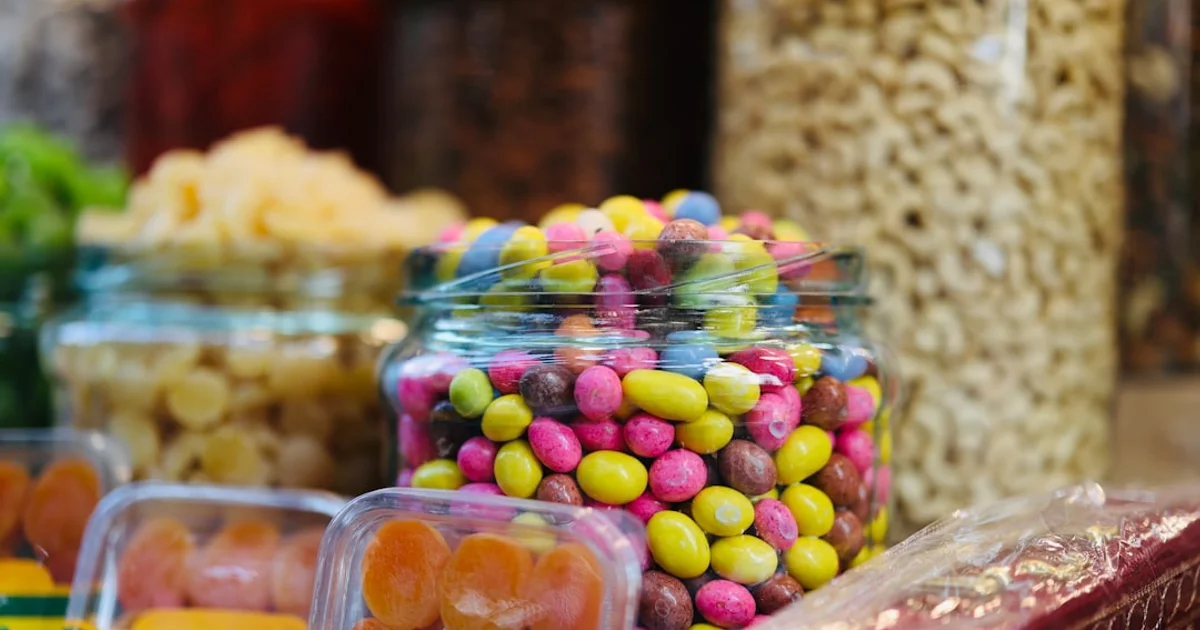
You have picked up a bag of Haribo Starmix in a Dunnes in Cork. The back says gelatine. It doesn’t say which animal. This guide tells you what that means on an Irish shelf, which mainstream sweets never had gelatine in the first place, and where the genuinely certified bags are.
Ireland has one structural fact worth knowing up front: no Irish confectionery brand holds Irish halal certification. The Islamic Foundation of Ireland has certified halal meat exports since 1981, and the Islamic Cultural Centre of Ireland in Clonskeagh offers certification services, but their work is overwhelmingly meat. Sweets certification in Ireland is imported certification.
Haribo: Same Stock as the UK
Irish supermarket Haribo comes through the same UK/German supply chain as British shelves.
Most Haribo products in the UK/EU contain pork gelatine and are not halal. Dedicated halal-certified Haribo ranges exist in Turkey, some Middle Eastern countries, and selected UK halal stores — but they are packaged separately.
Full Haribo brand guide →The halal-certified Haribo made in Turkey uses beef gelatine and carries a halal mark — but it is packaged separately, and in Ireland you will find it in halal grocers and online, not in the confectionery aisle of Tesco Ireland or SuperValu. Our Haribo verdict covers the country-of-origin rule in detail; it applies unchanged here.
Rowntree’s: The Gelatine-Free Lines
Nestlé’s Rowntree’s range is split. Fruit Pastilles and Jelly Tots are set with starch and pectin, not gelatine; Randoms and wine gums are gelatine products.
Rowntree's is split: Fruit Pastilles and Jelly Tots contain no gelatine and are generally considered halal. Wine Gums, Randoms, and Jelly Snakes contain gelatine, which in UK products is almost certainly pork-derived. Always check the specific product ingredients.
Full Rowntree's brand guide →Jelly Tots are gelatin-free and made with glucose syrup, sugar, and fruit juice concentrates. No animal-derived E-codes. Suitable for vegetarians. One of the safest confectionery options for Muslim consumers.
Full Jelly Tots brand guide →The caveat Nestlé itself raises: the gelatine-free lines are made in the same factories as the gelatine lines. Under the majority position trace cross-contact is excused; stricter households will prefer a certified bag.
Cadbury Ireland: Coolock and Rathmore, UK Rules
Cadbury’s Irish factories at Coolock (Dublin) and Rathmore (Kerry) make the Irish and much of the UK Dairy Milk range. The product is the UK formulation, with the UK certification position — none.
Cadbury UK holds no halal certification. Products contain E442 (ammonium phosphatides) and E476 (PGPR) - emulsifiers that can be derived from animal fat. Until Cadbury discloses the source or obtains certification, UK products are Mushbooh. Cadbury products sold in Pakistan, Malaysia, and Egypt are manufactured locally and may hold regional halal certification.
Full Cadbury brand guide →The chocolate bars themselves have no gelatine; the E442/E476 emulsifier question is what keeps them Mushbooh. Cadbury’s marshmallow and jelly products (Flake-topped desserts, seasonal jellies) are a different matter — read for gelatine.
Lily O’Brien’s and Butlers: Ireland’s Premium Chocolatiers
Lily O’Brien’s (Newbridge, Co. Kildare) is the one Irish name with a halal certificate we could verify — and it is for the wrong product. The company won a Mercury Award for its halal-certified gourmet desserts range, a foodservice line. We found no published certificate for the retail chocolate collections, and Lily O’Brien’s does not market them as halal. The plain pieces list no gelatine; the caramel, cream and liqueur-flavoured pieces carry undisclosed flavourings. Mushbooh for the chocolates.
Butlers Chocolates (Dublin) publishes no halal certification. Same reading rule: plain solid chocolate is ingredient-clean; filled pieces need the full label, and any truffle described as “with Irish cream” or “with whiskey” is out.
The Certified Aisle: Imports
The halal-certified gummies on Irish shelves are Turkish and Spanish, and they turn up in Dunnes’ and SuperValu’s world-food shelves, in Asian and Middle Eastern grocers in Dublin, Cork, Limerick and Galway, and on Irish sweet-shop sites that run a halal filter.
Bebeto is halal. All products are manufactured in Turkey and carry halal certification from Turkish halal authorities. The brand sets its mainstream gummies with halal beef gelatine, with plant-based alternatives (pectin, agar) on selected lines — no pork gelatine in any product.
Full Bebeto brand guide →Sweetzone is 100% halal. The brand was founded specifically to serve the Muslim and halal market. Every product is halal certified — no pork gelatine in any line. One of the UK's most trusted halal sweet brands.
Full Sweetzone brand guide →Vidal gummy products contain pork gelatine (E441) and are Haram. Hard candies and lollipops without gelatine are Mushbooh — no halal certification. Gulf market Vidal variants may be halal certified.
Full Vidal brand guide →Vidal’s Varies verdict is the one to respect: Vidal makes both halal-marked and standard gelatine lines, and Irish pick-and-mix counters often mix them. Buy the sealed bag with the halal logo, not the scoop.
Is There Any Halal-Certified Chocolate in Ireland?
Not on the mainstream shelf, as far as we can verify. No chocolate bar you would pick up in Tesco, Dunnes, SuperValu, Aldi or Lidl in Ireland carries a halal certificate we have been able to confirm.
What Ireland does have is two genuine certification bodies, which is more than most European markets:
- The Department of Halal Certification EU, based in Ireland and operating under the Islamic Centre of Ireland since 2011. Its certification is recognised by JAKIM in Malaysia, MUIS in Singapore, EIAC in Dubai and IHAF. Every certificate carries a number and a QR code that resolves to a public register, so a claim can be checked rather than believed.
- The Islamic Foundation of Ireland, which has certified Irish meat for export since 1981 and is recognised by JAKIM, MUIS and the State of Qatar.
Two Irish chocolatiers come up and both need care. Butlers appears in a 2020 certificate posting by the Department of Halal Certification, but the entry names no products, no certificate number and no validity dates, so we cannot tell you what it covered or whether it still stands. Butlers also sells Irish cream liqueur bars, which are a separate matter whatever that certificate covered. Lily O’Brien’s won an award in 2015 for a halal-certified range, but that range was four airline desserts rather than the retail boxes, and the certifier was never named.
On Cadbury Ireland, made at Coolock and Rathmore, Mondelez has said of its UK products that none are halal certified and that no change was ever made to the recipe to make them halal. We have found no Ireland-specific statement, so treat the UK wording as the closest available guide rather than as an Irish answer.
The Three-Line Check for Any Sweet in Ireland
- Gelatine in the list with no halal mark → not halal-safe.
- E120 (carmine — insect dye, common in red and pink sweets) and E904 (shellac glaze) → read our E120 and E904 verdicts; most scholars treat E120 as haram.
- Halal mark from a named certifier → certified for that bag.
Summary
| Question | Answer |
|---|---|
| Is Haribo halal in Ireland? | Supermarket stock is UK/German pork-gelatine product — no. Turkish halal Haribo only via halal shops. |
| Gelatine-free mainstream sweets | Rowntree’s Fruit Pastilles, Jelly Tots (shared lines) |
| Certified gummies in Ireland | Bebeto, Sweetzone, halal-marked Vidal |
| Irish chocolatiers | Lily O’Brien’s (desserts certified, chocolates not), Butlers (uncertified) — Mushbooh |
| Irish certifier for sweets | None active for confectionery; IFI/ICCI certify meat |
Look up any E-number from an Irish wrapper in the E-codes database, or scan the whole list with the ingredient scanner. For the supermarket-by-supermarket picture, see Halal Shopping in Ireland.
How we reached this verdict
Sources checked September 2026:
- Haribo, Rowntree’s, Jelly Tots, Cadbury, Bebeto, Sweetzone, Vidal: existing HalalCodeCheck brand verdicts, rendered from the brand pages above — not re-derived here.
- Irish certification landscape: Islamic Foundation of Ireland (halal meat export certification since 1981); Islamic Cultural Centre of Ireland, Clonskeagh (certification services). No Irish confectionery manufacturer appears in either body’s published material.
- Lily O’Brien’s: company awards page (Mercury Award, halal-certified gourmet desserts range). No retail-chocolate certificate published.
- Butlers Chocolates: company site — no halal certification statement.
- Cadbury Ireland: Coolock and Rathmore production; UK formulation and certification position.
- Fatwa references: IslamQA (Hanafi) and Darul Iftaa Birmingham on gelatine source and on trace cross-contact.
Madhab note
- Pork gelatine — haram across all four madhabs.
- Bovine gelatine — halal only from halal-slaughtered cattle (Hanafi, Maliki, Shafi’i, Hanbali); the Hanafi istihala minority view is not extended to undisclosed sources.
- E120 carmine — haram under the Hanafi, Shafi’i and Hanbali mainstream; some Maliki scholars permit.
- Shared-line cross-contact — excused under the majority position; stricter scholars advise a certified alternative where one exists.
For binding rulings, consult a competent scholar in your tradition.
Ingredients change. Be first to know.
Brands reformulate without warning. We track every E-code update and halal certification — one short weekly email.
Related Articles
 Shopping Guides
 Halal Bakery, Cakes and Gummies in South Africa: Albany, Woolworths, Beacon (2026)
South Africa is the easiest country in this series: Albany's bakeries sit on SANHA's public register, Sasko is certified for flour, and Woolworths prints the SANHA logo on what its certified suppliers make. Beacon Jelly Tots are starch-set with no gelatine; Beacon's gelatine lines say 'bovine'. Here is the logo rule.
 Shopping Guides
 Is Bebeto Halal? Yes — the Turkish Certification Behind It
Bebeto gummy sweets are halal — but they are set with beef gelatine, not plant or fish. The verdict rests on Bebeto's stated TSE halal certification. Full breakdown inside.
 Shopping Guides
 Are Bassett's Sweets Halal? Jelly Babies, Wine Gums & the Sherbet Exception
Bassett's Jelly Babies and Wine Gums contain pork gelatine — haram. Liquorice Allsorts use E120 cochineal — also haram. Two products in the range are the exception.