
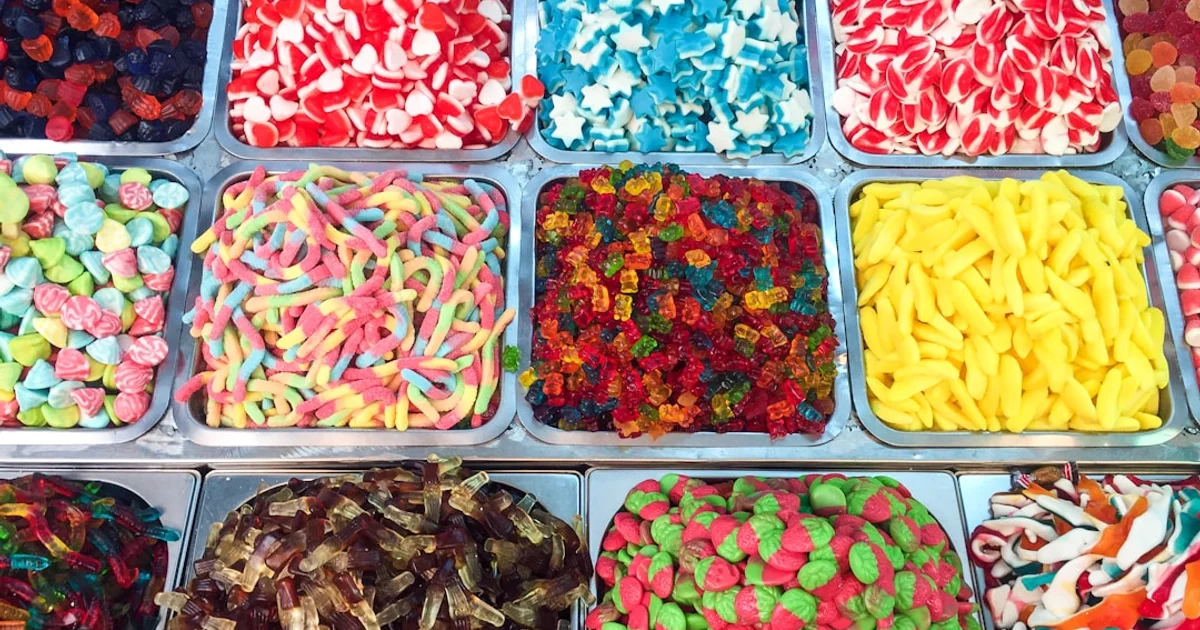
Sweden has one of the most beloved candy cultures in the world. Lördagsgodis — Saturday candy — is a national tradition where families fill paper bags from the lösgodis (pick-and-mix) bins found in virtually every supermarket. But for Muslim shoppers, that colourful wall of sweets hides a persistent problem: almost all of it contains pork gelatine.
This guide breaks down which Swedish gummy sweets are safe, which are Haram, and where to find halal-certified alternatives.
Why Most Swedish Lösgodis Is Not Halal
The vast majority of gummy, chewy, and soft sweets rely on gelatine as a gelling agent. In Sweden — as across most of Europe — that gelatine comes from pork. The additive is listed on packaging as E441 or simply gelatin (Swedish spelling).
Gelatine sits at the heart of Swedish candy culture. Brands such as Ahlgrens bilar (the red, yellow, and green car-shaped sweets beloved since 1953) and Skipper’s Pipes (liquorice) both use pork gelatine. The major Swedish and Scandinavian candy manufacturers — Leaf and Cloetta — produce most of what fills the lösgodis bins, and neither brand holds halal certification. Fazer, the Finnish brand with a strong Swedish presence, similarly uses pork gelatine in its gelatine-based sweets.
For a deeper look at how gelatine is classified, see our full E441 gelatine guide.
E-Codes to Watch on Swedish Candy Labels
Swedish packaging uses the same EU additive numbering system, so these codes apply directly:
E441 — Gelatine: The main concern in gummy sweets. Pork source = Haram. Bovine source with halal certification = Halal. No stated source = Mushbooh. Treat as Mushbooh unless you see a halal stamp.
E120 — Carmine (Cochineal): A red dye derived from crushed insects, used in some red and pink Swedish sweets. Classified as Haram by most Sunni scholars.
E904 — Shellac: A resin secreted by lac insects, used as a glazing agent on some coated sweets. Haram.
E322 — Lecithin: Usually soy or sunflower-derived in Sweden. Generally Halal, but worth confirming the source on the label.
Halal-Certified Alternatives Available in Sweden
Swedish Muslim families — particularly those from Somali and Arab communities — have developed reliable sourcing habits. Here is what to look for:
Bebeto
A Turkish brand and the most widely available halal-certified gummy option in Sweden. Bebeto sweets use bovine gelatine and carry halal certification. You will find them in halal grocery stores across Stockholm, Gothenburg, and Malmö, and in some ICA stores in areas with high Muslim populations. The range includes gummy bears, worms, peach rings, and cola bottles — comparable to mainstream European brands in variety.
Vidal
A Spanish brand with a dedicated halal-certified range. Vidal is available through speciality sweet shops and some halal grocers in Sweden. Check the packaging for the halal logo, as not all Vidal products are certified.
Red Band
A Dutch brand found in many Swedish supermarkets. Caution: Red Band’s halal status is Mushbooh. Some variants use bovine gelatine (nötgelatin in Swedish) rather than pork, but not all products are halal-certified. Check the label carefully. If the label says gelatin without specifying the source and there is no halal certificate, treat it as Mushbooh. For a broader comparison of gummy brands, see our guide to halal gummy bears.
Where to Shop for Halal Sweets in Sweden
Halal grocery stores: The most reliable option. Most Swedish cities with significant Muslim populations have dedicated halal grocers that stock Bebeto and similar certified brands.
ICA stores in diverse areas: Some ICA supermarkets in Stockholm (Rinkeby, Tensta, Husby), Gothenburg (Angered, Biskopsgården), and Malmö (Rosengård) stock halal-certified candy alongside conventional lösgodis. Availability varies by store — call ahead if you are travelling.
Online: Several Swedish online retailers and Swedish Amazon ship Bebeto and other certified brands. Our best halal gummy sweets guide for 2026 covers online options in detail.
Avoid: Generic supermarket lösgodis bins at Coop, Willys, and mainstream ICA unless you can confirm the product labelling shows halal certification.
Quick Reference: Common Swedish Sweets
| Product | Brand | Gelatine Source | Halal Status |
|---|---|---|---|
| Ahlgrens bilar | Ahlgrens | Pork | Haram |
| Skipper’s Pipes | Various | Pork | Haram |
| Cola bottles (Cloetta/Leaf) | Cloetta / Leaf | Pork | Haram |
| Fazer gelatine sweets | Fazer | Pork | Haram |
| Bebeto gummies | Bebeto | Bovine (certified) | Halal |
| Vidal (certified range) | Vidal | Bovine (certified) | Halal |
| Red Band (nötgelatin) | Red Band | Bovine | Mushbooh |
| Haribo (standard) | Haribo | Pork | Haram |
Always verify current certification on the packaging — formulations can change.
Practical Tips for Swedish Muslim Candy Shoppers
-
Learn the Swedish terms: Gelatin on a Swedish label is gelatine. Nötgelatin means bovine gelatine. Fläskgelatin or grisfett (pork fat) confirms pork origin.
-
Look for the halal symbol: A halal stamp from a recognised certifying body is the clearest signal. Bebeto and the Vidal halal range both carry visible certification logos.
-
Ask the shop: Halal grocery store staff in Sweden are generally knowledgeable about which brands are certified and can advise on new arrivals.
-
Avoid unverified bulk bins: Even in halal shops, if the bin does not have clear labelling, ask for the original packaging to check the ingredients.
-
Check for E120: Some red and pink-coloured Swedish sweets use carmine (E120) rather than synthetic dyes. This is Haram regardless of the gelatine source.
Summary
Sweden’s lördagsgodis tradition is wonderful — but the lösgodis wall is largely off-limits for Muslim shoppers. Ahlgrens bilar, Skipper’s Pipes, Cloetta, Leaf, and Fazer all use pork gelatine in their soft sweets. The safest options are Bebeto (widely stocked in halal shops) and the certified range from Vidal. Red Band is Mushbooh — check the specific product label.
For comprehensive guidance on gelatine in sweets across different brands and countries, see our halal gummy bears deep dive and our 2026 online buying guide.
Disclaimer: Brand formulations and certification status can change. Always verify current ingredient lists and halal certificates before purchasing.
Ingredients change. Be first to know.
Brands reformulate without warning. We track every E-code update and halal certification — one short weekly email.
Related Articles
 Shopping Guides
 Are Bassett's Sweets Halal? Jelly Babies, Wine Gums & the Sherbet Exception
Bassett's Jelly Babies and Wine Gums contain pork gelatine — haram. Liquorice Allsorts use E120 cochineal — also haram. Two products in the range are the exception.
 Shopping Guides
 Is Chupa Chups Halal? Cola Lollipop and All Lines Checked (2026)
Chupa Chups Cola lollipops contain no gelatin or E120 — but carry no halal certification. Gummies and soft chews contain gelatin and are Haram. Full breakdown by product line.
 Shopping Guides
 Halal Gummy Sweets in the UK: Which Brands Are Certified (2026)
Haribo UK uses pork gelatine and is Haram. SweetZone and Bebeto are HMC-certified. Here is the complete ranked list of gummy sweet brands for UK Muslims, including Pic n Mix traps to avoid.