
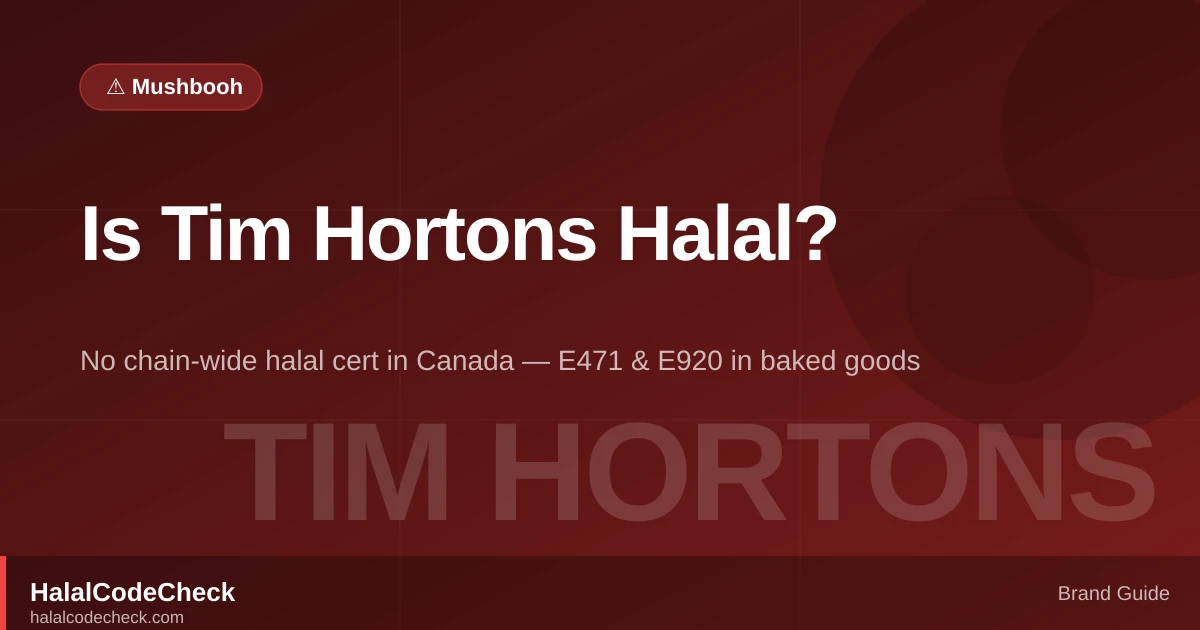
Is Tim Hortons Halal?
⚠️ MushboohTim Hortons has no chain-wide halal certification in Canada or the US. Meat products are not halal certified, and key baked goods contain E471 (mono- and diglycerides) and E920 (L-cysteine) from undisclosed sources. A handful of individual locations in Ontario have obtained local halal certification, but this does not apply to the chain as a whole. Treat any Tim Hortons as Mushbooh unless that specific outlet displays a valid halal certification.
Country
Canada
Product Types
Donuts, Timbits, Muffins +6 more
Halal Certification
No chain-wide halal certification. A small number of individual Ontario locations hold local halal certification — not applicable to other outlets.
Safer alternatives
Browse halal-friendly substitutes while this brand remains uncertain.
Is Tim Hortons Halal?
Tim Hortons is Canada’s most popular quick-service restaurant chain, owned by Restaurant Brands International (the same parent company as Burger King and Popeyes). Despite its cultural ubiquity across Canada, Tim Hortons holds no chain-wide halal certification — not in Canada, the US, or any other market where it operates.
The situation is more nuanced than a flat yes or no. A small number of individual Tim Hortons franchise locations — primarily in areas of Ontario with large Muslim populations such as parts of Mississauga and the Hamilton region — have independently obtained local halal certification. However, this applies only to those specific outlets. You cannot assume any Tim Hortons is halal without a visible halal certification sign at that particular location.
For the vast majority of Tim Hortons customers, the verdict is Mushbooh — the menu is not verifiably halal.
Key Concerns
Meat products are the clearest concern. Tim Hortons serves beef chili, chicken sandwiches, and bacon. None of these carry halal certification across the standard supply chain. Chicken suppliers used by Tim Hortons in Canada are not halal-certified for the mainstream market.
Baked goods present a secondary concern via E-codes. Timbits, donuts, muffins, and certain breads use emulsifiers and dough conditioners that require scrutiny:
- E471 (mono- and diglycerides of fatty acids) — used in many baked goods to improve texture and extend shelf life. Can be derived from plant oils (halal) or animal fats (haram if pork-derived). Tim Hortons does not publicly disclose the source.
- E920 (L-cysteine) — a dough conditioner used in bagels and some baked goods. L-cysteine is frequently sourced from poultry feathers or human hair. Without certification confirming a permissible source, this is Mushbooh.
- E481 (sodium stearoyl-2-lactylate) — another emulsifier found in some baked items. Like E471, it can be animal-derived.
Coffee and tea are a different matter. Black coffee, plain tea, and hot chocolate (without animal-derived additives) carry no E-code concerns. These are generally considered safe for Muslim consumers — but if you add dairy products, confirm those are acceptable under your own standards.
Product-by-Product Breakdown
| Product | Key concern | Verdict |
|---|---|---|
| Timbits | E471, E481 (source undisclosed) | Mushbooh |
| Donuts | E471, E481 (source undisclosed) | Mushbooh |
| Muffins | E471 (source undisclosed) | Mushbooh |
| Bagels | E920 L-cysteine (source undisclosed) | Mushbooh |
| Chicken sandwiches / wraps | No halal cert on chicken supply chain | Mushbooh |
| Beef chili | No halal certification | Mushbooh |
| Bacon / pork items | Contains pork | Haram |
| Black coffee | No E-code concerns | Generally Halal |
| Plain tea | No E-code concerns | Generally Halal |
What to Look For
If you are in Canada and want to find a genuinely halal-certified Tim Hortons:
- Look for a halal certification sign at the specific location — not a sticker added by a customer, but an official displayed certificate from a recognised body such as ISNA Canada or HMA.
- Ask the staff directly — certified outlets will have documentation available.
- Do not rely on word of mouth — halal status of franchise locations changes as ownership changes. A location that was certified in a previous year may no longer hold that status.
There is no publicly maintained list of certified Tim Hortons locations, so direct verification at the outlet is the only reliable method.
Alternatives for Muslims in Canada
Canadian Muslims looking for certified quick-service options have a growing number of alternatives:
- Local halal chicken shops — widely available in cities like Toronto, Mississauga, Brampton, and Hamilton, often serving comparable items
- Halal-certified fast food chains — some regional chains and independent operators across Ontario and Quebec carry full halal certification
- Grocery halal bakeries — for baked goods comparable to donuts or muffins with certified halal ingredients
Summary
| Factor | Details |
|---|---|
| Halal certification | None chain-wide. A small number of individual Ontario locations only. |
| Key baked-good concerns | E471 and E920 (sources undisclosed) |
| Meat concerns | No halal certification on chicken or beef supply chain |
| Pork items | Present on standard menu — haram |
| Safe items | Black coffee, plain tea |
| Verdict | Mushbooh — do not assume halal without seeing certification at that specific outlet |
| Recommended action | Look for a displayed halal certificate at the specific location before ordering |
For strict halal consumers, Tim Hortons cannot be treated as a halal restaurant unless the outlet you are visiting has a valid, displayed halal certification. The coffee is fine — everything else requires verification.
How we reached this verdict
We checked the following Tier-1 sources before publishing this verdict:
- HMC / HFA: Silent on this brand’s UK retail. No formal halal certification.
- Manufacturer: Where the product is labelled “suitable for vegetarians” on UK packaging, that is treated as plant-source disclosure under mainstream Sunni rulings. Where source-ambiguous E-codes (E471, E476, E631, E627, E635, E920) appear without a vegetarian listing or formal certification, the source cannot be verified.
- Sunni fatwa on E-code source verification: IslamQA Hanafi (case 34988), Darul Iftaa Trinidad — emulsifiers and flavour enhancers from a verified plant or halal-slaughtered animal source are halal; from undisclosed sources, must contact the company. Pork-derived = haram. Plant-derived = halal.
- Sunni fatwa on vegetarian-suitable label: Darul Ifta Birmingham (IslamQA case 245452) — vegetarian-suitable + no alcohol is treated as a halal indicator under the mainstream Sunni view, accepted across the four madhabs as a sound general principle.
Madhab note
The four Sunni madhabs broadly converge on the source-verification rule for source-ambiguous E-codes:
- Hanafi, Maliki, Shafi’i: A manufacturer “suitable for vegetarians” listing or vegan label is treated as plant-source disclosure for the emulsifiers. Combined with no alcohol, the products lean Halal under the mainstream Sunni rule. Without that disclosure or a formal cert, Mushbooh.
- Hanbali / HMC-strict view: Requires formal independent halal certification. Mushbooh until certified, regardless of vegetarian labelling.
In Muslim-majority markets where this brand operates under local halal certification (JAKIM / MUI / GCC / regional bodies), the certified SKUs are halal across all four schools.
Key E-Codes in Tim Hortons Products
Not sure about a specific Tim Hortons product?
Scan the ingredient label or search by E-code — checks every additive instantly against our database.
Stay informed
Brand formulas change without warning
We update every brand guide when manufacturers reformulate or earn halal certification. Be first to know — one short weekly email.
Related Brands
Dunkin'
⚠ MushboohDunkin' in the US and UK is Mushbooh — doughnuts may contain E471 or gelatine glazes, and no halal certification exists for Western market locations.
Read brand guide
Pret A Manger
⚠ MushboohPret A Manger UK has no halal certification. Pork sandwiches are sold in-store alongside other items. Chicken and other meats are standard, non-halal sourced. Not suitable for strict halal requirements.
Read brand guide
Starbucks
✓ HalalStarbucks core beverages — espresso, teas, cold brews, and most syrups — contain no haram ingredients. No meat is served at UK Starbucks. However, Starbucks is subject to widespread Muslim boycott calls due to its association with Israel. Halal status and boycott status are separate considerations.
Read brand guide