
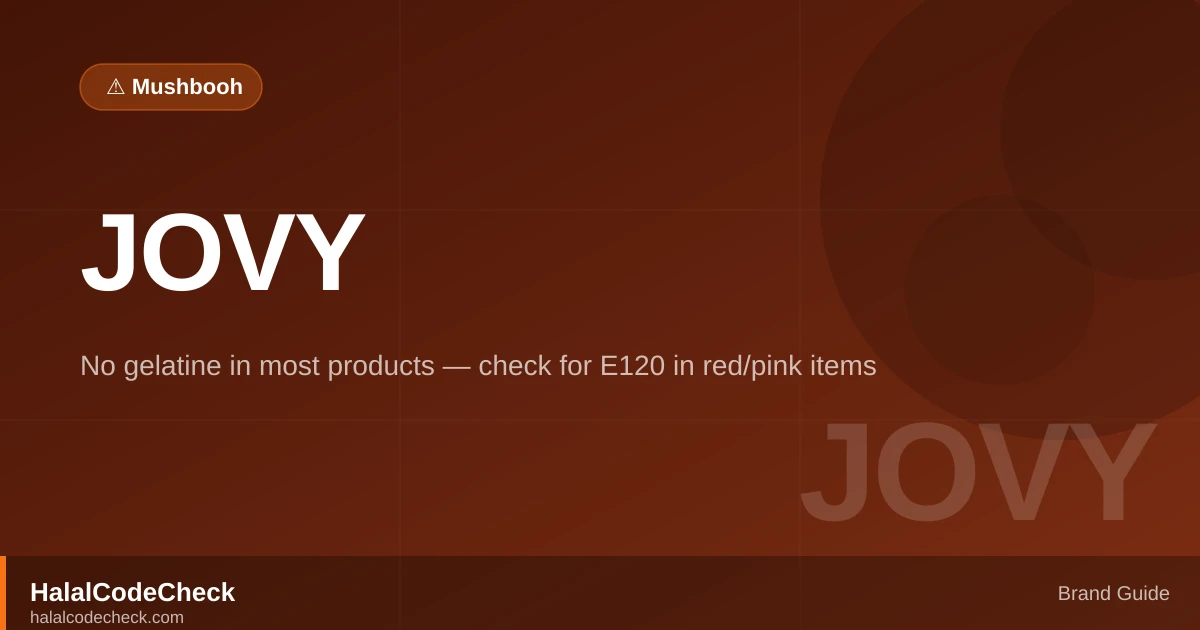
Is Jovy Halal?
⚠️ MushboohJovy Mexican candy (chamoy rings, gummy belts, lollipops) generally does not contain gelatine. No halal certification. Key concern is E120 (carmine) which appears in some red/pink products. Chamoy flavouring itself — a sour/spicy plum-based sauce — contains no haram ingredients in Jovy's formulation.
Country
Mexico
Product Types
Chamoy rings, Gummy belts, Lollipops +2 more
Halal Certification
No halal certification on any Jovy product. Jovy does not hold halal certification for any market.
Safer alternatives
Browse halal-friendly substitutes while this brand remains uncertain.
Is Jovy Halal?
Jovy is a Mexican confectionery brand popular in Latin American communities and widely sold across the United States, and increasingly in European ethnic food stores. The brand is best known for its chamoy-flavoured candy, tamarind sweets, gummy belts, and lollipops — colourful, intensely flavoured products that have built a following far beyond the Latin American diaspora.
Jovy carries no halal certification. However, the gelatine situation is more favourable than many gummy candy brands — most Jovy products use pectin or starch rather than animal gelatine as their setting agent. The primary concern for Muslim consumers is E120 (carmine), which appears in some red and pink Jovy products and is derived from crushed insects, making those products Haram. Products without E120 fall into Mushbooh territory due to the absence of any halal audit and the presence of “natural flavours” with undisclosed sources.
Does Jovy Candy Contain Gelatine?
Many Jovy products — including the popular chamoy rings — do not list gelatine in their standard formulation. They use pectin (E440, plant-derived from fruit) or modified starch as the gelling and texturising agent. This is a meaningful distinction: it places Jovy in a different category from gelatine-heavy brands like Haribo or Trolli, where the gelatine concern is the primary issue.
That said, always check the specific product label. Some Jovy gummy belt lines and fruit strip products may contain gelatine — formulations vary by product and can change over time. Without halal certification, even a gelatine-free formulation cannot be verified as fully halal, because the source of other ingredients (natural flavours, colours) remains unconfirmed.
The bottom line on gelatine: it is not the main concern with Jovy, but do not assume all products are gelatine-free without reading the label.
Does Jovy Contain E120 (Carmine)?
E120 (carmine, also listed as cochineal or carminic acid) is Haram. It is derived from the dried and crushed bodies of the cochineal insect. In Islamic jurisprudence, all insects other than locusts are considered haram. E120 is used as a red or pink colourant and appears in some Jovy products that have a red, pink, or deep orange colour.
Check the ingredients list for any of the following terms — if present, the product is Haram:
- E120
- Carmine
- Cochineal
- Carminic acid
- “Natural red colour” (which in Mexican confectionery often means carmine)
Jovy chamoy rings in their standard US retail formulation typically use E129 (Allura Red AC / FD&C Red 40) — a synthetic azo dye, which is Halal — rather than E120. However, this is not consistent across all Jovy product lines or production runs, and the formulation may differ by country. The only reliable way to confirm is to read the label on the specific pack you are buying.
Key E-Codes in Jovy Products
| E-code | Name | Status | Notes |
|---|---|---|---|
| E120 | Cochineal / Carmine | Haram | Insect-derived red colourant; Haram if present — check every red/pink Jovy product |
| E129 | Allura Red AC (FD&C Red 40) | Halal | Synthetic azo dye; water-soluble; halal across all four schools |
| E330 | Citric acid | Halal | Produced by fermentation of plant sugars; halal; common in chamoy and tamarind candy for tartness |
| E420 | Sorbitol | Halal | Plant-derived sugar alcohol from corn or wheat; halal; used as humectant in some Jovy strips |
E129 vs E120 is the central question when assessing Jovy colourants. Both produce red/pink colours, but E129 is Halal while E120 is Haram. The label will list one or the other by name — or by its number. Read carefully.
E330 (citric acid) is ubiquitous in Jovy’s sour candy range and chamoy products. It is produced by fermentation of plant-based sugars and is halal without qualification.
What is Chamoy? Is it Halal?
Chamoy is a traditional Mexican condiment and flavouring made from pickled fruit (most commonly plum, apricot, or mango), dried chilli, lime juice, and salt. It is entirely plant-based with no animal derivatives. The chamoy flavouring itself is not an Islamic dietary concern.
In Jovy’s chamoy candy products, the chamoy flavour is typically delivered via a concentrated seasoning that is sour, sweet, salty, and spicy. None of the core chamoy flavour components — fruit, chilli, citric acid, salt — are problematic from a halal perspective.
The concern in Jovy chamoy candy is not the chamoy flavour itself. It is the colourant (E120 risk in red/pink products) and the absence of any halal certification to verify the full supply chain, including natural flavours listed without source disclosure.
Bottom Line
| Factor | Details |
|---|---|
| Gelatine | Not present in most Jovy products — check label per product |
| E120 (carmine) | Present in some red/pink products — check for carmine/cochineal on label |
| Chamoy flavour | Plant-based — not a halal concern |
| Halal certification | None — Jovy holds no halal certification for any market |
| Verdict | Mushbooh — check per product; Haram if E120 is listed |
How we reached this verdict
We checked the following Tier-1 sources before publishing this verdict:
- HMC / HFA: Silent on this brand. No halal certification issued.
- Manufacturer: Jovy does not hold halal certification and does not make halal claims. Ingredient lists on standard US retail products reviewed for gelatine, E120, and natural flavour disclosures.
- E120 ruling: All four Sunni madhabs and major halal advisory bodies (HMC, HFA, IFANCA, JAKIM) classify E120 (carmine) as Haram — insect-derived colourant, insects are prohibited except locust.
- E129 ruling: Darul Iftaa Birmingham and IslamQA Hanafi — synthetic azo dyes soluble in water, including E129 (Allura Red), are halal.
- Chamoy ingredient analysis: Chamoy is a plant-based preparation; no animal-derived components in standard commercial chamoy flavouring.
Madhab note
On the E120 question, all four Sunni madhabs converge: carmine (derived from crushed insects) is Haram. There is no scholarly disagreement on this point across Hanafi, Maliki, Shafi’i, or Hanbali schools.
On the broader Mushbooh verdict for E120-free Jovy products:
- Hanafi, Maliki, Shafi’i: Natural flavours without source disclosure and absence of halal certification place the product in the Mushbooh category. Cautious avoidance is recommended; not consuming doubtful products is the safer position.
- Hanbali / HMC-strict view: Requires formal independent halal certification. Without it, Mushbooh regardless of ingredient list analysis.
In practice: read the label on every Jovy product individually, check for E120 / carmine / cochineal, and make your decision on the basis of that specific product’s formulation.
Key E-Codes in Jovy Products
Red/pink food coloring
Red food coloring - most widely used red dye in the USA
Acidity regulator, preservative and flavoring - universally sour taste
Sweetener, humectant and texturiser
Not sure about a specific Jovy product?
Scan the ingredient label or search by E-code — checks every additive instantly against our database.
Stay informed
Brand formulas change without warning
We update every brand guide when manufacturers reformulate or earn halal certification. Be first to know — one short weekly email.
Related Brands
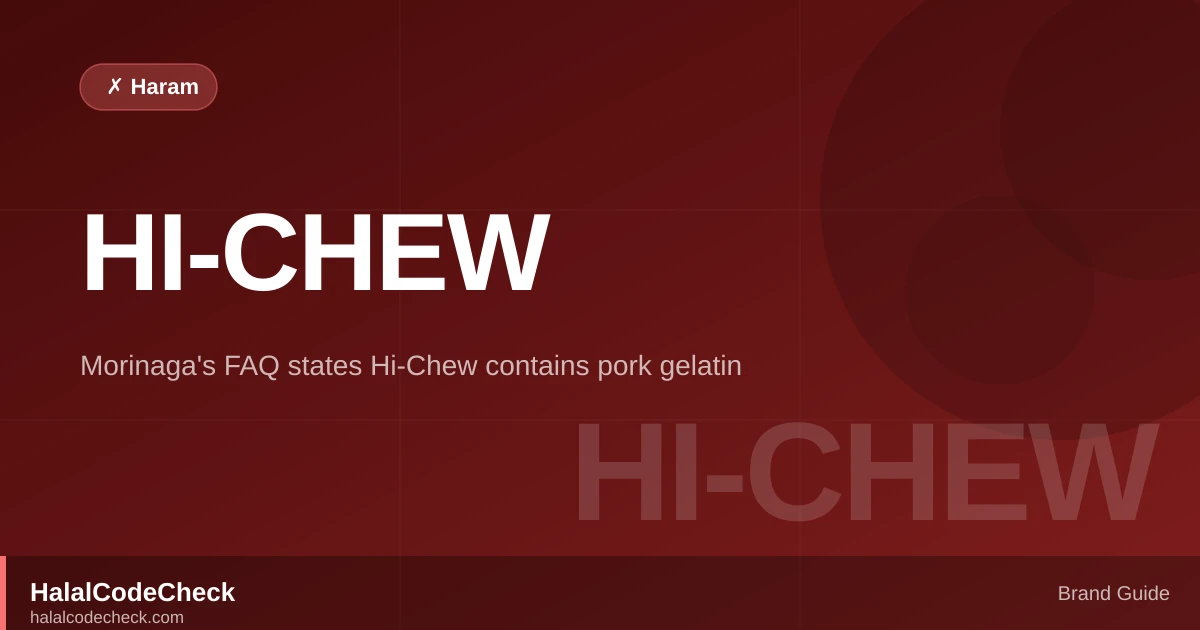
Hi-Chew
✗ HaramMorinaga's official Hi-Chew FAQ states plainly that Hi-Chew products contain pork gelatin, which makes the standard fruit chews haram across all four madhabs. The only acceptable packs are those carrying a recognised halal logo, such as JAKIM-certified stock sold in Malaysia.
Read brand guide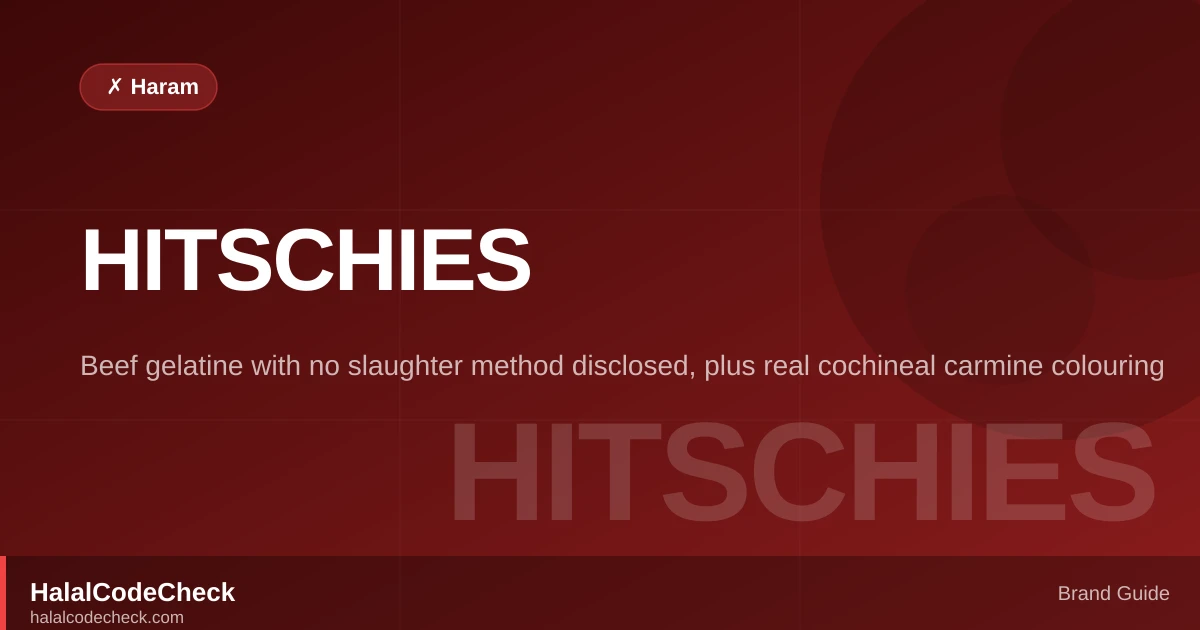
Hitschies
✗ HaramHitschler's Hitschies fruit chews use beef gelatine rather than pork, which some retailers market as 'halal' on that basis alone — but that's not the full picture. The gelatine's slaughter method isn't disclosed or certified, and separately, the coating uses real carmine, a cochineal-derived red colouring. Either issue on its own would block a Halal verdict; together they make Hitschies clearly Haram, regardless of retailer marketing claims.
Read brand guide
Vidal
ℹ VariesVidal gummy products contain pork gelatine (E441) and are Haram. Hard candies and lollipops without gelatine are Mushbooh — no halal certification. Gulf market Vidal variants may be halal certified.
Read brand guide