
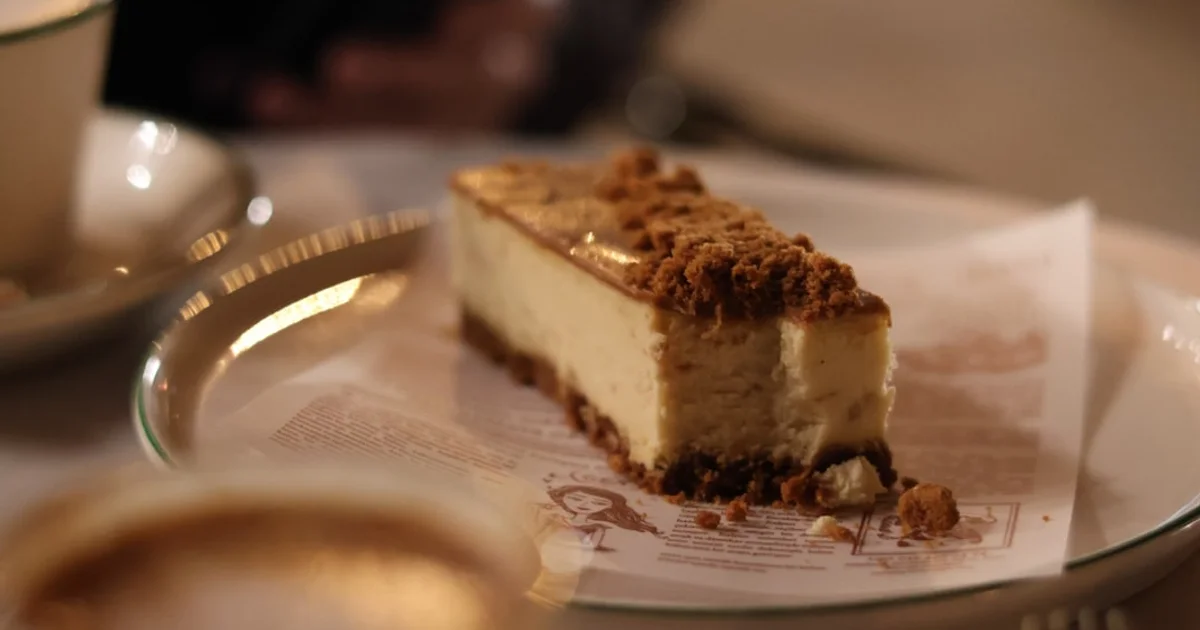
Biscoff cheesecake has become one of those desserts you’ll find both homemade and on a supermarket shelf — and the two versions aren’t always made the same way. Woolworths Australia’s version settles the question cleanly.
The direct verdict: halal on ingredients. This is a baked, egg-set cheesecake — no gelatine anywhere in the formulation.
Full Ingredient List
Neufchâtel cheese (26%) — milk, cream, salt, stabilisers (410, 412), starter culture; Biscoff spread (19%) — Biscoff biscuits, rapeseed oil, sugar, lecithin (soy), citric acid; Biscoff crumble (13–16%) — wheat flour, sugar, vegetable oils (palm, rapeseed), candy sugar syrup, raising agent (sodium hydrogen carbonate, 500), soy flour, salt, cinnamon; sugar; egg; cream; water; white chocolate (4%) — sugar, milk solids, cocoa butter, emulsifier (lecithin (soy), 476), natural flavour; butter; Biscoff biscuit (0.7%); flour.
Allergens: egg, gluten, milk, soy, wheat. May contain peanuts and pistachio.
Why “Baked” Matters Here
This is the detail that resolves the whole question. Plenty of Biscoff cheesecake recipes — the no-bake, fridge-set style you’ll find all over food blogs and cafés — use gelatine to firm up the filling without an oven. Woolworths’ version isn’t that kind of cheesecake. It’s baked and set with egg, the traditional New York-cheesecake method, which is why gelatine never enters the ingredient list at all. If you’re checking a different Biscoff cheesecake — homemade, from a café, or a different retailer — don’t assume the same applies; check whether it’s baked or no-bake first.
The E-Numbers, One by One
410 (locust bean gum) and 412 (guar gum) — both plant-derived thickening/stabilising gums, halal, no ambiguity.
476 (polyglycerol polyricinoleate, PGPR) — used in the white chocolate component to reduce viscosity. Almost universally manufactured from castor oil (a plant source) in commercial use; no animal-source variant is in common circulation. Halal.
500 (sodium bicarbonate) — a mineral raising agent in the biscuit crumble. Halal, no ambiguity.
Every emulsifier and lecithin in the product is specified as soy-derived — plant-based, halal.
The Biscoff Component
Lotus Biscoff spread and biscuits — the flavour component running through this whole dessert — are made from wheat flour, sugar, vegetable oils, soy lecithin, raising agents, cinnamon, and citric acid. Nothing there raises a halal flag. Lotus Bakeries doesn’t hold third-party halal certification for the base Biscoff product, but it’s widely treated as acceptable by halal consumers on an ingredient-analysis basis, and nothing in this cheesecake’s use of it changes that assessment.
Which Retailer, Which Market
This is a Woolworths Australia product specifically — confirmed through Australian retailer listings and product codes. Woolworths South Africa (a completely separate company sharing only the name) doesn’t appear to stock a matching product. If you’re in South Africa checking Woolworths Food’s own-brand desserts, this verdict doesn’t transfer — check the specific SA product on its own label.
Summary
| Question | Answer |
|---|---|
| Does it contain gelatine? | No — baked and egg-set, not gelatine-set |
| Does it contain alcohol? | No |
| Are the E-numbers a concern? | No — all plant or mineral-derived |
| Which Woolworths sells it? | Australia, not South Africa |
| Is it halal-certified? | No — halal on ingredients, uncertified |
Look up any additive in the E-codes database.
To scan a full ingredient list for halal status in seconds, use the ingredient scanner.
How we reached this verdict
We checked the following Tier-1 sources before publishing this verdict:
- Manufacturer statements: Woolworths Australia’s own product listings (cross-referenced across two related product codes) and Open Food Facts, which agreed closely on the ingredient list and confirmed the product as a baked, not no-bake, cheesecake.
- Halal certification bodies (HMC, HFA, JAKIM, MUI): no certified-establishment listing exists for this product.
- Sunni fatwa scholarship across the four madhabs:
- Hanafi-leaning bodies: IslamQA Hanafi, Darul Iftaa Birmingham, AskImam.org, Daruliftaa.com (Mufti Taqi Usmani), Wifaqul Ulama, Darul Iftaa New York.
- Shafi’i / Maliki-leaning bodies: NU (Nahdlatul Ulama, Indonesia), Dar al-Ifta al-Misriyyah (Egypt), e-fatwa.com (UAE), al-Azhar.
- Hanbali / Saudi-Salafi-leaning bodies: Saudi Permanent Committee for Scholarly Research, IslamQA Saudi.
Madhab note
The four Sunni madhabs broadly converge on the rules applied in this guide:
- Plant-derived stabilisers and gums (410, 412) — Halal across all four madhabs.
- PGPR (476) — Halal across all four madhabs when castor-oil-derived, as is standard commercial practice; no animal-source variant identified.
- Egg-set desserts without gelatine — no animal-tissue question applies at all; halal by default across all four madhabs, subject only to the other ingredients in the formulation being clean, as they are here.
If your madhab differs on a specific ruling, the relevant section above flags the school-specific position. For binding rulings on borderline products, consult a competent scholar in your tradition.
Ingredients change. Be first to know.
Brands reformulate without warning. We track every E-code update and halal certification — one short weekly email.
Related Articles
 Shopping Guides
 Halal Dairy and Ice Cream in Poland: No Certified Ice Cream, and Why the Dairy Certificates Say Export
We found no halal-certified ice cream in Poland from any brand or any certifier. Koral, the country's largest maker, publishes its certificate register and there is no halal certificate in it. The dairy certificates that do exist are marked for export.
 Shopping Guides
 Halal Ice Cream and Dairy in the Philippines: Only One Ice Cream Brand Is in the Register
The Islamic Da'wah Council of the Philippines publishes a register of 1,457 certified products. Exactly one ice cream brand appears in it, and it is not the one you would expect. Selecta claims certification its own certifier's register does not show.
 Shopping Guides
 Halal Ice Cream and Dairy in New Zealand: Tip Top Labels It, But Nobody Names the Certifier
Tip Top tags 24 of its 73 products halal certified on its own site and runs a separate gelatine-free filter. Kāpiti does the same. Neither names a certifier, and FIANZ publishes no dairy client list. Here is what that gap means for a shopper.