
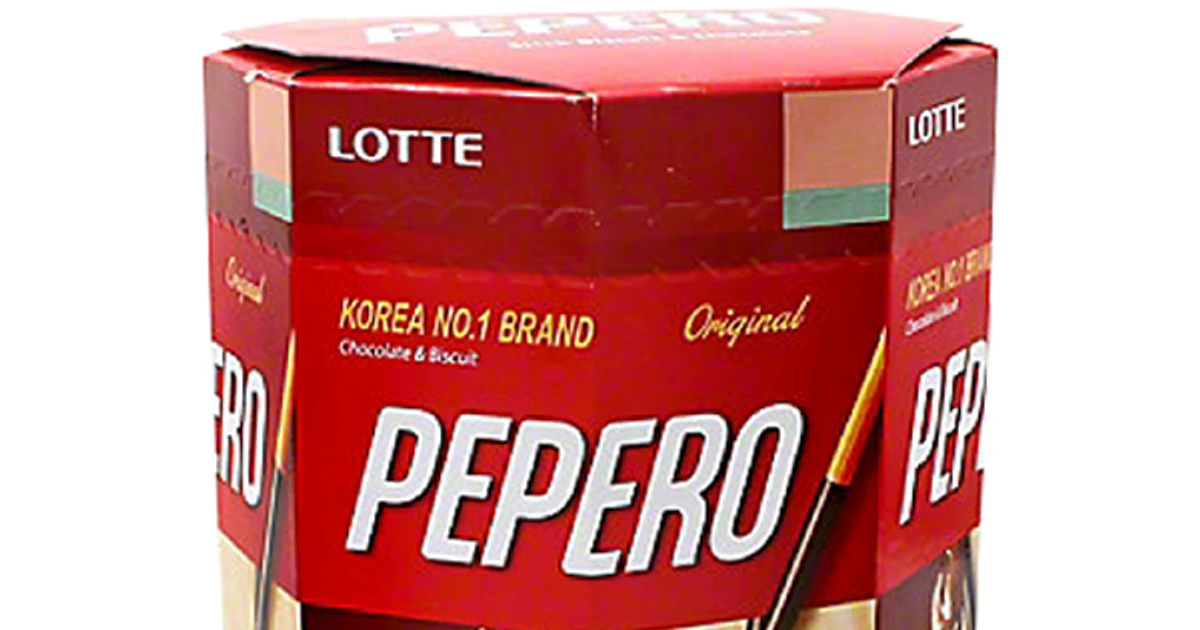
The direct verdict: Standard domestic Pepero is Mushbooh — the base ingredients are broadly permissible but natural flavouring sources are undisclosed and no halal certification exists for Korean-market Pepero. Lotte does produce a halal-certified Pepero for export markets; that version is Halal. The pack’s halal logo is the only reliable indicator.
If you bought Pepero from a Korean grocery store, a convenience store, or an Asian supermarket carrying domestic Korean stock, there is no halal certification on that product. The brand name and the familiar stick-and-chocolate format tell you nothing about the supply chain for the natural flavourings used in manufacturing.
If you bought Pepero from a halal supermarket or an online halal retailer that sources specifically from the Gulf or Malaysian supply chain, and the pack carries a JAKIM or ESMA halal logo, that product is halal certified.
The distinction is on the pack. Nothing else.
What Is in Standard Pepero?
Standard Pepero — the original biscuit stick dipped in chocolate — contains: wheat flour, sugar, cocoa mass, cocoa butter, milk powder, vegetable fat, salt, and natural flavouring including vanilla extract.
The ingredient list raises no immediate red flag in terms of haram ingredients. There is no gelatine, no lard, and no declared animal-derived emulsifier. This is why Pepero is often assumed to be safe by Muslim consumers.
The concern sits in two areas:
1. Vanilla extract and natural flavourings. Vanilla extract in confectionery can be produced using alcohol as a solvent during the extraction process. Depending on the Sunni madhab position followed, vanilla extract from an alcohol-based process may be considered Mushbooh or impermissible. More importantly, “natural flavouring” as a catch-all term on a label can conceal a range of ingredients whose animal or alcohol-derived origins are never disclosed to the consumer.
2. Absence of halal certification. Even if every ingredient in domestic Pepero happened to be individually permissible, there is no third-party audit confirming this across the supply chain. Halal certification provides that audit. Without it, the consumer is taking the manufacturer’s word — and Lotte has not made that representation for domestic Korean Pepero.
Classification: Mushbooh. Proceed with caution; do not consume unless you can confirm the product carries a halal certification logo.
The Halal Export Version
Lotte is one of the largest confectionery manufacturers in Asia and produces substantial export volumes for Muslim-majority markets. For these markets, Lotte certifies specific product lines — including Pepero — under recognised halal authorities.
For the Gulf and Middle East market, the relevant certification body is typically ESMA (Emirates Authority for Standardization and Metrology) or equivalent GCC-recognised halal authorities. Pepero sold through UAE, Saudi, and Kuwaiti retail channels sourced from these certified production runs carries visible halal certification on the packaging.
For the Malaysian market, the relevant certification body is JAKIM (Jabatan Kemajuan Islam Malaysia). Malaysia has one of the world’s most rigorous national halal certification systems. Pepero imported into Malaysia through official Lotte distribution will carry JAKIM certification.
The halal export production uses supply chains that are separately audited for halal compliance — including the sourcing of natural flavourings and vanilla. This is not the same product as domestic Korean Pepero, even when the outer packaging looks nearly identical.
How to tell the difference: Look at the pack. A halal-certified Pepero will have a halal logo prominently displayed — typically on the front panel or back, near the barcode. The logo will name the certifying body. If there is no logo, there is no certification, regardless of where the shop is located.
How to Identify Halal Pepero at the Point of Purchase
The certification logo is the only reliable signal. Here is what to look for depending on where you are shopping:
Gulf / Middle East market (UAE, Saudi Arabia, Kuwait, Qatar):
- Look for ESMA halal logo or the MUI / IFANCA mark
- Arabic labelling on the back panel is a secondary indicator that the product is distributed through the Gulf supply chain
- Pepero purchased from a halal-certified retailer in the Gulf is likely (but not guaranteed) to be the certified variant — always confirm with the logo
Malaysian market:
- JAKIM halal logo — the green triangle with the stylised text — is the definitive mark
- Malaysian retail Pepero distributed by Lotte Malaysia should carry this mark
UK, Europe, North America (Korean grocery stores, Asian supermarkets):
- Most stock is sourced directly from South Korea as domestic product
- Do not assume these are the Gulf or Malaysian export variants
- Check the pack for a halal logo; in the overwhelming majority of cases, you will not find one
- Without a logo, the product is Mushbooh
Online purchases:
- Halal online retailers that explicitly stock Gulf or Malaysia-imported Pepero may carry the certified variant
- The product listing should state the halal certification
- If the listing does not mention halal certification and the product image does not show a halal logo, assume it is the domestic Korean variant
Other Lotte Products: The Same Pattern Applies
Pepero is not unique within the Lotte product range. The same domestic-versus-export certification split applies across Lotte’s confectionery line-up:
Lotte Choco Pie — the marshmallow-filled, chocolate-coated biscuit sandwich — is one of the most searched Korean snacks for halal status. Standard Korean-market Choco Pie contains gelatine in the marshmallow filling. Lotte produces a halal-certified Choco Pie for export markets using halal-certified gelatine alternatives, but the domestic Korean product is not halal suitable. The gelatine concern makes Choco Pie more clearly problematic than Pepero.
Lotte Kancho — chocolate cream-filled biscuit balls — follows the same pattern: no halal cert for domestic stock, check for export halal variants specifically.
Lotte Homerun Ball — chocolate-filled puffed rice balls — similarly lacks domestic halal certification. Export versions may carry certification for specific markets.
The rule across all Lotte products is consistent: the domestic Korean product is not halal certified; export versions for Muslim-majority markets may be certified; the pack’s halal logo is the only confirmation.
Verdict Summary
| Product | Halal Status | Key Notes |
|---|---|---|
| Domestic Korean Pepero (standard retail) | Mushbooh | No halal cert; vanilla / natural flavouring source undisclosed |
| Pepero — Gulf / Middle East export | Halal (verify logo) | ESMA or equivalent cert; confirm logo on specific pack |
| Pepero — Malaysian market | Halal (verify logo) | JAKIM certification; confirm logo on specific pack |
| Lotte Choco Pie (domestic Korean) | Not halal suitable | Contains gelatine in marshmallow |
| Lotte Choco Pie (halal export) | Halal (verify logo) | Halal-certified gelatine; confirm logo on pack |
| Lotte Kancho / Homerun Ball (domestic) | Mushbooh | No halal cert for domestic stock |
Bottom line: Buy Pepero with a halal logo on the pack. If you cannot see a halal certification logo, do not assume — classify as Mushbooh and seek a certified alternative.
Look up any E-code from a snack label in the E-codes database.
To scan a full ingredient list for halal status in seconds, use the ingredient scanner.
How we reached this verdict
We checked the following Tier-1 sources before publishing this verdict:
- Halal certification bodies (JAKIM, ESMA, MUI, IFANCA): Export Pepero certification claims verified against the certifying bodies’ published product registers where available.
- Manufacturer information: Lotte Group export product documentation and regional distribution information for Gulf and Malaysian markets.
- Sunni fatwa scholarship across the four madhabs:
- Hanafi-leaning bodies: IslamQA Hanafi, Darul Iftaa Birmingham, AskImam.org, Daruliftaa.com (Mufti Taqi Usmani), Wifaqul Ulama, Darul Iftaa New York.
- Shafi’i / Maliki-leaning bodies: NU (Nahdlatul Ulama, Indonesia), Dar al-Ifta al-Misriyyah (Egypt), e-fatwa.com (UAE), al-Azhar.
- Hanbali / Saudi-Salafi-leaning bodies: Saudi Permanent Committee for Scholarly Research, IslamQA Saudi.
Madhab note
The four Sunni madhabs broadly converge on the rules applied in this guide:
- Pork-derived sources — Haram across all four madhabs.
- Alcohol-based ingredients — Haram across all four madhabs.
- Vanilla extract — where produced via alcohol solvent, Hanafi-Deobandi mainstream treats as Mushbooh; Maliki and Shafi’i positions vary; HMC-strict view requires formal certification.
- Source-ambiguous natural flavourings — manufacturer disclosure of plant-source is treated as sufficient under the Hanafi/Maliki/Shafi’i mainstream rule; HMC-strict / Hanbali-leaning view requires formal independent certification.
- Gelatine — pork-derived gelatine is haram across all four madhabs; bovine gelatine from non-halal-slaughtered animals is also haram; certified halal gelatine alternatives are permissible.
If your madhab differs on a specific ruling, the relevant section above flags the school-specific position. For binding rulings on borderline products, consult a competent scholar in your tradition.
Ingredients change. Be first to know.
Brands reformulate without warning. We track every E-code update and halal certification — one short weekly email.
Related Articles
 Shopping Guides
 Halal Snacks in Indonesia: Which Crisps and Chips Are MUI-Certified? (2026)
Most Indonesian domestic snack brands — Chitato, Piattos, Cheetos Indonesia — carry MUI certification. The risk is in imported snacks without a halal label. Here is the full guide.
 Shopping Guides
 Is Shin Ramyun Halal? What the Label Doesn't Tell You (2026)
Standard Shin Ramyun sold in Korean/Asian grocery shops is not halal certified — it contains beef extract with no zabiha guarantee. Nongshim makes halal-certified versions for Gulf markets. Here's how to tell them apart.
 Shopping Guides
 Is Cornetto Halal? Unilever Ice Cream — Verdict by Market (2026)
Cornetto's halal status depends on the market. UK/EU standard Cornetto is not halal certified and may contain gelatine (E441). Halal-certified Cornetto is sold in Gulf, Malaysia, and Indonesia. Check the packaging.