
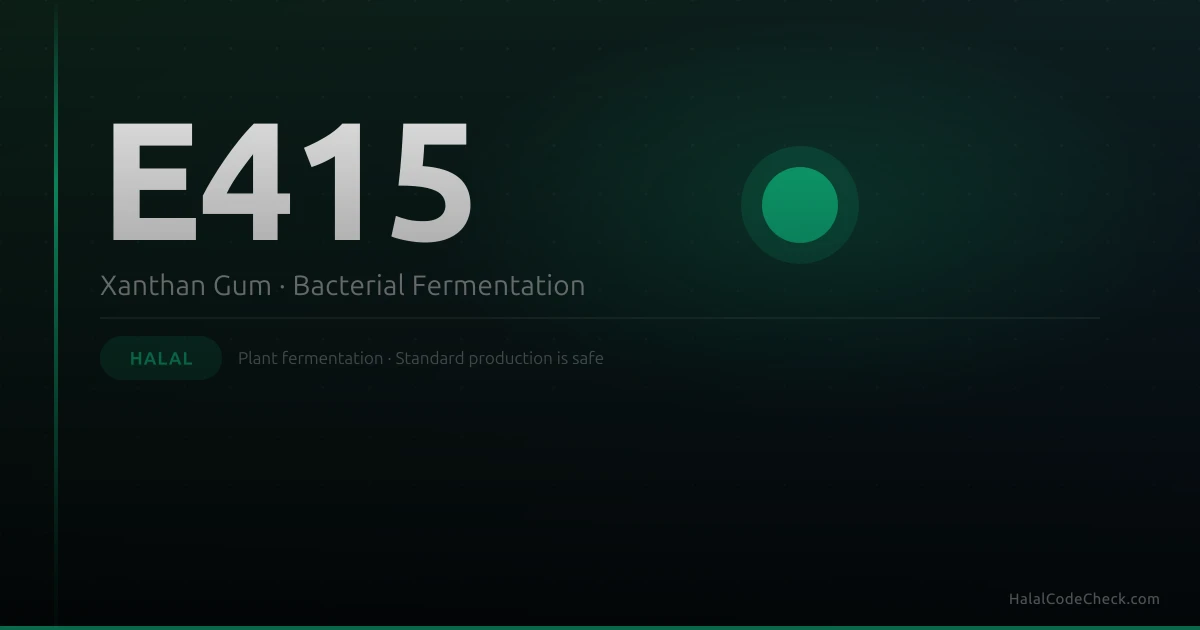
You are checking a gluten-free bread, a salad dressing, or a dairy-free yogurt. The ingredient list includes E415 or Xanthan Gum. Halal or not?
In the vast majority of products, yes - E415 is halal. Here is what you need to know to be certain.
What Is E415 (Xanthan Gum)?
E415 is Xanthan Gum - a polysaccharide (complex sugar) produced by fermenting glucose or sucrose with the bacterium Xanthomonas campestris. The result is a white powder that dissolves in water to form a thick, stable gel.
E415 is one of the most versatile food additives in modern food production:
- Thickener - adds body to sauces, dressings, and gravies
- Stabiliser - prevents separation in emulsified products
- Binder - essential in gluten-free baking (replaces the binding function of gluten)
- Suspension agent - keeps particles evenly distributed in drinks
You will find it in:
- Gluten-free bread and pasta
- Salad dressings and sauces
- Ice cream and frozen desserts
- Dairy alternatives (oat milk, coconut yogurt)
- Soups, gravies and condiments
- Personal care products (not food)
Is E415 Halal?
Yes. E415 is halal in standard commercial production.
| Factor | Status | Detail |
|---|---|---|
| Fermentation substrate | ✅ Halal | Usually corn starch, wheat, or sugar cane - all plant-derived |
| Bacterium (Xanthomonas campestris) | ✅ Halal | Non-pathogenic bacteria - no animal content |
| Growth medium (standard) | ✅ Halal | Glucose or sucrose from plant sources |
| Growth medium (edge case) | ⚠️ Verify | Some historical formulations used casein (dairy) or other proteins in the growth medium |
The vast majority of commercial xanthan gum uses corn starch or sucrose as the fermentation substrate, making it unambiguously halal.
View E415 in the E-codes database
The One Edge Case Worth Knowing
Xanthan gum is produced by bacterial fermentation - and the growth medium (what the bacteria eat) can theoretically include ingredients of animal origin. Some earlier industrial processes used casein (milk protein) as a nitrogen source in the fermentation medium.
Modern food-grade xanthan gum production has largely moved away from casein-based media, and major certification bodies (including IFANCA) have verified major xanthan gum suppliers as halal. However, if a product does not carry halal certification and you want to be completely certain, you can ask the manufacturer about the fermentation medium used.
In practice, this is a very low-risk question for most mainstream products.
Why Xanthan Gum Matters for Halal Shoppers
E415 is particularly important for two reasons:
1. It is everywhere in gluten-free products. The gluten-free market is large and growing, and xanthan gum is the standard binder in almost all gluten-free baked goods. Muslims with coeliac disease or gluten intolerance frequently rely on gluten-free products - knowing that E415 is almost always halal removes a common point of uncertainty.
2. It is in many “clean label” products. Natural, organic, and health food products often list xanthan gum by name rather than by E-number. Either format refers to the same ingredient.
Xanthan Gum vs Other Halal Thickeners
| E-code | Name | Source | Halal Status |
|---|---|---|---|
| E415 | Xanthan Gum | Bacterial fermentation | ✅ Halal |
| E406 | Agar Agar | Red seaweed | ✅ Halal |
| E440 | Pectin | Apple/citrus peel | ✅ Halal |
| E412 | Guar Gum | Guar bean | ✅ Halal |
| E410 | Locust Bean Gum | Carob seeds | ✅ Halal |
| E441 | Gelatin | Animal collagen | ⚠️ Depends on source |
All of these are common thickeners and stabilisers. The first five are always halal. Gelatin is the exception - the ingredient to check in any thickened product.
Frequently Asked Questions
Is xanthan gum suitable for vegetarians and vegans?
Yes. Xanthan gum is plant-derived (via bacterial fermentation of plant sugars) and contains no animal products. It is accepted by vegetarian and vegan standards, which aligns with its halal status.
Does “gluten-free” with xanthan gum mean the product is halal?
No - not automatically. The xanthan gum itself is halal, but the other ingredients in a gluten-free product still need checking. Gluten-free products can contain gelatin, non-halal flavourings, or other additives. Use the ingredient scanner to check the full label.
Is there a difference between food-grade and industrial xanthan gum?
Yes. Industrial xanthan gum (used in drilling fluids and other applications) may use different production processes. Food-grade E415, which is what appears in food products, is produced under food safety regulations that generally exclude non-plant growth media.
Is E415 the same as “xanthan”?
Yes. “Xanthan”, “xanthan gum”, and “E415” all refer to the same ingredient. On labels you may see either the name or the E-number.
What To Do Next
For E415, the answer is straightforward:
- Check E415 in the database - full halal ruling and common foods
- Scan any product - see E415’s status alongside every other additive at once
- If you need certainty - look for a halal-certified product, or contact the manufacturer to confirm the fermentation substrate
Xanthan gum is one of those ingredients where you can generally move on without a second thought - and spend your verification time on the ingredients that genuinely need it.
Seen an E-code in this article?
Look it up instantly — 370+ codes, halal status in one click.
Ingredients change. Be first to know.
Brands reformulate without warning. We track every E-code update and halal certification — one short weekly email.
Related Articles
 Food & Ingredients
 Is Chocolate Halal or Haram? The Complete Guide (2026)
Is chocolate halal? Cacao is halal, but emulsifiers like E471 and colorings like E120 change the answer. Learn which chocolates are safe and what to check on the label.
 E-Codes & Additives
 Is E621 (MSG) Halal or Haram? The Complete Guide
E621 (MSG) is usually halal - modern production uses plant-based fermentation. Learn why it caused controversy, when to verify, and how to check fast.
 How-To Guides
 How to Grocery Shop Halal in 10 Minutes (Step-by-Step System)
A practical 3-step system that lets you verify halal status on any product in under a minute - and build a trusted shopping list that gets easier every week.