
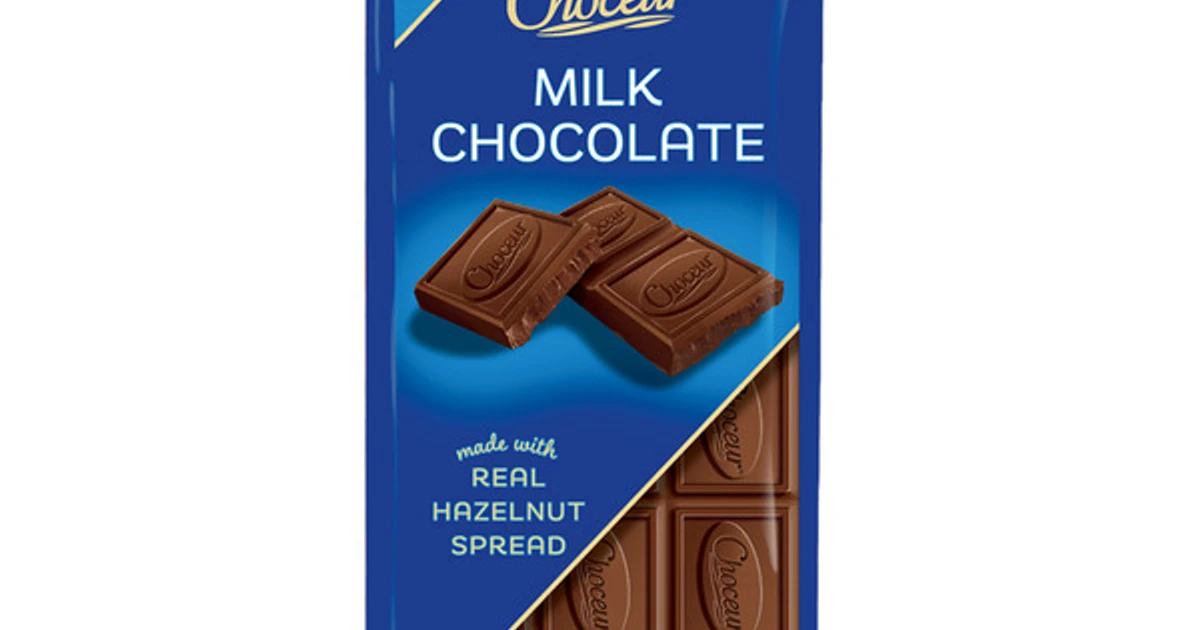
The direct verdict: Choceur chocolate is Mushbooh. There is no pork gelatine and the emulsifier is halal soya lecithin — but the vanilla flavouring source is undisclosed, and Aldi holds no halal certification for Choceur from any recognised body.
That combination is the definition of Mushbooh: not confirmed haram, but not confirmed halal either. If you buy strictly certified, Choceur does not meet the standard.
What Is Choceur?
Choceur is Aldi’s own-brand chocolate range, sold across Aldi stores in the UK, Ireland, Germany, Australia, and the US. The line includes milk chocolate bars, truffles, pralines, advent calendars, and seasonal items. It is one of the most widely available supermarket-own-brand chocolates in markets where Aldi operates.
Because it is an Aldi own-label product, Choceur is not sold on Amazon or specialist food sites — it is only available in Aldi stores.
Choceur Ingredients — What Is Actually in It
The standard Choceur milk chocolate bar ingredient list reads:
Sugar, cocoa butter, cocoa mass, skimmed milk powder, whey powder, butterfat, emulsifier (E322 soya lecithin), vanilla flavouring
Going through each item:
Sugar — Halal. Standard refined sugar from sugar beet or sugar cane. No bone char filtration concern is flagged in European production.
Cocoa butter — Halal. Pure fat extracted from cocoa beans. Entirely plant-derived.
Cocoa mass — Halal. Ground roasted cocoa beans. Plant-derived.
Skimmed milk powder — Halal. Dairy ingredient, permissible.
Whey powder — Halal. A by-product of cheese production. The milk source is dairy, not meat. No rennet concern at the powder stage.
Butterfat — Halal. Anhydrous milk fat, dairy-derived and permissible.
E322 — Soya lecithin — Halal. This is the key emulsifier. Soya lecithin is extracted from soybean oil — it is entirely plant-derived and considered halal across all four Sunni madhabs. This is confirmed by the label specifying “soya” — not just “lecithin” or “E322” with an undisclosed source.
Vanilla flavouring — Mushbooh. This is the one ingredient that requires scrutiny. See the next section.
The Vanilla Flavouring Problem
The label states “vanilla flavouring” without specifying whether this is natural vanilla extract, artificial vanillin, or a blend. That distinction matters for halal purposes.
Natural vanilla extract is produced by steeping vanilla pods in food-grade ethanol. The ethanol acts as a solvent to extract and stabilise the flavour compounds. The finished extract typically contains between 35% and 60% ethanol by volume before being diluted into the final food product. In the chocolate bar itself, the quantity of vanilla extract is very small — typically a fraction of a percentage — which means the residual ethanol content in the finished bar is negligible.
Artificial vanillin is a synthetic flavour compound derived from lignin (wood pulp) or guaiacol (a petrochemical). It does not involve ethanol in production and is considered halal.
The Mushbooh gap: Choceur’s label simply says “vanilla flavouring” — it does not say “natural vanilla extract,” “vanillin,” or “alcohol-free vanilla.” Without that disclosure, the source cannot be confirmed.
No Halal Certification — What That Means in Practice
Aldi has not sought halal certification for Choceur from HMC (Halal Monitoring Committee), HFA (Halal Food Authority), or any other recognised UK certifying body. Aldi Germany, where the brand originates, similarly does not carry EU halal accreditation for the Choceur range.
This matters for two reasons:
-
Ingredient sourcing is unaudited. A halal certificate is not just a label — it involves an independent auditing body inspecting the full ingredient supply chain, not just the finished product label. Without that audit, the consumer cannot verify that every input (including the vanilla flavouring) comes from halal-compliant sources.
-
Production practices are unverified. Halal certification also covers production line hygiene and cross-contamination protocols. Shared equipment or facilities processing non-halal items are relevant to some consumers’ standards.
The absence of certification does not mean the product is haram — it means it is unverified. That is precisely what Mushbooh means.
Madhab Note: Vanilla Extract and the Alcohol Debate
The vanilla flavouring question sits in a well-documented grey area of Islamic jurisprudence.
Mainstream Hanafi position: Many contemporary Hanafi scholars — including respected Darul Iftaa institutions — permit trace vanilla extract on the basis that the quantity in the finished product is so small as to be non-intoxicating, and that the alcohol functions as a carrier rather than a purpose ingredient. On this view, buying Choceur is likely permissible even without certification, provided no other haram ingredient is present.
Strict / HMC-standard position: HMC and HFA-certified products exclude all ethanol-containing flavourings, regardless of trace quantity. If you follow this standard — or if you are buying for someone who does — you need a certified product.
Practical guidance: If you default to certified products, Choceur does not qualify. If you follow the mainstream scholarly position on trace alcohol carriers, the ingredients list is otherwise clean. Consult your local scholar if you need a binding ruling for your madhab and situation.
Halal Alternatives
These chocolate brands carry halal certification and are widely available:
Ulker — The large Turkish confectionery group. Most Ulker products carry halal certification. Widely stocked in Turkish, Eastern European, and South Asian grocery stores across the UK. Their chocolate bars, pralines, and biscuit-chocolate products are popular alternatives.
Nestle Damak — Turkish-produced Nestle chocolate (not the same supply chain as UK Nestle). Damak pistachio chocolate is halal certified and widely distributed. Available in many Turkish grocery stores and some larger supermarkets.
Choc&Nuts — A dedicated halal-certified chocolate brand. Available in Islamic food stores and some mainstream retailers in areas with large Muslim populations.
Middle Eastern and South Asian grocery stores — These typically stock a range of certified halal chocolate brands from Turkey, Malaysia, and the Gulf. Look for a recognisable halal certification logo on the pack (HMC, HFA, JAKIM, MUI, Halal Turkey).
The rest of the Aldi shelf is covered in our Aldi UK halal shopping guide — aisle by aisle, including where this Choceur verdict fits.
Verdict Summary
| Factor | Detail |
|---|---|
| Halal Status | Mushbooh |
| Pork Gelatine | Not present in standard chocolate bars |
| Emulsifier | E322 soya lecithin — halal (plant-derived, source stated) |
| Vanilla Flavouring | Undisclosed — natural extract may use ethanol carrier |
| Halal Certification | None — not certified by HMC, HFA, JAKIM, or equivalent |
| Main Concern | Undisclosed vanilla flavouring source + no third-party certification |
| Certified Alternatives | Ulker, Nestle Damak, Choc&Nuts |
Check any E-code on a Choceur label in the E-codes database. To scan a full ingredient list for halal status, use the ingredient scanner.
Ingredients change. Be first to know.
Brands reformulate without warning. We track every E-code update and halal certification — one short weekly email.
Related Articles
 Shopping Guides
 Halal Snacks in Indonesia: Which Crisps and Chips Are MUI-Certified? (2026)
Most Indonesian domestic snack brands — Chitato, Piattos, Cheetos Indonesia — carry MUI certification. The risk is in imported snacks without a halal label. Here is the full guide.
 Shopping Guides
 Halal Snacks in Austria: Crisps, Crackers and Biscuits Guide (2026)
TUC kekse, Chio chips, Pringles Austria — most Austrian snacks are Mushbooh due to E471 and undisclosed flavouring sources. Here is the full guide.
 Shopping Guides
 Is Shin Ramyun Halal? What the Label Doesn't Tell You (2026)
Standard Shin Ramyun sold in Korean/Asian grocery shops is not halal certified — it contains beef extract with no zabiha guarantee. Nongshim makes halal-certified versions for Gulf markets. Here's how to tell them apart.