
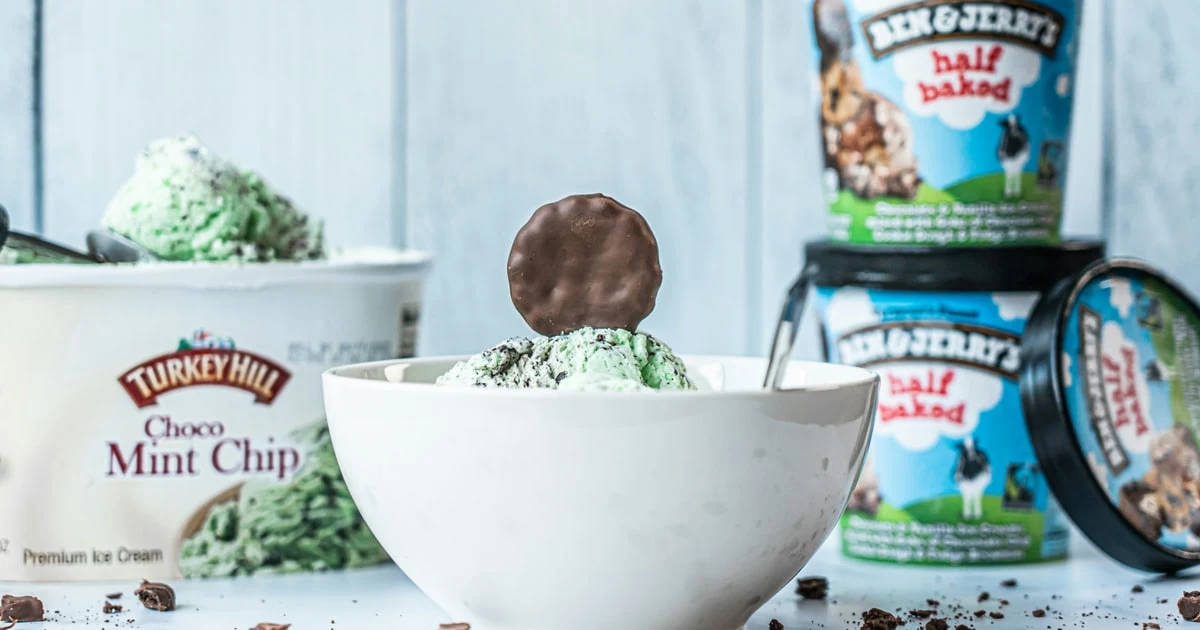
Ben & Jerry’s Cookie Dough is Mushbooh — not halal-certified, and it contains E471 (mono- and diglycerides) from an undisclosed source. Most other ingredients are fine. The verdict is the emulsifier.
If you’re standing in the freezer aisle holding a tub right now, the short answer is: it’s not certified, the source of the emulsifier isn’t disclosed by Unilever, and most halal authorities classify this as “doubtful” rather than outright haram. Whether you eat it depends on which scholarly position you follow.
The longer answer — what every other ingredient does, what’s actually in the cookie dough chunks, and what to buy instead — is below.
The Quick Verdict
| Question | Answer |
|---|---|
| Is Ben & Jerry’s Cookie Dough halal-certified? | No — no halal mark on UK or US tubs |
| Does it contain pork? | Not declared, but E471 source is not specified |
| Does it contain alcohol? | Trace amounts possible (vanilla extract) |
| Does it contain gelatin? | No |
| Final status | Mushbooh (doubtful) |
What’s Actually in Ben & Jerry’s Cookie Dough?
Key ingredients to check
The standard tub contains two parts: the vanilla ice cream base and the chocolate chip cookie dough chunks. Each has its own ingredient profile.
The vanilla ice cream base typically contains:
- Cream, skimmed milk, water
- Liquid sugar, sugar
- Egg yolks
- Vanilla extract
- Stabilisers: guar gum (E412), carrageenan (E407)
- Emulsifier: mono- and diglycerides (E471) ← the issue
The cookie dough chunks typically contain:
- Wheat flour
- Butter, sugar, brown sugar
- Chocolate chips (cocoa mass, sugar, cocoa butter, soya lecithin)
- Salt
- Vanilla extract
The flour is heat-treated for safety (it’s safe to eat raw in this product), and the dough is egg-free. So the dough chunks themselves are not the source of the halal concern.
The Real Issue: E471
E471 (mono- and diglycerides of fatty acids) is an emulsifier added to ice cream to prevent ice crystal formation and create the characteristic soft, creamy texture you expect from a premium pint.
The problem: E471 can be derived from plant oils (halal) or animal fat — including pork. The label on a Ben & Jerry’s tub does not specify which. Without halal certification or a direct statement from Unilever about the sourcing for this product, the source remains unverified.
This is what makes Cookie Dough — and every other Ben & Jerry’s flavour — Mushbooh rather than clearly halal or clearly haram.
For the full ruling on E471 and what to do when you see it on a label, see Is E471 Halal? The Complete Guide.
What About the Vanilla Extract?
Vanilla extract is traditionally made by soaking vanilla beans in alcohol (usually ethanol). The alcohol carries the flavour compounds and a small residual amount typically remains in the finished product.
Two scholarly positions exist:
- Trace alcohol in flavourings is acceptable — most contemporary scholars hold that flavourings used at fractions of a percent in finished food are not the same as drinking alcohol, and the food remains halal.
- Any alcohol is impermissible — a stricter interpretation requires alcohol-free flavourings.
If you follow position 2, vanilla extract in Ben & Jerry’s Cookie Dough is an additional concern beyond the E471. Ben & Jerry’s does not produce an alcohol-free version of any flavour.
Are Any Ben & Jerry’s Flavours Halal?
None of Ben & Jerry’s flavours are halal-certified in the UK, US, or any other market we have checked. The same E471 question applies across the entire range:
- Cookie Dough — Mushbooh (E471, vanilla extract)
- Phish Food — Mushbooh (E471, contains marshmallow swirl which may have additional emulsifiers)
- Half Baked — Mushbooh (E471, contains brownie pieces)
- Chocolate Fudge Brownie — Mushbooh (E471)
- Strawberry Cheesecake — Mushbooh (E471, possible E120 in the strawberry — verify per batch)
- Non-Dairy Cookie Dough — Still Mushbooh (E471 is still present in the dairy-free formulation)
The dairy-free range is sometimes assumed to be safer because it removes dairy. It does not. The non-dairy range still contains E471 from an undisclosed source. The base changes — the emulsifier does not.
For the full brand breakdown, see the Ben & Jerry’s brand guide.
What If You Find a Halal-Marked Ben & Jerry’s Tub?
In some Muslim-majority countries (notably parts of the Middle East and Malaysia), Unilever produces locally certified versions of Ben & Jerry’s with adjusted formulations. These tubs will carry a recognised halal mark on the packaging itself.
If you find a Ben & Jerry’s tub with a halal logo:
- Check the logo is on the tub itself, not just on the shelf label or store signage
- Confirm the certifying body (JAKIM, MUI, ESMA, etc.) — recognised authorities only
- Verify the import — re-imported tubs from non-Muslim markets will not have the halal mark
UK and US standard tubs do not carry any halal certification.
Halal Ice Cream Alternatives
If you want a similar premium ice cream experience without the E471 question, look for these halal-certified options:
- Halal-certified own-brand pints — some UK supermarkets (Tesco, Sainsbury’s) carry halal-certified ice cream lines, particularly during Ramadan
- Häagen-Dazs Bahrain/UAE imports — produced under halal certification in the Gulf region
- Local halal ice cream brands — many countries have dedicated halal ice cream producers (Saadia in the UK, Al Safa in the US)
- Sorbet and gelato — naturally egg- and emulsifier-free in their simplest forms
For more on identifying halal ice cream and similar products, see How to Identify Halal Products.
Frequently Asked Questions
Is Ben & Jerry’s Cookie Dough halal in the UK?
No. Ben & Jerry’s tubs sold in the UK do not carry halal certification, and the standard recipe contains E471 from an undisclosed source. The product is classified as Mushbooh (doubtful).
Is Ben & Jerry’s Cookie Dough halal in the US?
No. The same E471 emulsifier issue applies to US tubs, and there is no halal certification on the standard US range either.
Does Ben & Jerry’s Cookie Dough contain pork?
The label does not declare pork as an ingredient. However, the E471 emulsifier in the recipe can be derived from animal fat — including pork — and Unilever does not disclose the source. This is why the product is Mushbooh rather than confirmed halal.
Is the cookie dough in Ben & Jerry’s safe to eat raw?
Yes — the flour is heat-treated and the dough contains no raw egg, so it is safe to eat as-is in the product. The halal concern is not the dough chunks but the E471 in the surrounding vanilla ice cream base.
Is Ben & Jerry’s Non-Dairy Cookie Dough halal?
No — the non-dairy range still contains E471. Removing dairy does not remove the emulsifier source question. It remains Mushbooh.
Is Ben & Jerry’s Cookie Dough vegetarian?
The standard dairy version is vegetarian (no meat ingredients). The non-dairy version is vegan. Neither classification confirms halal status — vegetarian and halal are not the same.
Bottom Line
Ben & Jerry’s Cookie Dough is Mushbooh. There is no halal certification on UK or US tubs, the E471 emulsifier source is not disclosed, and the vanilla extract contains trace alcohol. Whether you eat it depends on your scholarly position on Mushbooh ingredients.
If you want a clear halal ice cream, look for a recognised halal mark on the tub or choose from dedicated halal brands. The full Ben & Jerry’s range follows the same pattern — see the Ben & Jerry’s brand guide for every flavour.
Verify any product label in 30 seconds: Scan with HalalCodeCheck →
How we reached this verdict
We checked the following Tier-1 sources before publishing this verdict:
- Halal certification bodies (HMC, HFA, JAKIM, MUI): Where the brand or ingredient appears in certified products, the certifying body’s audit covers source verification; where it appears in uncertified products, manufacturer disclosure is required.
- Manufacturer statements: Public ingredient lists, vegetarian / vegan suitability labels, customer-service correspondence on source disclosure.
- Sunni fatwa scholarship across the four madhabs:
- Hanafi-leaning bodies: IslamQA Hanafi, Darul Iftaa Birmingham, AskImam.org, Daruliftaa.com (Mufti Taqi Usmani), Wifaqul Ulama, Darul Iftaa New York.
- Shafi’i / Maliki-leaning bodies: NU (Nahdlatul Ulama, Indonesia), Dar al-Ifta al-Misriyyah (Egypt), e-fatwa.com (UAE), al-Azhar.
- Hanbali / Saudi-Salafi-leaning bodies: Saudi Permanent Committee for Scholarly Research, IslamQA Saudi.
Madhab note
The four Sunni madhabs broadly converge on the rules applied in this guide:
- Pork-derived sources — Haram across all four madhabs.
- Alcohol-based ingredients — Haram across all four madhabs.
- Source-ambiguous E-codes (E471, E476, E631, E627, E635, E920) — manufacturer plant-source disclosure (vegetarian-suitable label) is treated as sufficient under the Hanafi/Maliki/Shafi’i mainstream rule (Darul Ifta Birmingham, IslamQA case 245452); HMC-strict / Hanbali-leaning view requires formal independent certification.
- Istihāla (transformation) — Hanafi and Maliki accept istihāla strongly; spirit vinegar (alcohol → vinegar) is halal. Most Shafi’i scholars permit spirit vinegar specifically; some Hanbali scholars more cautious.
- Insect-derived dyes (E120 cochineal/carmine) — Hanafi, Shafi’i, and Hanbali generally treat as haram; some Maliki scholars permit small insects.
- Non-zabihah meat (Ahl al-Kitāb / People-of-the-Book slaughter) — Maliki and classical Shafi’i/Hanbali generally accept; Hanafi-Deobandi tradition more restrictive.
If your madhab differs on a specific ruling, the relevant section above flags the school-specific position. For binding rulings on borderline products, consult a competent scholar in your tradition.
Ingredients change. Be first to know.
Brands reformulate without warning. We track every E-code update and halal certification — one short weekly email.
Related Articles
 Brand Guides
 Is Wall's Ice Cream Halal? Mushbooh in the UK (2026)
Verdict: Wall's UK ice cream is Mushbooh — E471 and E472 from an undisclosed source, no UK halal certification. Cornetto and Twister checked too.
 Brand Guides
 Is Carte D'Or Halal? Mushbooh in the UK (2026)
Verdict: Carte D'Or is Mushbooh — E471/E472b from an undisclosed source, no UK halal certification. Strawberry variants also carry an E120 risk.
 Brand Guides
 Is Ben & Jerry's Ice Cream Halal? Every Flavour Checked (2026)
Ben & Jerry's is Mushbooh — no halal certification in any market, E471 in every flavour from an undisclosed source. Full flavour-by-flavour breakdown and halal alternatives.