
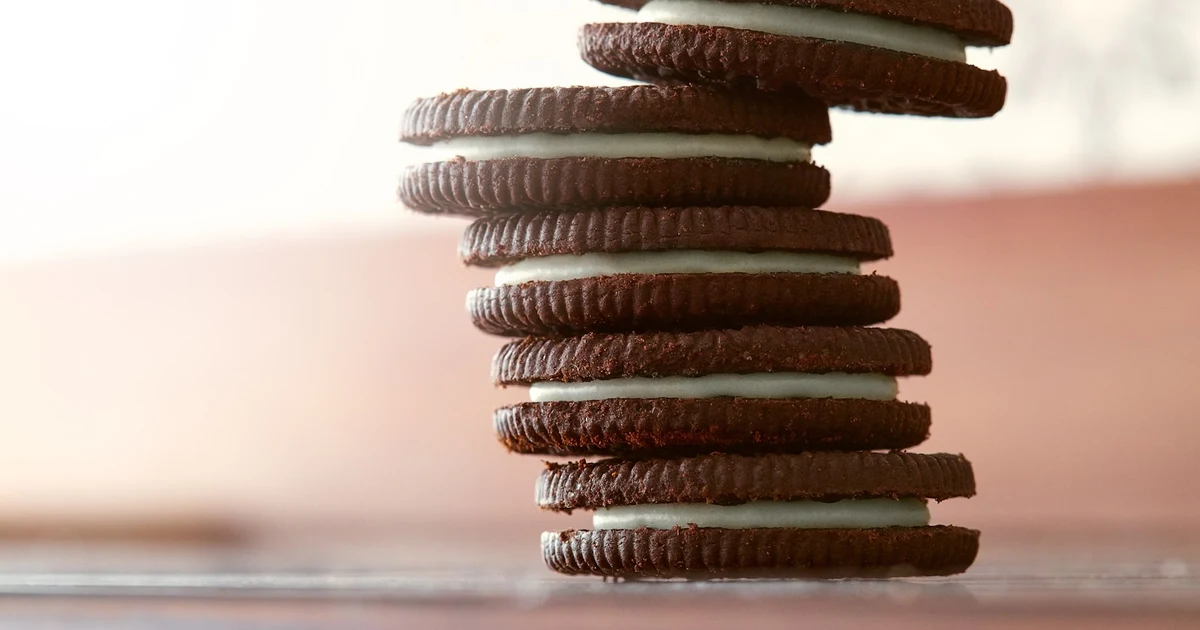
The direct verdict: Oreos are Mushbooh in the UK and US — Mondelez International holds no halal certification for Western-market Oreos, flavourings are undisclosed, and Mondelez confirms milk cross-contact on shared lines.
This is not speculation. Mondelez’s own website acknowledges the absence of halal certification for US Oreos, and no HMC, HFA, or MCB certification has been obtained in the UK. One thing has improved: the current labels no longer list E471. The UK label (verified against the Ocado, Waitrose and Bestway Wholesale listings, August 2026) reads: wheat flour, sugar, palm oil, rapeseed oil, wheat starch, fat reduced cocoa powder, glucose-fructose syrup, raising agents, salt, emulsifier (soya lecithins), acidity regulator, flavourings. Until Mondelez certifies the product, Oreos in the UK and US remain Mushbooh.
Certified halal Oreos do exist — in Malaysia and parts of the Middle East. This guide covers the complete picture.
The E-Codes in Oreos
E322 — Soya Lecithins (the emulsifier on the current label)
E322 (lecithin) is the only emulsifier on the current UK Oreo label, declared as “emulsifier (SOYA lecithins)”. Soya lecithin is plant-derived and halal. The current US list on oreo.com likewise shows soy lecithin.
What happened to E471?
Older Oreo labels listed E471 (mono and diglycerides of fatty acids) — an emulsifier whose fat source can be plant oils (permissible) or animal tallow (haram if pork or non-halal-slaughtered), and whose origin the label never disclosed. On the labels we re-verified in August 2026 (Ocado, Waitrose and Bestway Wholesale UK listings; oreo.com for the US), E471 no longer appears. If you have an older pack, read its own ingredient list.
A manufacturer’s claim is not the same as halal certification. Certification requires an independent auditing body to inspect ingredient sourcing, production facilities, and supply chains — that audit is still absent for UK and US Oreos, which is why the verdict stays Mushbooh.
Milk — Cross-Contact, Not a Declared Ingredient
The current UK label declares no milk ingredient, yet Oreo states the product is “not suitable for vegans” because of milk cross-contact on shared production lines. Cross-contact is an allergen and process-control issue rather than a haram ingredient, but it confirms Oreo production is not run as a segregated, certifiable line. This — with the undisclosed flavourings — is the substance of the remaining doubt.
”May Contain” — Shared Equipment
UK Oreo packaging notes that the product may contain traces of other allergens due to shared production equipment. While this specific advisory relates to allergens (milk, nuts), it also indicates that Mondelez does not operate Oreo production as a segregated halal line. Halal certification requires not just ingredient purity but also production segregation and cleaning protocols.
Regional Breakdown
| Region | Halal Status | Key Notes |
|---|---|---|
| UK | Mushbooh | No HMC/HFA/MCB cert. Current label: soya lecithins, undisclosed flavourings. |
| US | Mushbooh | Mondelez confirms no halal cert. Soy lecithin on current list. |
| Canada | Mushbooh | Same formulation as US. No certification. |
| Malaysia | Halal | Manufactured locally with JAKIM certification. |
| UAE / Middle East | Halal (check label) | Regional authority cert. Verify logo on specific pack. |
| Australia | Mushbooh | Mondelez AU. No certification. Check the local label. |
UK: The Honest Picture
Standard Oreos sold in UK supermarkets — Tesco, Sainsbury’s, Asda, Morrisons, Waitrose — are not halal-certified. No halal authority has verified Mondelez’s UK ingredient sourcing, and the flavourings on the label are of undisclosed origin.
Some UK halal supermarkets import certified Oreos from Malaysia. If you see Oreos in a halal shop, check:
- Whether the label is in English or Malay/Arabic (imported product)
- Whether a certification logo (JAKIM or equivalent) is visible on the pack
- Whether the pack is the standard UK format
Do not assume a halal shop has sourced the certified variant automatically.
US: The Manufacturer’s Own Admission
The Mondelez US FAQ has historically stated that Oreos are not suitable for a halal diet due to cross-contact and the absence of formal certification. This is an unusually direct acknowledgement from a manufacturer. It confirms what the ingredient label implies: without certification, the product is Mushbooh.
Malaysia: Genuinely Halal
Mondelez manufactures Oreos in Malaysia under JAKIM (Jabatan Kemajuan Islam Malaysia) certification. The Malaysian Oreo is produced in a halal-compliant facility with certified ingredients and production protocols. A pack of Oreos purchased in Kuala Lumpur is halal. The same brand name from a UK supermarket shelf is not.
UK Product Variant Overview
| Variant | Emulsifier on current label | Status |
|---|---|---|
| Original Oreo | Soya lecithins (label verified August 2026) | Mushbooh |
| Oreo Double Stuf | Check label | Mushbooh |
| Oreo Thins | Check label | Mushbooh |
| Oreo Golden | Check label | Mushbooh |
| Oreo Cadbury Dairy Milk | Check label — adds Cadbury’s emulsifiers (E442, E476) | Mushbooh |
| Oreo Mini (sharing bags) | Check label | Mushbooh |
| Oreo Ice Cream Bar | Check product label | Mushbooh / Verify |
We re-verified the Original label in August 2026; for other variants, read the pack in hand — older stock and different formats can still carry E471. Every standard UK variant shares the same certification gap, so the Mushbooh status applies across the range. The Oreo Cadbury Dairy Milk variant combines Mondelez’s two most searched Mushbooh products and inherits concerns from both.
Why “No Pork Listed” Does Not Mean Halal
A frequently repeated argument is: “Oreos don’t list any pork ingredient, so they must be halal.” This misunderstands how halal food law works.
The concern is not that Oreos contain declared pork. On older labels the concern was E471 with an undisclosed source — if the fatty acids in an E471 are rendered from pork fat, the emulsifier is haram even though “pork” never appears on the label. On the current label the same logic applies to the undisclosed flavourings and the unaudited supply chain.
Halal certification exists precisely to resolve this gap. An auditing body inspects the actual ingredient supply chain — not just the label — and verifies that every input is halal. Without that audit, the consumer cannot know.
Mushbooh is the correct classification: uncertain, proceed with caution.
Halal Biscuit Alternatives
These options either carry halal certification or are free from animal-derived emulsifiers.
Lotus Biscoff
The original Lotus Biscoff speculoos biscuit (the plain, individually wrapped variant) contains a short ingredient list with no animal-derived emulsifiers. Check the label of the specific format — Biscoff spreads and cream-filled variants may differ.
Fox’s Chocolate Crunch Creams
Fox’s produces a range of chocolate sandwich biscuits. Check the label for halal certification or emulsifier source — formulations can change. Some Fox’s products have carried halal marks in specific retail channels.
Bourbon Biscuits (Selected Brands)
Several own-brand and supermarket-label bourbon biscuits use palm oil-derived E471 and carry halal certification. Check the label of the specific product — not all Bourbons are equivalent.
How to Check Any Biscuit in 30 Seconds
- Find the emulsifier section of the ingredient list — look for E471, E472, E476
- Check for source disclosure — does it say “soya lecithin” or just “emulsifier (E471)”?
- Look for a halal certification logo on the front or back (HMC, HFA, JAKIM, MUI, IFANCA)
- If the source is not stated and there is no halal logo — the product is Mushbooh
Summary
| Question | Answer |
|---|---|
| Are Oreos halal in the UK? | No — Mushbooh, no certification; current label lists soya lecithins |
| Are Oreos halal in the US? | No — Mushbooh, Mondelez confirms no halal cert |
| Are there halal Oreos? | Yes — in Malaysia (JAKIM) and some Middle Eastern markets |
| Key E-code concern | None on the current label (soya lecithin is halal) — doubt rests on flavourings + no certification |
| Does “no pork listed” mean halal? | No — flavour sourcing and the supply chain are unaudited without certification |
| Best alternatives | Lotus Biscoff (original), Fox’s (check label), certified halal biscuit brands |
If the Oreo craving is really a chocolate craving, a different aisle solves it: our roundup of the certified chocolate bars we’ve ranked is bars rather than sandwich biscuits, but every product on it carries the certification Oreos don’t.
Look up any E-code from a biscuit packet in the E-codes database.
To scan a full ingredient list for halal status in seconds, use the ingredient scanner.
How we reached this verdict
Ingredient claims in this guide were re-verified against the current retail labels — the Ocado, Waitrose and Bestway Wholesale UK listings for Oreo Original, and the oreo.com US ingredient list — in August 2026.
We checked the following Tier-1 sources before publishing this verdict:
- Halal certification bodies (HMC, HFA, JAKIM, MUI): Where the brand or ingredient appears in certified products, the certifying body’s audit covers source verification; where it appears in uncertified products, manufacturer disclosure is required.
- Manufacturer statements: Public ingredient lists, vegetarian / vegan suitability labels, customer-service correspondence on source disclosure.
- Sunni fatwa scholarship across the four madhabs:
- Hanafi-leaning bodies: IslamQA Hanafi, Darul Iftaa Birmingham, AskImam.org, Daruliftaa.com (Mufti Taqi Usmani), Wifaqul Ulama, Darul Iftaa New York.
- Shafi’i / Maliki-leaning bodies: NU (Nahdlatul Ulama, Indonesia), Dar al-Ifta al-Misriyyah (Egypt), e-fatwa.com (UAE), al-Azhar.
- Hanbali / Saudi-Salafi-leaning bodies: Saudi Permanent Committee for Scholarly Research, IslamQA Saudi.
Madhab note
The four Sunni madhabs broadly converge on the rules applied in this guide:
- Pork-derived sources — Haram across all four madhabs.
- Alcohol-based ingredients — Haram across all four madhabs.
- Source-ambiguous E-codes (E471, E476, E631, E627, E635, E920) — manufacturer plant-source disclosure (vegetarian-suitable label) is treated as sufficient under the Hanafi/Maliki/Shafi’i mainstream rule (Darul Ifta Birmingham, IslamQA case 245452); HMC-strict / Hanbali-leaning view requires formal independent certification.
- Istihāla (transformation) — Hanafi and Maliki accept istihāla strongly; spirit vinegar (alcohol → vinegar) is halal. Most Shafi’i scholars permit spirit vinegar specifically; some Hanbali scholars more cautious.
- Insect-derived dyes (E120 cochineal/carmine) — Hanafi, Shafi’i, and Hanbali generally treat as haram; some Maliki scholars permit small insects.
- Non-zabihah meat (Ahl al-Kitāb / People-of-the-Book slaughter) — Maliki and classical Shafi’i/Hanbali generally accept; Hanafi-Deobandi tradition more restrictive.
If your madhab differs on a specific ruling, the relevant section above flags the school-specific position. For binding rulings on borderline products, consult a competent scholar in your tradition.
Ingredients change. Be first to know.
Brands reformulate without warning. We track every E-code update and halal certification — one short weekly email.
Related Articles
 Shopping Guides
 Is Ritz Crackers Halal? Nabisco Ingredients Checked (2026)
Ritz Original Crackers are Mushbooh — they contain E471 (mono and diglycerides) with no animal source disclosure and no halal certification.
 Shopping Guides
 Is Biscolata Halal? Turkish Chocolate Brand Ingredients Checked
Biscolata is Mushbooh — the Turkish chocolate biscuit brand uses E471 with no halal certification for export markets, though Turkish production may meet local standards.
 Shopping Guides
 Is McVitie's Halal? (UK Biscuits Guide 2026)
McVitie's holds no UK halal certification despite its Turkish parent company. E471 in chocolate coatings is mushbooh. Full product breakdown and halal alternatives.