
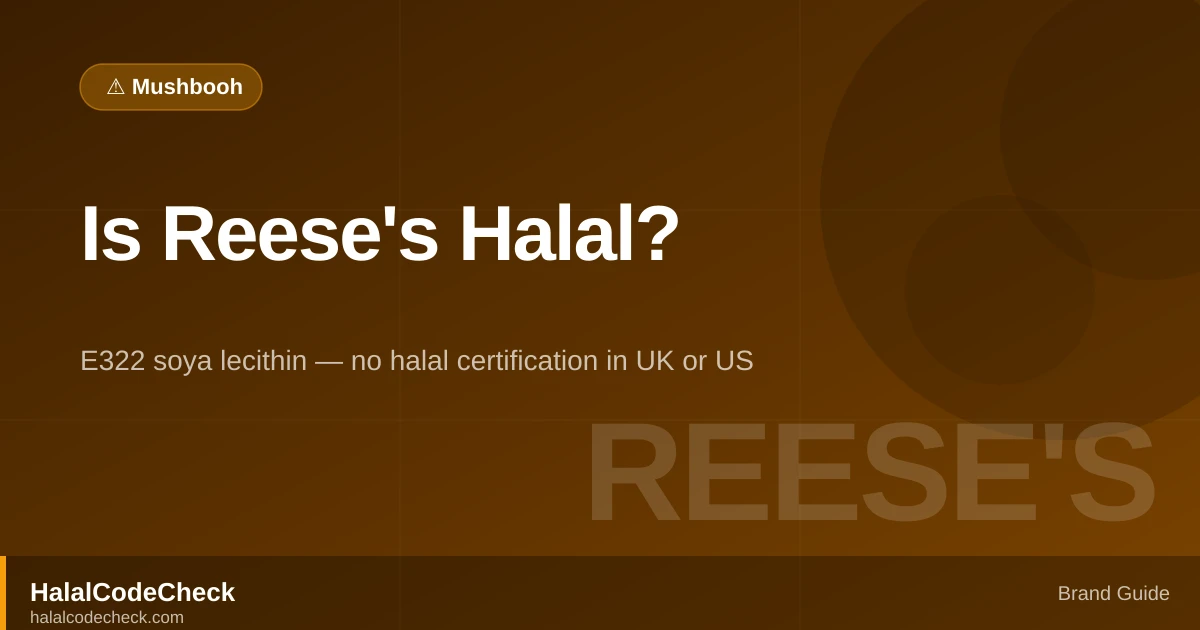
Is Reese's Halal?
⚠️ MushboohReese's Peanut Butter Cups, Pieces, Thins, and Big Cups are manufactured by The Hershey Company and carry no halal certification in the US, UK, Canada, or Australia. There are no confirmed pork-derived ingredients or gelatine. The emulsifier is E322 (soya lecithin — plant-based and halal). The main concern is the absence of a halal audit covering dairy sourcing and manufacturing processes. TBHQ antioxidant is synthetic with no animal concern. Overall verdict: Mushbooh — no overt haram ingredients, but no independent certification.
Country
United States
Product Types
Peanut butter cups, Chocolate pieces, Thins +3 more
Halal Certification
No halal certification in the US, Canada, UK, or Australia. The Hershey Company does not hold halal certification for any Reese's product in these markets.
Safer alternatives
Browse halal-friendly substitutes while this brand remains uncertain.
Is Reese’s Halal?
Reese’s is one of the most popular confectionery brands in the world, produced by The Hershey Company. The orange-wrapped peanut butter cups are widely available across the US, UK, Canada, and Australia — and increasingly in European supermarkets.
The short answer: Reese’s is not halal-certified in any of these markets. There are no pork-derived ingredients confirmed on the label, and no gelatine. The emulsifier used is soya lecithin (E322), which is plant-derived and halal. However, without independent halal certification, the range sits in the Mushbooh category.
Key Ingredients
Standard Reese’s Peanut Butter Cups contain:
- Milk chocolate (sugar, cocoa butter, chocolate, nonfat milk, milk fat, lactose, soya lecithin, PGPR)
- Peanuts
- Sugar
- Dextrose
- Contains 2% or less of: salt, TBHQ, citric acid
Let’s look at the ingredients that matter for halal compliance.
E322 — Soya Lecithin
Status: Halal
The emulsifier in Reese’s chocolate coating is soya lecithin — a plant-derived ingredient universally accepted as halal. This is a straightforward halal ingredient.
Reese’s does not use E471 (mono and diglycerides of fatty acids), which is the more frequently questioned emulsifier in chocolate products. The soya lecithin in Reese’s carries no halal concern.
Milk Chocolate and Dairy
Reese’s contains several dairy-derived ingredients: nonfat milk, milk fat, and lactose. Dairy itself is halal. The question, as with all uncertified products, is whether the dairy supply chain has been independently audited for halal compliance.
The Hershey Company sources dairy from US supply chains that are not halal-certified. For strict halal observers who require full supply chain certification — including feed, processing, and facility audits — this remains unverified.
TBHQ (Tertiary Butylhydroquinone)
TBHQ is a synthetic antioxidant used in Reese’s to prevent fat oxidation and extend shelf life. It is a petroleum-derived synthetic additive. There is no animal-derived concern with TBHQ — it is not E-coded on US labels but would be E319 in EU labelling. No halal concern with TBHQ.
No Pork, No Gelatine, No E120
To state clearly what Reese’s does not contain:
- No pork or pork-derived ingredients
- No gelatine
- No E120 (cochineal/carmine)
- No E471 (mono and diglycerides of fatty acids from unspecified sources)
- No alcohol in flavourings
For consumers checking the most common haram ingredients, Reese’s has a clean label. The Mushbooh classification is driven by the absence of certification, not the presence of a confirmed haram ingredient.
Seasonal and Variant Products
The Reese’s range extends beyond the standard Peanut Butter Cup. Key variants:
| Product | Notes | Verdict |
|---|---|---|
| Reese’s Peanut Butter Cups | Standard product. E322 (soya lecithin) only. | Mushbooh |
| Reese’s Pieces | Candy-coated peanut butter pieces. No gelatine. | Mushbooh |
| Reese’s Thins | Thinner cup format. Same formulation. | Mushbooh |
| Reese’s Big Cup | Larger cup. Same base formulation. | Mushbooh |
| Reese’s Spreads | Peanut butter/chocolate spread. Check current label. | Mushbooh |
| Reese’s Peanut Butter | Pure peanut butter (no chocolate). Generally halal-friendly ingredients — but not certified. | Mushbooh |
Seasonal products (Easter eggs, Halloween pumpkins, Christmas trees) use the same base formulation as the standard cups. No additional halal concerns are introduced by the seasonal shape, but they carry the same uncertified status.
What to Check on the Label
- Halal certification logo — currently absent from all Reese’s products in US, UK, CA, and AU
- Emulsifier type — “soya lecithin” is what appears, and it is plant-derived
- Gelatine — not present in standard Reese’s products, but always verify on limited editions
- Dairy ingredients — present, but not haram; concern is certification of supply chain only
Summary
| Factor | Details |
|---|---|
| Halal certification | None in US, UK, CA, or AU |
| Key emulsifier | E322 (soya lecithin) — plant-derived, halal |
| Pork / gelatine | Not present in standard products |
| Dairy | Present — not certified halal source |
| TBHQ | Synthetic antioxidant — no animal concern |
| Verdict | Mushbooh — no overt haram ingredients, no certification |
Reese’s is one of the more straightforward Mushbooh cases: the ingredient profile is clean of confirmed haram additives, but the lack of independent halal certification means it cannot be classified as halal. For consumers who require certification, avoid. For consumers who judge based on the absence of haram ingredients, Reese’s presents no specific concern beyond uncertified dairy.
How we reached this verdict
We checked the following Tier-1 sources before publishing this verdict:
- HMC / HFA: Silent on this brand’s UK retail. No formal halal certification.
- Manufacturer: Where the product is labelled “suitable for vegetarians” on UK packaging, that is treated as plant-source disclosure under mainstream Sunni rulings. Where source-ambiguous E-codes (E471, E476, E631, E627, E635, E920) appear without a vegetarian listing or formal certification, the source cannot be verified.
- Sunni fatwa on E-code source verification: IslamQA Hanafi (case 34988), Darul Iftaa Trinidad — emulsifiers and flavour enhancers from a verified plant or halal-slaughtered animal source are halal; from undisclosed sources, must contact the company. Pork-derived = haram. Plant-derived = halal.
- Sunni fatwa on vegetarian-suitable label: Darul Ifta Birmingham (IslamQA case 245452) — vegetarian-suitable + no alcohol is treated as a halal indicator under the mainstream Sunni view, accepted across the four madhabs as a sound general principle.
Madhab note
The four Sunni madhabs broadly converge on the source-verification rule for source-ambiguous E-codes:
- Hanafi, Maliki, Shafi’i: A manufacturer “suitable for vegetarians” listing or vegan label is treated as plant-source disclosure for the emulsifiers. Combined with no alcohol, the products lean Halal under the mainstream Sunni rule. Without that disclosure or a formal cert, Mushbooh.
- Hanbali / HMC-strict view: Requires formal independent halal certification. Mushbooh until certified, regardless of vegetarian labelling.
In Muslim-majority markets where this brand operates under local halal certification (JAKIM / MUI / GCC / regional bodies), the certified SKUs are halal across all four schools.
Key E-Codes in Reese's Products
Not sure about a specific Reese's product?
Scan the ingredient label or search by E-code — checks every additive instantly against our database.
Stay informed
Brand formulas change without warning
We update every brand guide when manufacturers reformulate or earn halal certification. Be first to know — one short weekly email.
Related Brands
Snickers
⚠ MushboohSnickers bars sold in the UK and US contain E471 (mono and diglycerides of fatty acids) from an undisclosed source — making them Mushbooh. No halal certification applies to standard UK or US Snickers. Mars produces halal-certified Snickers for Muslim-majority markets including Malaysia and Indonesia.
Read brand guide
Mars
⚠ MushboohMars UK/EU products have no halal certification. The key concern is E471 (mono & diglycerides of fatty acids) — present in most Mars chocolate bars — which can be derived from animal or plant fat. The source is not disclosed. Skittles and Starburst have removed carmine (E120) from the US recipe, but UK/EU formulations must be checked separately. Muslims in the UK should treat standard Mars products as Mushbooh until certification is obtained.
Read brand guide
Oreo
⚠ MushboohUK Oreo contains E471 (mono- and diglycerides) from an undisclosed source — it may be plant-derived (halal) or animal-derived (haram). No halal certification on UK products. Oreo is labelled vegan in the UK but 'vegan' does not mean halal certified.
Read brand guide