
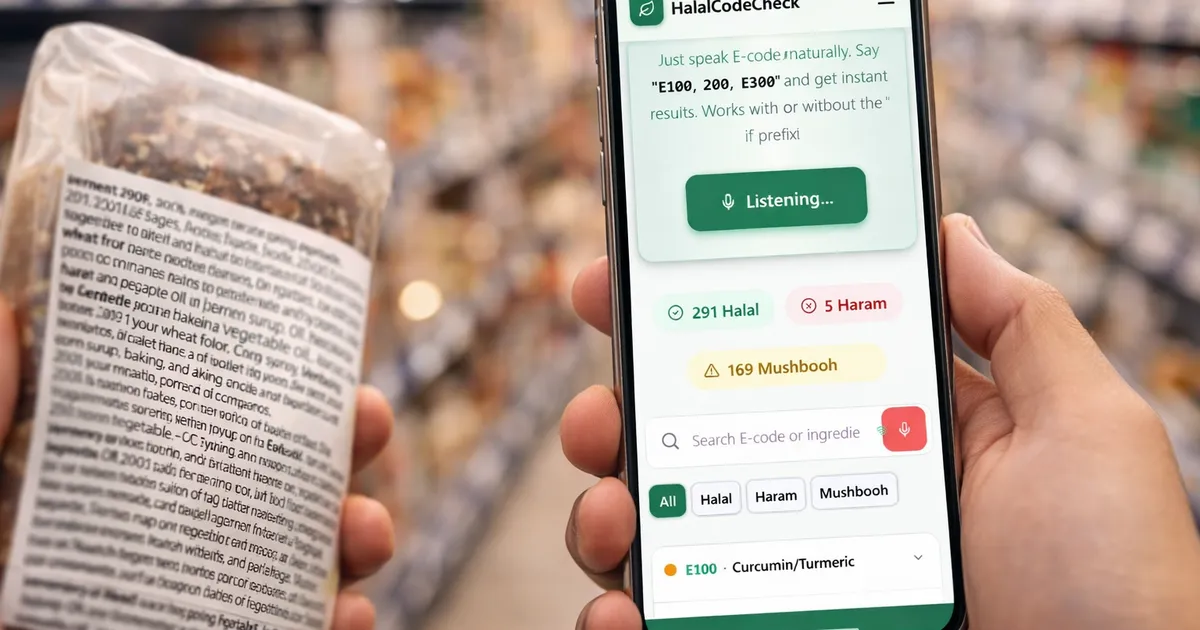
You’re standing in the grocery aisle with a product in one hand and your phone in the other. The label shows E471, E120, and E621.
Do you type each code manually? Or just say them out loud?
The right answer depends on where you are, how many codes you’re checking, and whether your kids are tugging at your sleeve. Here’s a real-world comparison so you can pick the faster method for your situation.

Manual Search: Best When Precision Matters
Manual search works best when:
- You have a single code to check (like E471)
- You’re in a noisy store where voice won’t pick up clearly
- You want exact control over what gets searched
Pros:
- Precise - you type exactly what you mean
- Works in any environment, no matter how loud
- Great for verifying one code at a time
Cons:
- Slower when checking 3+ additives on one label
- More effort during long shopping trips
Try a manual lookup now in the E-codes database - search any code and get instant halal status.
Voice Search: Best for Speed and Bulk Checks
Voice search shines when:
- You need to check multiple codes quickly from one label
- Your hands are busy with a cart, basket, or child
- You’re moving fast between products
Pros:
- Faster for multiple codes - say “E120, E471, E904” in one go
- Hands-free, perfect for busy parents
- Natural and quick for on-the-go use
Cons:
- Background noise can affect accuracy
- Takes a few tries to learn pronunciation patterns
Side-by-Side: Which Is Actually Faster?
| Scenario | Manual | Voice | Winner |
|---|---|---|---|
| Single code lookup | ~5 seconds | ~5 seconds | Tie |
| 3+ codes from one label | ~15-20 seconds | ~8-10 seconds | Voice |
| Noisy store environment | Works perfectly | May struggle | Manual |
| Hands full (cart/kids) | Awkward | Natural | Voice |
| Following up on a flagged result | Easy to re-check | Faster to type | Manual |
Bottom line: For one code, they’re about equal. For two or more, voice usually wins because you can say them in one flow.
The Hybrid Method (What Power Users Do)
Most experienced shoppers don’t pick one method - they use both:
- Voice for the first pass - quickly capture all visible codes from the label
- Manual for follow-up - re-check any result that’s flagged as mushbooh or uncertain
- Save the result - add verified products to your safe list so you don’t repeat the check
This gives you speed and accuracy without overthinking it.
3 Mistakes That Slow You Down
Switching methods too often
Pick one primary method for the trip and only switch when the situation demands it. Constantly going back and forth between typing and speaking wastes time.
Trying to memorize every risky code
Use the tool. Your brain isn’t a database, and it doesn’t need to be. That’s exactly what the E-codes database is for - so you can focus on making decisions, not recalling numbers.
Skipping the basics
If you’ve never learned how E-codes work, quick checks feel harder than they should. Spend 10 minutes reading our foundational E-codes guide once - after that, every in-store check becomes much faster.
For Parents: Which Method Works Best?
If you shop with kids, voice search reduces friction because you can keep one hand free and still verify fast. Say the codes while walking, get results, keep moving.
If the store is noisy or crowded, fall back to manual immediately - it’s more reliable in those conditions.
Shopping with children regularly? This guide pairs well with our 5-minute halal label reading crash course for parents.
FAQ
Is voice search accurate enough for halal decisions?
Yes, for first-pass checks. Voice search is strong for speed and catching codes quickly. For any result that comes back as mushbooh or uncertain, do a manual confirmation to be sure.
Does manual search work better for hard-to-read labels?
Yes. When the label is partially smudged, printed small, or the store lighting is bad, typing the code manually gives you more control than trying to speak it.
Can I use both methods in one shopping trip?
Absolutely. The hybrid method (voice first, manual follow-up) is what most regular users end up doing. It’s the most practical approach.
I’m new to this - where should I start?
Start with Verify Ingredients to scan a label, then use the E-codes database for individual code lookups. Within 2-3 shopping trips, you’ll have your own rhythm.
What To Do Next
Manual search is your precision tool. Voice search is your speed tool. Together, they cover every shopping scenario.
Try both right now:
- Search a code manually - type E471 and see instant results
- Scan a product label - try the voice or camera option on your next shopping trip
You don’t need to “pick a winner” forever. Use the right method for the moment, and your halal checks become faster and less stressful on every trip.
Seen an E-code in this article?
Look it up instantly — 370+ codes, halal status in one click.
Ingredients change. Be first to know.
Brands reformulate without warning. We track every E-code update and halal certification — one short weekly email.
Related Articles
 Food & Ingredients
 Is Chocolate Halal or Haram? The Complete Guide (2026)
Is chocolate halal? Cacao is halal, but emulsifiers like E471 and colorings like E120 change the answer. Learn which chocolates are safe and what to check on the label.
 E-Codes & Additives
 Is E415 (Xanthan Gum) Halal? Yes - Here's Why
E415 (Xanthan Gum) is halal in the vast majority of commercial products. Learn what it is, where it comes from, and the one edge case worth knowing about.
 E-Codes & Additives
 Is E621 (MSG) Halal or Haram? The Complete Guide
E621 (MSG) is usually halal - modern production uses plant-based fermentation. Learn why it caused controversy, when to verify, and how to check fast.