
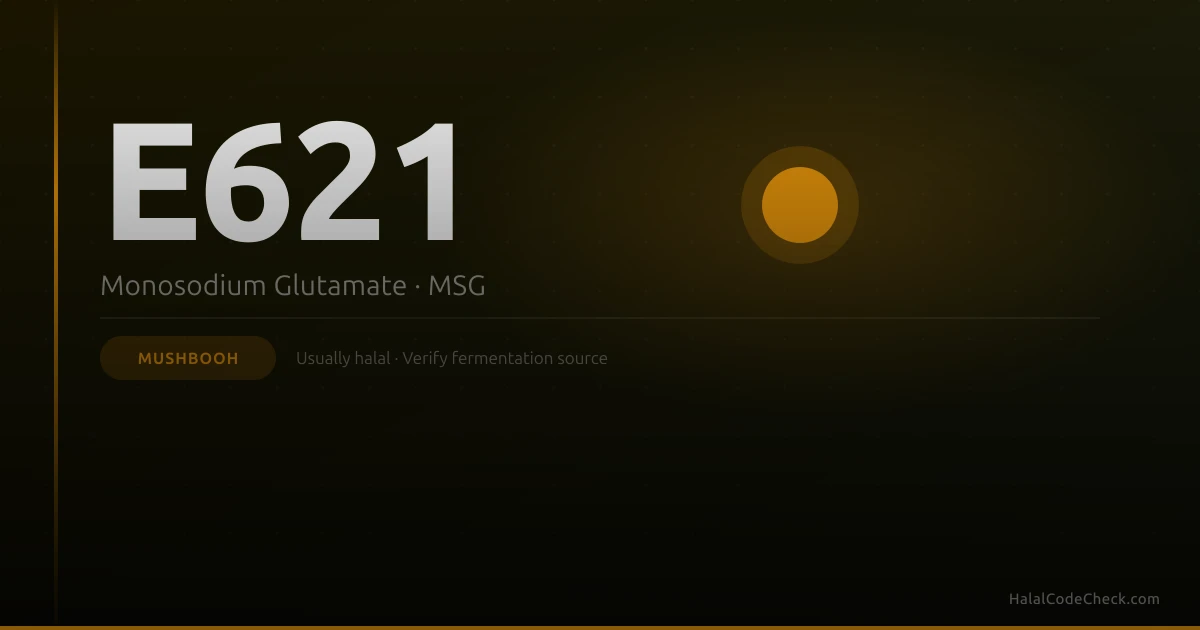
Few food additives have caused as much debate in Muslim communities as E621 - Monosodium Glutamate (MSG). For decades, it has been the subject of fatwas, boycotts, and family arguments at the dinner table.
Here is the clear answer - and the reason the question is more complex than it first appears.
What Is E621 (MSG)?
E621 is Monosodium Glutamate, a flavour enhancer that intensifies the savoury (umami) taste of food. It is a sodium salt of glutamic acid - an amino acid that occurs naturally in tomatoes, Parmesan cheese, mushrooms, and soy sauce.
MSG amplifies the existing flavours in food rather than adding a new one. A small amount makes food taste more rounded and satisfying.
You will find E621 in:
- Crisps and savoury snacks
- Instant noodles and ramen
- Seasoning mixes and stock cubes
- Chinese restaurant food and fast food
- Ready meals and frozen dinners
- Soy sauce and condiments
On labels it appears as: E621, MSG, Monosodium Glutamate, Sodium Glutamate, or simply “flavour enhancer (621)”.
Is E621 Halal or Haram?
E621 is classified as Mushbooh - halal in most cases, but requires verification in specific circumstances.
| Situation | Status | Reason |
|---|---|---|
| Plant-based fermentation (corn/sugar cane) | ✅ Halal | No animal involvement |
| Bacterial fermentation on halal media | ✅ Halal | Verified plant source |
| Bacterial fermentation on pork-derived media | ❌ Haram | Pork-based growth medium |
| Halal-certified product | ✅ Halal | Source independently verified |
The fermentation substrate - what the bacteria are fed to produce glutamate - is what determines the halal status. In modern Western production, this is almost always derived from corn starch or sugar cane (both halal). The concern arises from historical use of pork-derived media.
Why Did E621 Become Controversial?
In 1996, Ajinomoto Indonesia - one of the world’s largest MSG producers - was found to have used pork-derived enzyme media in some of its fermentation processes. This caused significant alarm across the Muslim world, particularly in Indonesia, Malaysia, and South Asia.
Indonesia’s MUI (Majelis Ulama Indonesia) issued a fatwa, halal certifications were revoked, and Ajinomoto products were pulled from shelves. Ajinomoto subsequently reformulated its Indonesian production to use halal media and re-obtained halal certification.
This incident created lasting suspicion around MSG - even among people who have no idea what actually happened.
Is MSG Produced in Western Countries Halal?
In general, yes. The major MSG producers in Europe, North America, and Australia use corn or sugar cane-based fermentation. The Ajinomoto Indonesia case was specific to one production facility at one point in time.
However, MSG is a globally traded commodity. When a product uses MSG without naming the supplier, there is no way to know from the label alone which fermentation medium was used.
The practical position of most halal certifiers: MSG from verified plant-based sources is halal. For products without halal certification that contain MSG, verification is recommended - particularly for products from regions or brands with opaque supply chains.
How to Check E621 When Shopping
Step 1 - Look for halal certification. If the product carries a recognised halal mark (HMC, HFA, IFANCA, MUI, Jakim), the MSG source has been verified as part of the certification process.
Step 2 - Search E621 in the database. See the full halal ruling, source details, and common food applications.
Step 3 - Scan the full ingredient list. Get the status of E621 alongside every other additive in the product simultaneously.
Step 4 - Contact the manufacturer. A short question - “Is the MSG in this product produced from plant-based fermentation media?” - usually gets a clear answer from technical teams.
E621 and the “MSG Is Unhealthy” Myth
A common misconception worth addressing: the concern about MSG in halal circles is a sourcing issue, not a health issue.
The idea that MSG causes “Chinese restaurant syndrome” or headaches has been thoroughly investigated and debunked by food science research. MSG is safe at normal dietary levels according to the FDA, EFSA, and WHO. This is a separate question from halal permissibility - do not confuse them.
E621 vs Similar Flavour Enhancers
If you are checking E621, it is worth knowing the related flavour enhancers that appear alongside it:
| E-code | Name | Halal Status | Notes |
|---|---|---|---|
| E621 | Monosodium Glutamate | Mushbooh | Verify fermentation source |
| E627 | Disodium Guanylate | Mushbooh | May be from meat or yeast - verify source |
| E631 | Disodium Inosinate | Mushbooh | Often from meat or fish - needs verification |
| E635 | Disodium Ribonucleotides | Mushbooh | Mix of E627+E631 - same source concerns |
E627 and E631 are commonly used alongside E621 as a synergistic combination. They raise similar questions about source and are worth checking at the same time.
Frequently Asked Questions
Is MSG the same as E621?
Yes. E621 is the European food additive code for Monosodium Glutamate. They refer to exactly the same substance.
Is Ajinomoto halal now?
Ajinomoto products in Indonesia, Malaysia, and several other markets are now halal-certified by local bodies following the 1996 reformulation. Specific certification status varies by country and product line - check the packaging for the current certification mark.
Is MSG in Chinese food halal?
This depends entirely on the restaurant and its sourcing. A halal-certified Chinese restaurant will use MSG from verified sources. An uncertified restaurant cannot confirm this. For restaurant food, halal certification of the establishment is the relevant factor.
Do health-food products that say “no MSG” contain other glutamates?
Often yes. Products that avoid MSG sometimes use yeast extract, hydrolysed vegetable protein, or soy sauce to achieve the same umami effect. These are functionally similar - and have the same sourcing considerations if you are checking carefully.
Is MSG made from seaweed halal?
Yes. Seaweed-derived glutamate is plant/algae-based and halal. This is an emerging source as manufacturers seek natural alternatives to synthetic MSG.
What To Do Next
E621 is one of those additives where the answer depends on the specific production context - not the ingredient itself.
- Check E621’s full ruling - halal status, source details, common foods
- Scan your current products - flag E621 alongside everything else in seconds
- Look for halal certification - the simplest resolution for any product you buy regularly
Related Articles
 How-To Guides
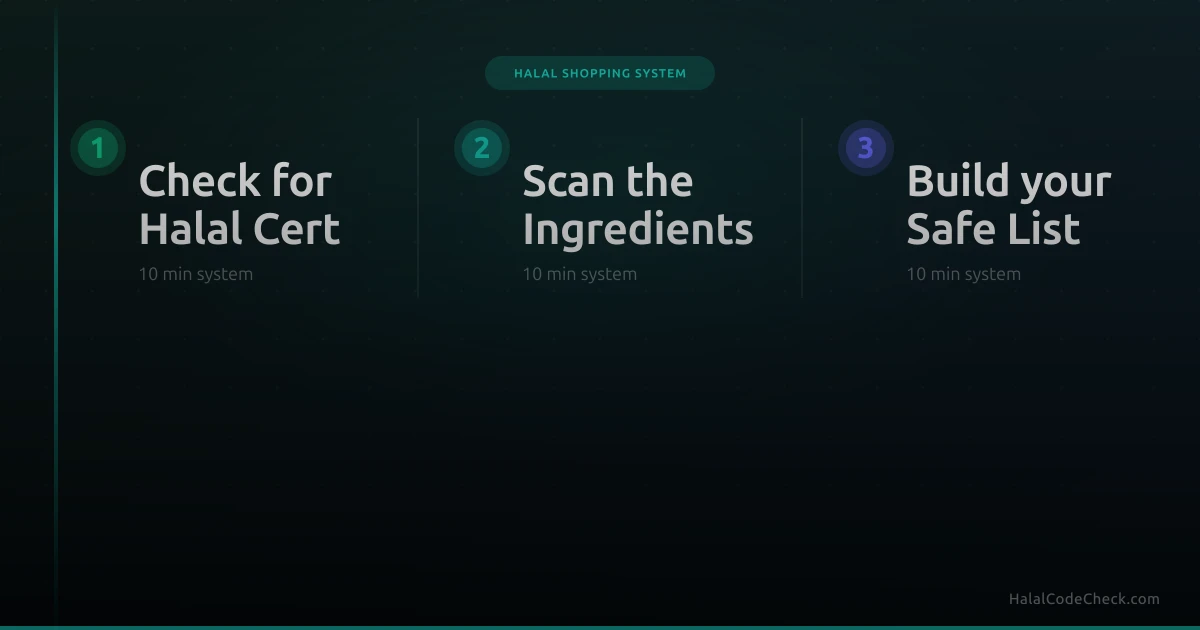
 How to Grocery Shop Halal in 10 Minutes (Step-by-Step System)
A practical 3-step system that lets you verify halal status on any product in under a minute - and build a trusted shopping list that gets easier every week.
 Ingredients
 15 Haram Ingredients Hiding in Everyday Groceries (Most Shoppers Miss These)
From gelatin to L-cysteine, these 15 ingredients are in products most Muslim shoppers consider safe. Learn exactly where they hide and how to spot them fast.
 How-To Guides
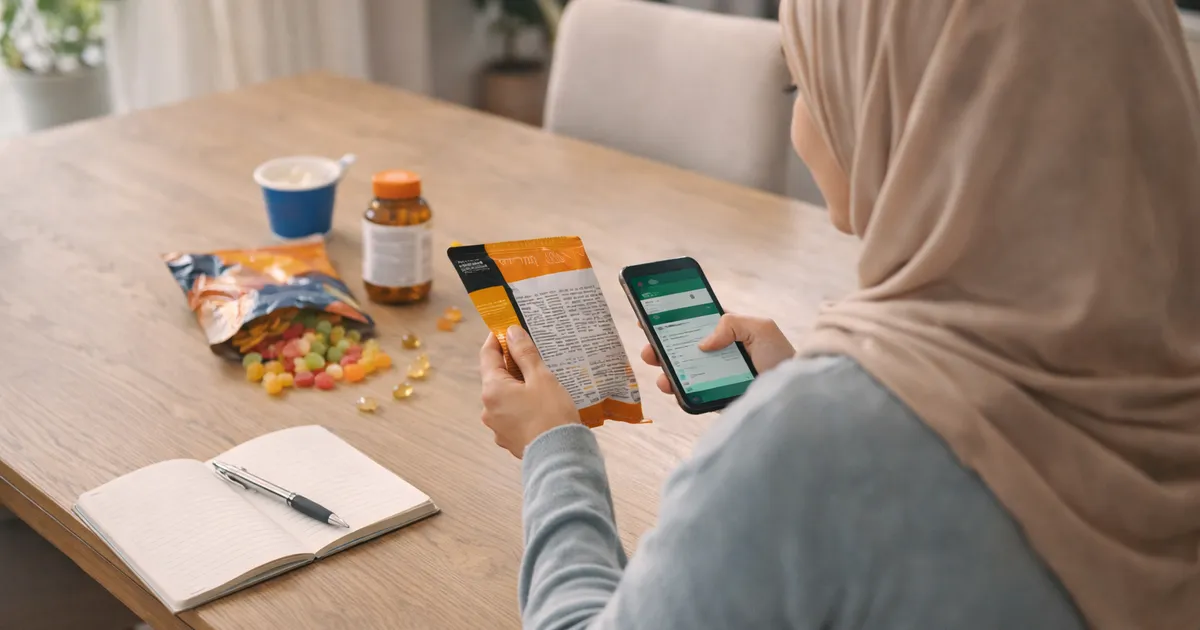
 The Most Searched Halal Food Questions, Answered Clearly
Straight answers to common halal food questions Muslims search for every week, from gelatin and E-codes to vegetarian labels and accidental mistakes.
Ingredients change. Be first to know.
Brands reformulate without warning. We track every E-code update and halal certification — one short weekly email.
Ready to verify E-codes instantly?
Stop guessing about food ingredients. Use HalalCodeCheck to scan products and get instant halal verification.